
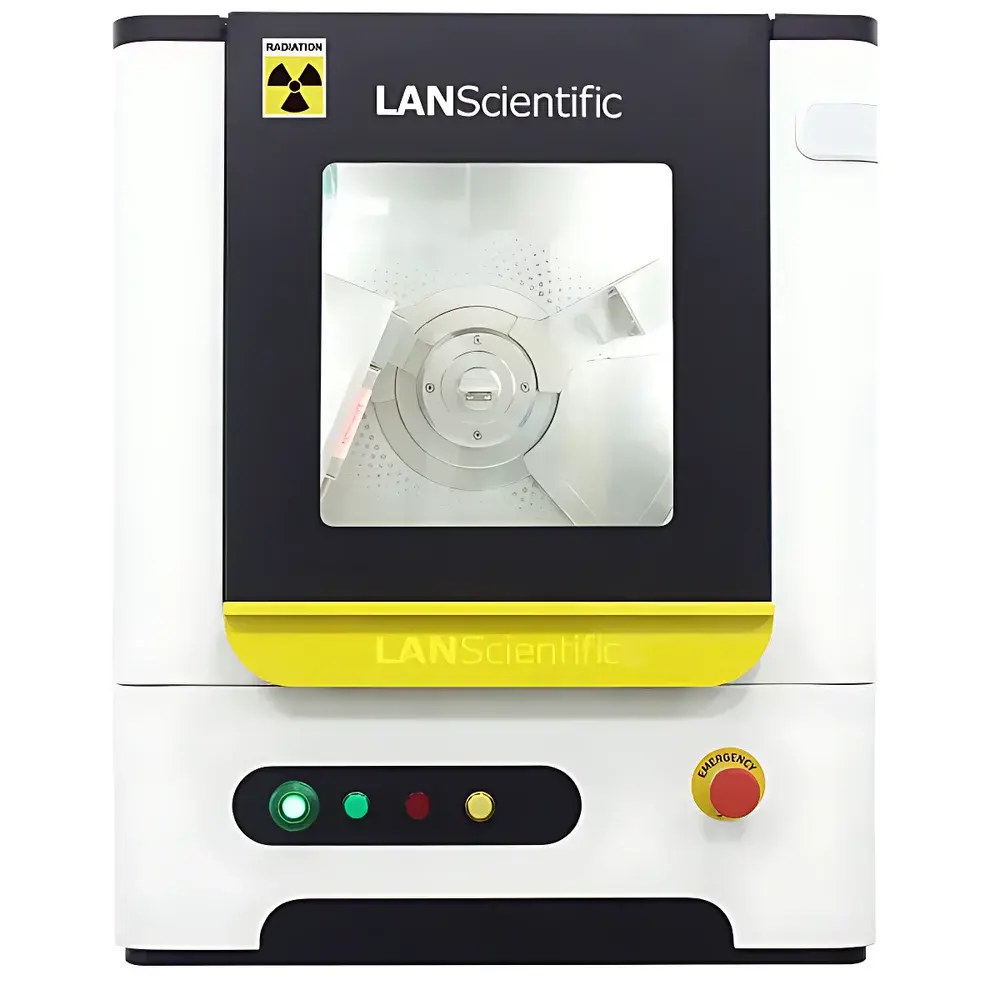
LANScientific FRINGE SH1827 Polymer Crystallinity X-ray Diffractometer
| Brand | LANScientific |
|---|---|
| Origin | Jiangsu, China |
| Manufacturer Type | Direct Manufacturer |
| Instrument Type | Powder X-ray Diffractometer |
| Applicable Standard | SH/T 1827–2019 |
| Measurement Principle | X-ray Diffraction (XRD) with Whole-Pattern Fitting |
| Sample Form | Granular or Powdered Polyolefins (PE, PP), Injection-Molded or Compression-Molded Specimens (α- and β+α-phase) |
| Detector | High-Resolution Scintillation Detector |
| Goniometer Architecture | θ–2θ Coupled Drive System (Single-Axis Motorized) |
| Cooling | Integrated Water-Circulation Cooling (Real-Time Monitoring of Temperature, Flow Rate & Velocity) |
| Software | CrystalX — Automated Crystallinity Quantification (DOC Calculation), ASTM/ISO-Compatible Data Export, Audit Trail & User Access Control |
| Safety | Interlocked Sample Chamber, Automatic X-ray Shutoff, Visual Closure Confirmation |
| Optical Component | Monolithic Soller Slit (Fixed, No Moving Parts) |
| Mobility | Designed for Benchtop and Mobile Lab Integration |
Overview
The LANScientific FRINGE SH1827 Polymer Crystallinity X-ray Diffractometer is a purpose-built powder X-ray diffractometer engineered for precise, reproducible quantification of the degree of crystallinity (DOC) in semi-crystalline polymers. It operates on the fundamental principle of Bragg diffraction, where monochromatic Cu-Kα radiation (λ = 1.5418 Å) interacts with ordered crystalline domains and disordered amorphous regions within polymer lattices. The resulting diffraction pattern—comprising sharp Bragg peaks superimposed on a broad amorphous halo—is digitized and subjected to whole-pattern fitting using Rietveld-based or pseudo-Voigt deconvolution algorithms. This approach enables rigorous separation of crystalline and amorphous scattering contributions without reliance on arbitrary baseline assumptions, delivering DOC values traceable to SH/T 1827–2019 and aligned with ISO 18477-3 and ASTM D1505 practices for polyolefin characterization.
Key Features
- θ–2θ coupled goniometer with single-axis motorized drive: Eliminates mechanical backlash and angular misalignment inherent in dual-motor systems, ensuring long-term angular accuracy and repeatability across repeated scans (±0.01° 2θ).
- Integrated water-circulation cooling system: Maintains stable X-ray tube anode temperature (<45 °C) during extended acquisition; real-time telemetry of coolant temperature, flow rate (L/min), and velocity (m/s) is embedded in the CrystalX interface.
- Monolithic Soller slit assembly: Fixed geometry eliminates wear-prone adjustment mechanisms, enhancing mechanical stability and enabling vibration-tolerant operation—validated for deployment in mobile laboratory environments and ISO 17025-accredited field testing setups.
- Interlocked safety architecture: Dual-redundant chamber door sensors trigger immediate X-ray beam termination upon opening; software enforces visual and audible confirmation of full closure prior to exposure initiation.
- Optimized optical path for low-Z polymer analysis: Reduced air scatter path length and minimized parasitic fluorescence from Al or Mg components ensure high signal-to-background ratios for PE, PP, and fluorinated polymers (e.g., PTFE).
Sample Compatibility & Compliance
The FRINGE SH1827 is validated for granular, powdered, and molded specimens of polyethylene (PE), polypropylene (PP), nylon (PA6/66), polyethylene terephthalate (PET), polybutylene terephthalate (PBT), polyoxymethylene (POM), polyphenylene sulfide (PPS), liquid crystal polymers (LCP), polyetheretherketone (PEEK), polytetrafluoroethylene (PTFE), and polyoxybenzoyl (POB). It supports α-phase, β+α-phase, and γ-phase identification per SH/T 1827–2019 requirements. Inorganic filler analysis—including CaCO₃, talc, TiO₂, and glass fibers—is enabled via simultaneous phase quantification using internal standard methods (e.g., corundum spike). All measurement protocols comply with GLP documentation standards, and CrystalX software includes 21 CFR Part 11–compliant audit trails, electronic signatures, and role-based access control for regulated environments.
Software & Data Management
CrystalX is a dedicated, Windows-based analytical suite developed exclusively for polymer XRD. Upon completion of data collection, it executes automated background subtraction, peak search, and full-pattern refinement using user-selectable crystalline reference patterns (ICDD PDF-4+ database integration optional). DOC is calculated as: DOC (%) = [Ic / (Ic + k·Ia)] × 100, where Ic and Ia denote integrated intensities of crystalline and amorphous scattering, respectively, and k is a material-specific scattering coefficient derived from calibration standards. Reports export to PDF, CSV, and CIF formats; metadata (sample ID, operator, date/time, instrument parameters, environmental conditions) is embedded and cryptographically timestamped. Raw data (.raw, .xy) and refined profiles (.csv) are stored in a hierarchical folder structure compliant with ISO/IEC 17025 Clause 7.5.2.
Applications
- Quality control of incoming polyolefin resins (PE/PP) against SH/T 1827–2019 specifications.
- Process optimization in extrusion, injection molding, and blow molding—correlating DOC with tensile strength, heat deflection temperature (HDT), and haze.
- Accelerated aging studies: Tracking crystallinity evolution under thermal, UV, or hydrolytic stress per ISO 5832-11 or ASTM F2129 protocols.
- R&D of nucleating agents: Quantifying crystallization kinetics and final DOC in β-nucleated PP formulations.
- Failure analysis: Identifying DOC anomalies linked to batch inconsistency, thermal degradation, or filler–matrix interfacial disruption.
FAQ
Does the FRINGE SH1827 support quantitative analysis of multi-phase polymer blends (e.g., PP/EPDM)?
Yes—CrystalX allows multi-phase Rietveld refinement when reference patterns for all crystalline constituents are available. Amorphous fractions are modeled independently per component using constrained linear combinations.
Is external chiller hardware required?
No—the integrated water-circulation system operates autonomously; no external chiller or tap-water connection is necessary.
Can the instrument be calibrated for absolute intensity measurements?
Yes—using NIST-traceable Si SRM 640e or LaB₆ SRM 660c, intensity calibration is performed during initial qualification and verified annually per ISO 17873.
What sample preparation protocols are recommended for molded PP specimens?
Specimens must be cut to 10 mm × 10 mm × 1–2 mm thickness, surface-polished to minimize preferred orientation, and mounted flat on zero-background silicon holders with minimal pressure.
Is remote diagnostics supported?
Yes—CrystalX includes secure TLS-encrypted remote access (with customer-configurable firewall rules) for technical support and preventive maintenance scheduling.





