
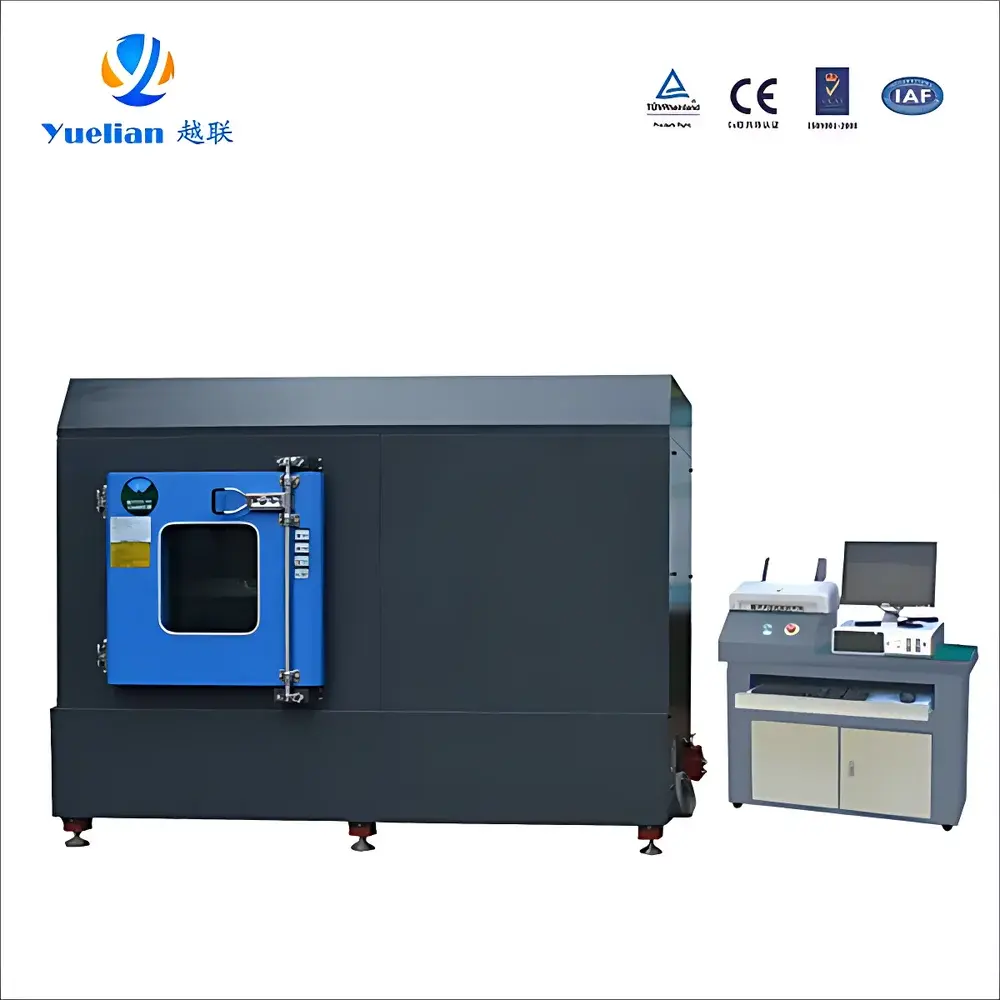
Yuelian YL-JZ-10T Integrated Battery Crush & Nail Penetration Test System
| Brand | Yuelian |
|---|---|
| Origin | Guangdong, China |
| Model | YL-JZ-10T |
| Max. Crushing Force | 100 kN (10 tf) |
| Max. Penetration Force | 100 kN |
| Sample Chamber Dimensions | W500 × D500 mm |
| Stroke Range | 0–500 mm |
| Crushing Speed | 1–10 mm/s (adjustable) |
| Penetration Speed | 1–50 mm/s (adjustable) |
| Force Accuracy | ±0.5% of reading |
| Force Resolution | 1/500,000 FS |
| Displacement Accuracy | ±0.5% of reading |
| Displacement Resolution | 0.01 mm |
| Data Acquisition Rate | ≥30 Hz |
| Voltage Measurement Range | 0–36 V (±0.1% FS) |
| Temperature Measurement Range | 0–600 °C (±1 °C) |
| Safety Enclosure | Dual-layer tempered explosion-proof glass viewport (350 × 400 mm), forced exhaust, automatic pressure relief port |
| Control System | Servo-motor-driven + proprietary PC-based software with synchronized force/displacement/voltage/temperature/time curve overlay |
| Compliance | Designed per GB/T 31485–2015, UN GTR No. 20, ISO 12405-4, SAE J2464, and IEC 62660-2 test requirements |
Overview
The Yuelian YL-JZ-10T Integrated Battery Crush & Nail Penetration Test System is an engineered safety validation platform for lithium-ion and solid-state battery cells and modules. It performs two critical mechanical abuse tests—controlled uniaxial crush and high-velocity nail penetration—in accordance with internationally recognized automotive and energy storage safety standards. The system operates on a dual-actuator servo-hydraulic architecture, enabling precise, repeatable application of compressive load or puncture force while simultaneously acquiring synchronized multi-parameter data streams including real-time force, displacement, terminal voltage, surface temperature, and time. Its rigid monolithic frame, reinforced stainless-steel chamber, and explosion-rated viewing window ensure operator safety during thermal runaway events. Unlike generic universal testers, the YL-JZ-10T integrates purpose-built fixtures, calibrated instrumentation, and regulatory-aligned test logic to replicate the physical failure modes observed in vehicle crash scenarios and manufacturing defects.
Key Features
- Modular dual-test capability: Independent, programmable control of crush and nail penetration sequences within a single enclosure—eliminating cross-contamination risk and setup downtime.
- Precision servo-motor actuation with closed-loop feedback: Enables stable speed regulation (crush: 1–10 mm/s; penetration: 1–50 mm/s) and sub-0.01 mm displacement resolution across full stroke (0–500 mm).
- High-fidelity multi-sensor acquisition: Simultaneous sampling at ≥30 Hz of axial force (±0.5% accuracy), voltage (0–36 V, ±0.1% FS), and surface temperature (0–600 °C, ±1 °C) via thermocouple inputs.
- Regulatory-grade safety enclosure: 12-mm dual-layer laminated tempered glass viewport (350 × 400 mm), integrated forced-air exhaust ducting, and fail-safe automatic pressure relief valve compliant with EN 14470-1 venting principles.
- Dedicated test fixtures: Two sets each of ASTM/GB-compliant semi-cylindrical crush platens (R75 mm, L > sample width) and tungsten-carbide nails (Φ5–8 mm, 45°–60° conical tip, Ra ≤ 0.4 µm) pre-mounted on quick-release carriers.
- Traceable software environment: Windows-based control interface with audit trail logging, user-level access control, electronic signature support, and export-ready CSV/PDF reporting aligned with GLP and FDA 21 CFR Part 11 data integrity requirements.
Sample Compatibility & Compliance
The YL-JZ-10T accommodates prismatic, pouch, and cylindrical cells up to 500 mm × 500 mm footprint and 300 mm height. Module testing supports configurations up to 100 kg mass under defined deformation thresholds (e.g., 30% dimensional reduction or 1000× module weight). All test protocols adhere to mandatory clauses in GB/T 31485–2015 (China), UN GTR No. 20 (Global Technical Regulation), ISO 12405-4 (Electrically propelled road vehicles), SAE J2464 (Recommended practice for hybrid/electric vehicle battery safety), and IEC 62660-2 (Secondary lithium cells for industrial applications). The system’s force calibration certificate is traceable to CNAS-accredited national metrology institutes, and software validation documentation—including IQ/OQ protocols—is available upon request for GMP or ISO 17025 laboratory accreditation.
Software & Data Management
The proprietary YL-TestSuite v3.2 software provides deterministic test sequencing, real-time parameter overlay (force vs. displacement vs. voltage vs. temperature vs. time), and post-test comparative analysis. Each test run generates a timestamped binary archive containing raw sensor values, event markers (e.g., voltage drop onset, smoke detection trigger), and operator annotations. Data export supports CSV (for MATLAB/Python processing), PDF summary reports with embedded curves, and direct upload to LIMS via configurable REST API. Role-based permissions enforce separation of duties: operators execute tests, supervisors approve methods, and QA personnel review audit logs. All data modifications are immutably logged with user ID, timestamp, and pre/post-value deltas—fully satisfying ALCOA+ principles for regulated environments.
Applications
- Cell-level safety qualification prior to pack integration in EV, ESS, and aerospace applications.
- Root-cause analysis of mechanical-induced internal short circuits using synchronized voltage collapse and thermal imaging correlation.
- Validation of separator robustness, jelly-roll integrity, and structural reinforcement designs under controlled crush strain rates.
- Comparative benchmarking of thermal runaway propagation kinetics across cathode chemistries (NMC, LFP, NCA) and packaging formats.
- Supporting DOE-funded research into next-generation solid-state electrolyte fracture behavior under localized shear loading.
- Third-party certification testing for UL 2580, GB 38031, and CATL/BYD internal safety specifications.
FAQ
What standards does the YL-JZ-10T natively support?
It implements built-in test templates for GB/T 31485–2015, UN GTR No. 20 Section 6.2.1 (crush) and 6.2.2 (penetration), ISO 12405-4 Annex C, and SAE J2464 Appendix A—with customizable parameter limits for OEM-specific variants.
Can the system be upgraded to 20T capacity?
Yes—the YL-JZ-10T shares mechanical and software architecture with the YL-JZ-20T variant; field upgrade kits include reinforced load frame components, higher-capacity servo amplifier, and recalibrated transducers, subject to factory inspection.
Is remote monitoring supported?
Standard Ethernet connectivity enables secure VNC-based remote supervision; optional 4G/LTE module and cloud dashboard (with TLS 1.3 encryption) provide real-time status alerts and historical trend dashboards for multi-site labs.
How is thermal runaway containment verified?
Each unit undergoes chamber integrity verification per EN 14470-1:2019 Annex B—measuring internal overpressure decay rate and confirming no structural deformation after 10 consecutive 100-kN thermal runaway simulations.
Does the software meet FDA 21 CFR Part 11 requirements?
Yes—electronic signatures, audit trail completeness, data immutability, and role-based access controls have been validated per Part 11 Annex A guidance; full validation documentation package available under NDA.



