
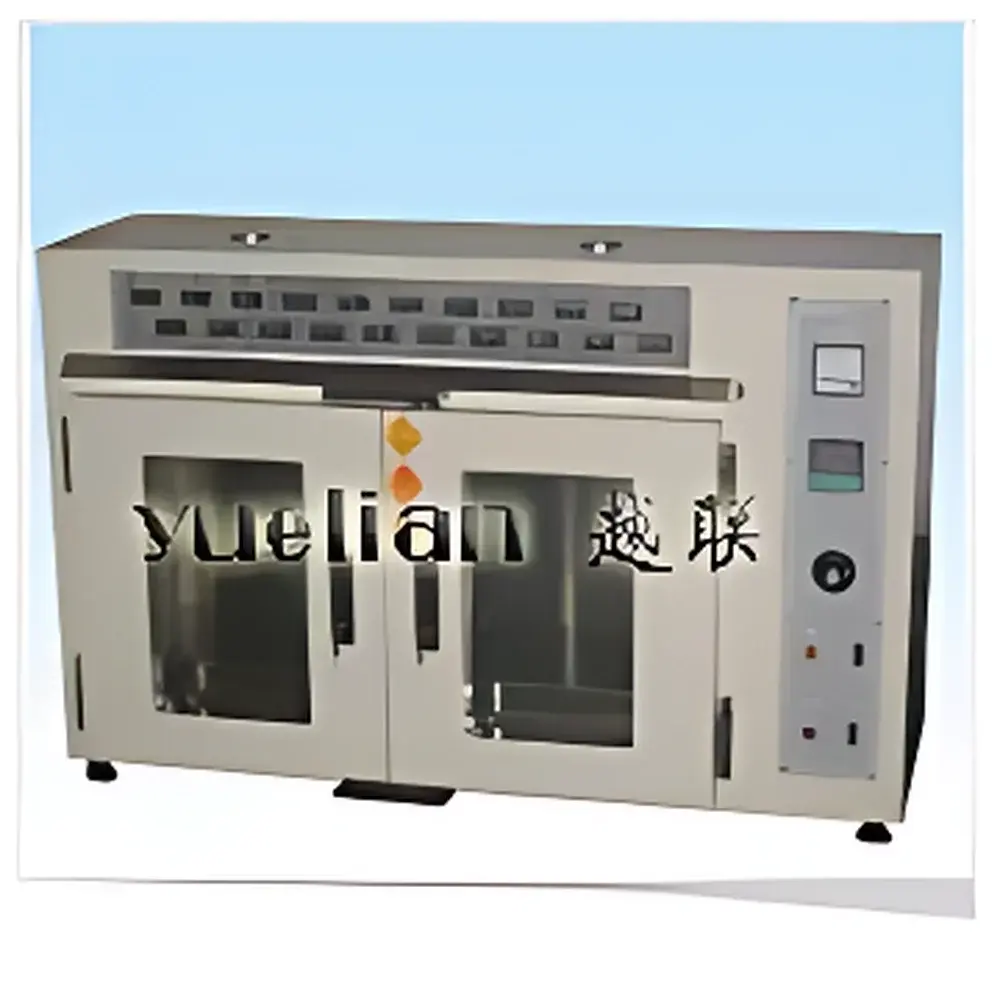
Yuelian YL-8808B 20-Station Constant-Temperature Adhesive Tape Holding Power Tester
| Brand | Yuelian |
|---|---|
| Origin | Guangdong, China |
| Model | YL-8808B |
| Temperature Range | +5°C to 150°C (±0.3°C accuracy) |
| Display Resolution | 0.1°C |
| Timer Capacity | 999 h 59 min 59 s (60-base, 20 independent channels) |
| Test Stations | 20 (10 upper + 10 lower, independently operable) |
| Load Mass | 1 kg stainless steel weights (10 pcs, ASTM-compliant mass tolerance) |
| Substrate | 20 × SUS304 stainless steel plates (100 mm × 25 mm × 1 mm) |
| Chamber Uniformity | ±0.5°C across full test volume |
| Control System | Microprocessor-based PID temperature controller with auto-tuning |
| Cabinet Construction | Interior – mirror-finished SUS304 |
| Dimensions (W×D×H) | 850 × 250 × 580 mm |
| Net Weight | 95 kg |
Overview
The Yuelian YL-8808B is a 20-station constant-temperature holding power tester engineered for precise, reproducible assessment of adhesive tape performance under thermally accelerated conditions. It operates on the principle of static shear stress application: a standardized tape specimen is affixed vertically to a polished SUS304 stainless steel substrate, loaded with a defined mass (typically 1 kg), and exposed to a controlled elevated temperature environment. The instrument continuously monitors the time elapsed until complete debonding (i.e., specimen detachment from the plate), providing quantitative data on adhesive thermal stability and long-term cohesive integrity. This method directly aligns with fundamental rheological concepts of creep deformation under constant load and elevated thermal energy—key determinants of real-world service life in automotive, electronics, and HVAC applications where tapes operate at sustained temperatures above ambient.
Key Features
- 20 independent test stations—10 upper and 10 lower—each equipped with dedicated weight suspension mechanisms and autonomous electronic timers, enabling parallel evaluation of multiple samples or comparative testing across temperature gradients.
- PID-controlled microprocessor temperature system ensures stable thermal conditions from +5°C to 150°C, with 0.1°C display resolution and ±0.3°C accuracy per ASTM E74 and ISO 17025 calibration traceability requirements.
- Uniform chamber design achieves ±0.5°C spatial temperature consistency across all 20 test positions—critical for eliminating inter-station variability and supporting GLP-compliant validation protocols.
- Self-contained timing modules require no external power; each displays time in standard 60-base format (HH:MM:SS) up to 999 hours, automatically freezing upon specimen drop detection via mechanical displacement sensing.
- Integrated safety logic triggers audible alarm (user-enabled buzzer) and cuts heating power when all specimens detach—preventing unattended overheating and supporting ISO 13857 hazard prevention guidelines.
- Full SUS304 interior construction resists corrosion from outgassed organics and thermal oxidation, ensuring long-term dimensional stability of test plates and compliance with USP particulate cleanliness expectations for cleanroom-adjacent use.
Sample Compatibility & Compliance
The YL-8808B accommodates standard tape specimens measuring 25 mm × 100 mm (per GB/T 4851, PSTC-7, and ASTM D3654), applied to precisely dimensioned 100 mm × 25 mm × 1 mm SUS304 plates. Its design conforms to national and international standards including GB/T 2792 (peel adhesion), GB/T 4851 (holding power at elevated temperature), PSTC-7 (Pressure Sensitive Tape Council), CNS 11887/11888 (Chinese National Standards), and supports alignment with ISO 29862 for adhesive classification. All structural materials meet RoHS Directive 2011/65/EU restrictions on hazardous substances, and electrical components comply with IEC 61000-4 immunity requirements.
Software & Data Management
While the YL-8808B operates as a stand-alone hardware platform without embedded PC software, its timer outputs are compatible with external data acquisition systems via TTL-level contact closure signals (optional interface module available). Each station’s retained time value can be manually logged into LIMS or Excel-based QA databases. For regulated environments, users may integrate the instrument into validated workflows under FDA 21 CFR Part 11 by pairing it with audit-trail-capable electronic notebooks (e.g., LabArchives or Veeva Vault) and implementing procedural controls for timer readout, transcription, and review—fully satisfying GMP Annex 11 and ISO/IEC 17025 clause 7.7 documentation requirements.
Applications
This tester serves critical quality assurance functions across industries reliant on thermally stable pressure-sensitive adhesives: automotive trim bonding (dashboards, emblems), medical device fixation tapes (wound care, ECG electrodes), lithium-ion battery cell lamination, HVAC duct sealing, and aerospace interior panel mounting. It enables R&D teams to rank formulations by thermal creep resistance, supports supplier qualification against OEM specifications (e.g., Ford WSS-M99P1111-A, GMW14872), and provides objective pass/fail criteria for lot release per internal QC protocols aligned with ISO 9001 clause 8.6.
FAQ
What temperature uniformity is guaranteed across all 20 stations?
The chamber maintains ±0.5°C deviation across the full active test volume at any setpoint between +5°C and 150°C, verified per ASTM E74 Annex A3 using NIST-traceable calibrated probes.
Can non-standard weights be used for specialized test protocols?
Yes—the fixture accepts interchangeable stainless steel masses (e.g., 0.5 kg, 2 kg) compliant with OIML R111 Class M2 tolerances; user-supplied weights must be certified for metrological equivalence.
Is the SUS304 plate surface finish specified?
Plates feature a Ra ≤ 0.4 µm ground and electropolished finish per ASTM B912, minimizing edge effects and ensuring consistent wetting and shear stress distribution.
Does the instrument support IQ/OQ protocol execution?
Yes—comprehensive factory calibration certificates, installation checklists, and operational qualification templates are provided; third-party validation support is available upon request.
How is test failure defined and recorded?
Failure occurs when the entire tape specimen detaches from the substrate and falls below the lower detection threshold; the timer freezes instantly, preserving the exact duration without manual intervention.



