
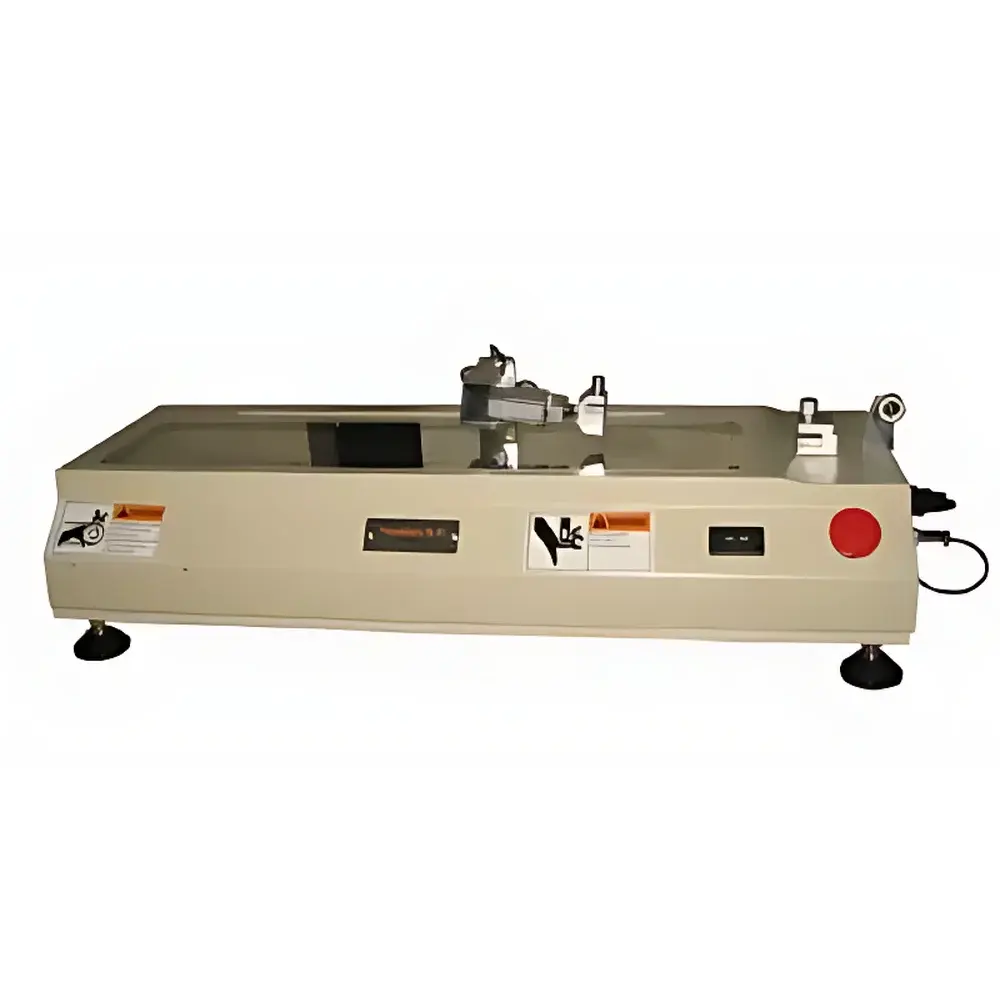
Yuelian YL-1103 LED Package Tape Peel Strength Tester
| Brand | Yuelian |
|---|---|
| Model | YL-1103 |
| Application | Tape peel strength testing for LED packaging carriers |
| Force Capacity Options | 10 N, 20 N, 50 N, 100 N, 200 N (dual-range configuration available) |
| Force Resolution | 1/250,000 full scale |
| Force Accuracy | ≤ ±0.5% of reading |
| Travel Resolution | 0.005 mm |
| Maximum Test Stroke | 500 mm |
| Test Width | Ø140 mm |
| Speed Range | 5–500 mm/min (PC-programmable) |
| Control Interface | PC-based with USB connectivity |
| Data Output | Real-time force–displacement curves, tabular reports (MS-ACCESS compatible), statistical parameters (peak force, average peel force, yield point, modulus approximation) |
| Safety & Stop Modes | Overload cutoff, emergency stop, automatic halt on specimen failure, programmable upper/lower limit stops, auto-return function |
| Drive System | Stepper motor + precision ball screw + timing pulley transmission |
| Power Supply | 220 V, 50/60 Hz, 5 A |
| Rated Power | 180 W |
| Dimensions (W×D×H) | 1063 × 300 × 200 mm |
| Net Weight | ~45 kg |
| Standard Accessories | One set of peel fixtures, proprietary test software, USB interface cable |
Overview
The Yuelian YL-1103 LED Package Tape Peel Strength Tester is a dedicated electromechanical tensile testing system engineered for quantitative evaluation of adhesive bond integrity in surface-mount LED packaging processes. It operates on the principle of controlled unidirectional peeling—applying a defined angular separation (typically 90° or 180° per ASTM D903 and ISO 8510-2) between carrier tape and component leads or encapsulant surfaces—to measure interfacial adhesion performance under standardized displacement rates. Designed specifically for semiconductor packaging quality assurance labs, this instrument supports traceable, repeatable assessment of peel resistance critical to reflow reliability, moisture sensitivity level (MSL) compliance, and post-assembly handling robustness. Its architecture integrates high-resolution load cell feedback, closed-loop stepper motor positioning, and real-time kinematic synchronization to ensure mechanical fidelity across low-force regimes typical of thin-film die attach tapes and wafer-level underfill interfaces.
Key Features
- Modular force capacity selection (10 N to 200 N) with dual-range option for enhanced resolution in sub-50 N peel applications common in LED leadframe and flex-tape bonding.
- Force measurement accuracy of ≤ ±0.5% of reading and resolution of 1 part in 250,000 full scale—meeting ISO 7500-1 Class 0.5 requirements for static force calibration.
- Precision travel control with 0.005 mm positional resolution and programmable speed range (5–500 mm/min), enabling adherence to IPC-TM-650 2.4.1 and JEDEC J-STD-020 peel rate specifications.
- Integrated auto-return mechanism and multi-mode stopping logic—including specimen rupture detection, programmable force/displacement limits, and hardware-triggered emergency shutdown—for GLP-compliant test repeatability and operator safety.
- PC-based control architecture with USB 2.0 interface, supporting Windows-compatible software with audit-trail-enabled data logging compliant with FDA 21 CFR Part 11 (when deployed with validated user access controls and electronic signature modules).
- Rigid frame construction (aluminum alloy base, hardened steel guide columns) and ball-screw-driven crosshead ensure minimal deflection (<0.02 mm under max load), preserving geometric fidelity during peel angle maintenance.
Sample Compatibility & Compliance
The YL-1103 accommodates standard industry carrier formats including 8 mm, 12 mm, and 16 mm embossed plastic tapes (per EIA-481-D), as well as custom substrate-mounted LED arrays on FR-4, polyimide, or ceramic carriers. Fixture adaptability supports both straight-edge and curved-edge peel geometries required for QFN, SOP, and COB package configurations. All mechanical and software functions align with international standards governing adhesive testing: ASTM D903 (peel resistance of adhesive bonds), ISO 8510-2 (peel testing of flexible materials), and IPC-TM-650 2.4.1 (adhesive bond strength for electronic components). When operated with calibrated load cells and documented environmental conditions (23 ± 2 °C, 50 ± 5% RH), test reports satisfy internal QA documentation requirements and external audit readiness for IATF 16949 and ISO 9001-certified manufacturing sites.
Software & Data Management
The embedded test software provides a deterministic, scriptable environment for defining test protocols—including preload application, dwell time, ramp rate, and termination criteria—ensuring method consistency across shifts and operators. Raw force–displacement data streams are captured at ≥1 kHz sampling rate and stored in encrypted binary format with timestamped metadata (operator ID, sample ID, environmental log, calibration certificate ID). Export options include CSV, PDF report templates, and native MS-ACCESS database integration for enterprise-level LIMS interoperability. Curve analysis tools compute peak peel force, mean peel force over specified displacement windows, energy-to-peel (area under curve), and onset-of-debonding thresholds. Audit trail functionality records all parameter modifications, data exports, and user logins—supporting regulatory review in medical-grade LED lighting production environments subject to ISO 13485 and MDR Annex II documentation mandates.
Applications
- Quantitative validation of thermal release tape adhesion strength during LED wafer dicing and pick-and-place transfer.
- Comparative evaluation of UV-curable die attach adhesives across multiple cure profiles and substrate surface treatments (plasma, silane, HMDS).
- Process qualification of conductive epoxy peel resistance after reflow soldering (JEDEC J-STD-020 profile exposure).
- Failure mode analysis of delamination at LED chip-to-submount interfaces under thermal cycling stress (−40 °C to +125 °C).
- Lot-release testing for tape-and-reel packaging integrity prior to automated SMT line feeding.
- Supporting DOE studies on peel angle dependency (90° vs. 180°) and its correlation with interfacial fracture mechanics (GIc estimation via beam theory approximations).
FAQ
What peel angles does the YL-1103 support?
The system is mechanically configured for standard 90° and 180° peel geometries using interchangeable fixture kits; angular alignment is verified with digital inclinometer calibration per ISO 2747.
Can the software generate GMP-compliant test reports?
Yes—when deployed with role-based user authentication, electronic signatures, and version-controlled protocol libraries, the software meets baseline expectations for ALCOA+ data integrity principles in regulated LED manufacturing settings.
Is third-party calibration certification included?
Factory calibration is performed using NIST-traceable deadweight standards; optional UKAS-accredited calibration certificates (ISO/IEC 17025) are available upon request.
Does the system support dynamic fatigue testing?
No—the YL-1103 is optimized for quasi-static peel characterization; cyclic loading capability requires upgrade to servo-hydraulic platforms compliant with ASTM E466.
How is fixture interchangeability managed?
All peel fixtures utilize a standardized T-slot mounting interface with position-locking pins, ensuring repeatable alignment within ±0.1° angular tolerance across fixture swaps.



