
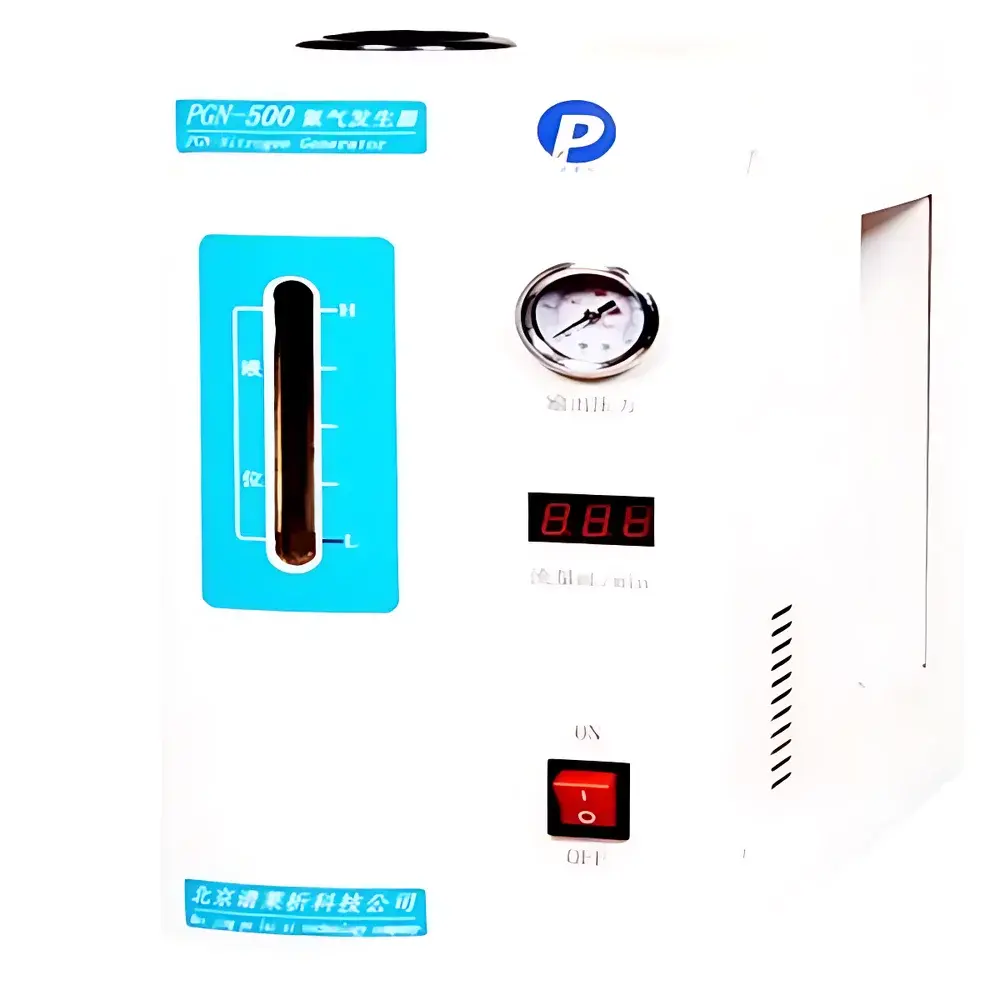
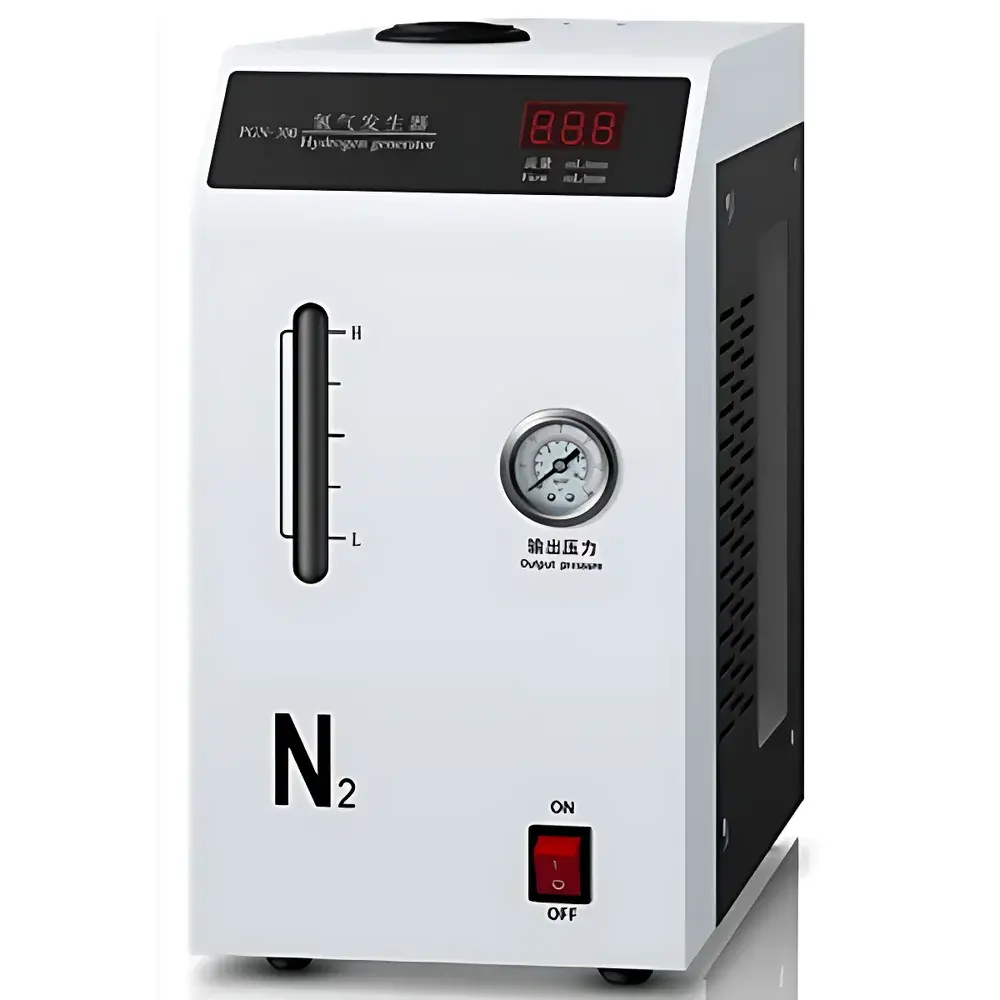
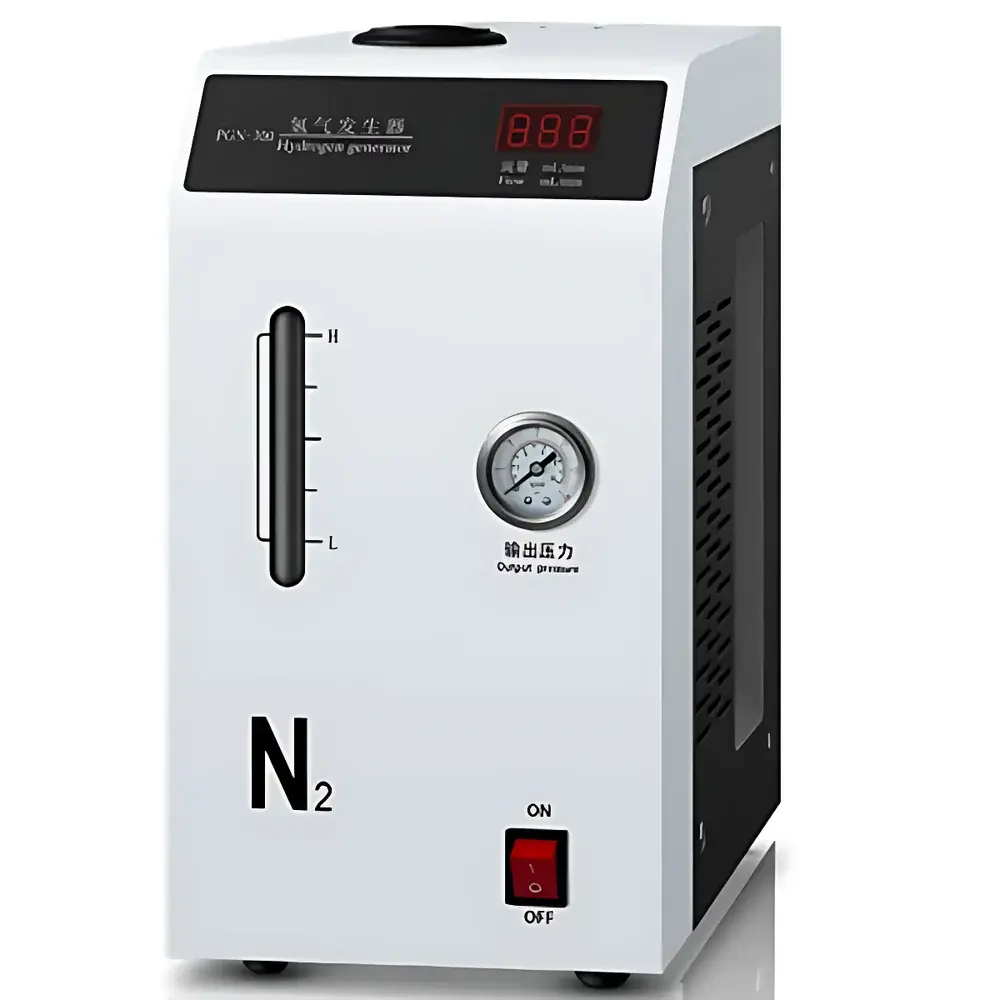
Huayisanpu PGH-500 High-Purity Hydrogen Generator
| Brand | Beijing Huayisanpu |
|---|---|
| Origin | Beijing, China |
| Model | PGH-500 Hydrogen Generator |
| Hydrogen Generation Principle | Pure Water Electrolysis |
| Output Flow Rate | 0–500 mL/min |
| Output Pressure | 0.4 MPa |
| Hydrogen Purity | ≥99.999% |
| Power Consumption | 150 W |
| Input Voltage | 220 V ±10%, 50 Hz |
| Operating Temperature | 0–40 °C |
| Relative Humidity | <85% |
| Dimensions (L×W×H) | 370 × 180 × 360 mm |
| Weight | ~12 kg |
Overview
The Huayisanpu PGH-500 High-Purity Hydrogen Generator is a laboratory-grade, on-demand hydrogen source engineered for analytical instrumentation requiring ultra-high-purity carrier or fuel gas—particularly gas chromatography (GC), GC–MS, and hydrogenation reactors. It employs zero-additive pure water electrolysis (PEM-free, KOH-free), eliminating the need for caustic electrolytes or chemical reagents. The core electrolytic cell adopts a cylindrical “bucket-type” architecture—distinct from conventional planar electrode stacks—which enables simultaneous electrolyte storage, hydrogen generation, and oxygen separation within a single integrated chamber. This design reduces thermal load on the membrane-electrode assembly, maintains stable cell temperature (<45 °C under continuous operation), and contributes to extended service life and consistent gas quality. Hydrogen exits the cell through a multi-stage purification train including catalytic oxygen recombination and dual-stage desiccant drying, achieving ≥99.999% purity (residual O₂ <1 ppm, H₂O <1 ppm, total hydrocarbons <0.1 ppm) compliant with ASTM D7622 and ISO 8573-1 Class 1 compressed air equivalency for trace gas applications.
Key Features
- On-demand, pressure-regulated hydrogen generation: output flow automatically adjusts between 0–500 mL/min in response to downstream demand; no manual throttling required.
- Digital LED flow display with ±2% full-scale accuracy provides real-time, operator-visible gas delivery rate.
- Integrated non-backflow protection system prevents electrolyte migration into gas lines—a critical safeguard for GC injectors, valves, and detectors.
- Low-power operation at 150 W nominal consumption; optimized energy efficiency supports 24/7 unattended use without thermal overload risk.
- Single-fluid maintenance: only deionized or distilled water replenishment required—no electrolyte replacement, no acid/base handling, no scheduled membrane cleaning.
- Compact footprint (370 × 180 × 360 mm) and lightweight chassis (~12 kg) facilitate benchtop integration in constrained lab spaces or mobile analytical platforms.
Sample Compatibility & Compliance
The PGH-500 is compatible with all standard 1/8″ and 1/4″ stainless steel or copper gas tubing interfaces used in GC systems (e.g., Agilent, Thermo Fisher, Shimadzu). Its output pressure of 0.4 MPa (4 bar) meets typical GC carrier gas requirements without external boosting. Gas purity exceeds USP and EP 2.5.27 specifications for hydrogen used in pharmaceutical residual solvent analysis. The instrument conforms to IEC 61010-1:2010 safety standards for laboratory electrical equipment and incorporates over-pressure shutoff (0.45 MPa threshold), over-temperature cutoff (>60 °C), and dry-run protection. While not certified to FDA 21 CFR Part 11, its analog control architecture and absence of embedded software ensure full auditability in GLP/GMP environments where electronic record integrity is governed by procedural controls rather than system-level validation.
Software & Data Management
The PGH-500 operates via analog electronics with no firmware, embedded OS, or network connectivity—eliminating cybersecurity risks and compatibility dependencies. All operational parameters (flow, pressure, status indicators) are conveyed through front-panel LEDs and mechanical gauges. For laboratories implementing digital lab infrastructure, optional analog-to-digital signal converters (4–20 mA or 0–5 V output modules) can be externally interfaced to SCADA, LIMS, or building management systems for centralized monitoring. No proprietary drivers or cloud services are involved; data logging is performed at the facility level using third-party DAQ hardware compliant with ISO/IEC 17025 calibration traceability requirements.
Applications
- Carrier gas supply for capillary GC and GC–MS systems requiring high-purity, low-moisture hydrogen.
- Fuel gas for flame ionization detectors (FID) and helium ionization detectors (HID), delivering stable baseline performance and reduced noise.
- Reducing atmosphere generation in catalytic testing rigs and small-scale hydrogenation reactors.
- Calibration gas blending systems where hydrogen serves as a primary component in certified reference mixtures (CRM).
- Research labs performing isotopic labeling studies (e.g., D₂/H₂ switching) where rapid gas source switchover and minimal dead volume are essential.
FAQ
What type of water must be used to operate the PGH-500?
Deionized water with resistivity ≥15 MΩ·cm (ASTM Type I) or distilled water meeting USP Purified Water specifications is mandatory. Tap water, tap-deionized blends, or low-resistivity water will accelerate electrode corrosion and compromise purity.
Can the output pressure be adjusted beyond 0.4 MPa?
No—the internal pressure regulation is fixed at 0.4 MPa ±0.02 MPa. Custom pressure configurations require factory modification prior to shipment and void standard warranty terms.
Is the PGH-500 suitable for use with mass spectrometry systems?
Yes, provided the MS inlet pressure and flow requirements fall within 0–500 mL/min and ≤0.4 MPa. Verify compatibility with your instrument manufacturer’s gas specification sheet, especially regarding maximum allowable particulate load and dew point.
How often does the unit require maintenance?
Under normal operation with proper water quality, no scheduled maintenance is required beyond quarterly visual inspection of water level, tubing integrity, and vent filter cleanliness. Electrolytic cell lifetime exceeds 10,000 hours at rated load.
Does the generator produce oxygen as a byproduct?
Yes—oxygen is generated stoichiometrically (2H₂O → 2H₂ + O₂) and safely vented through a dedicated exhaust port. The unit must be operated in a well-ventilated area or connected to an exhaust duct per local occupational health regulations (OSHA 1910.104, EN 14470-1).



