
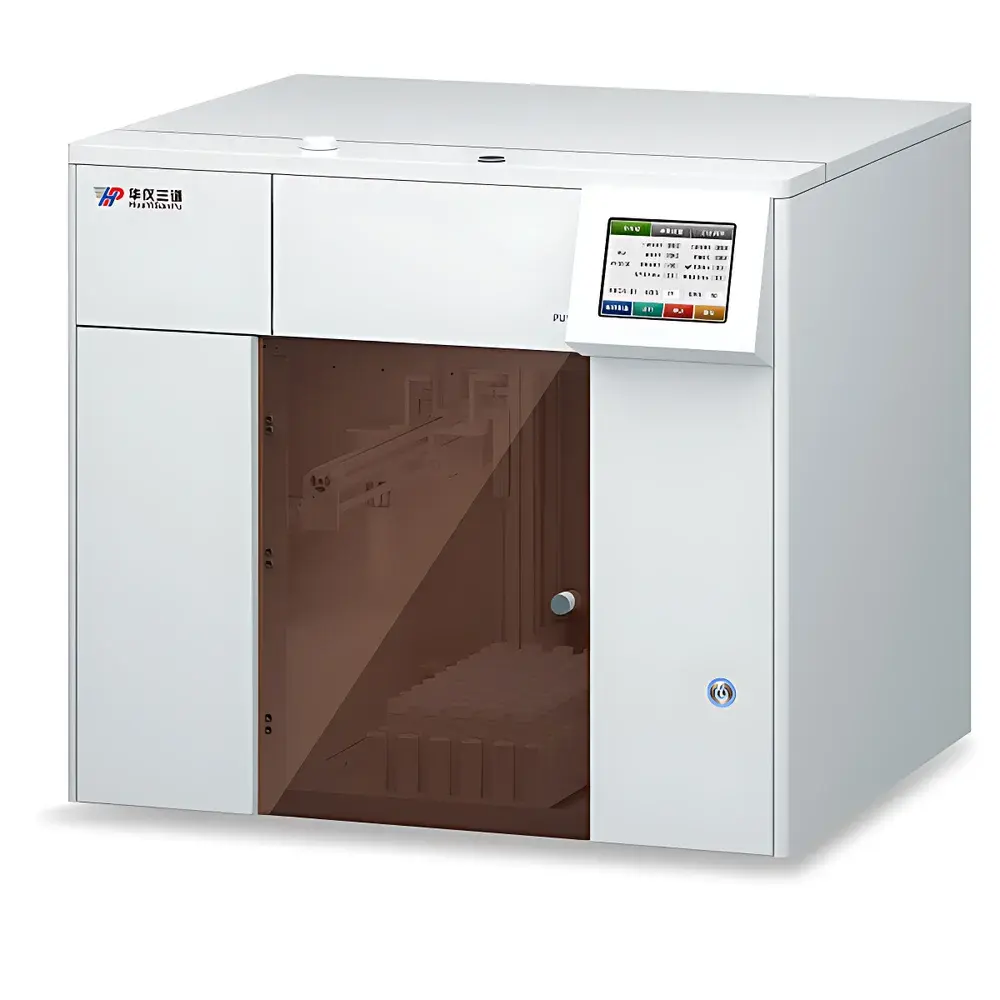
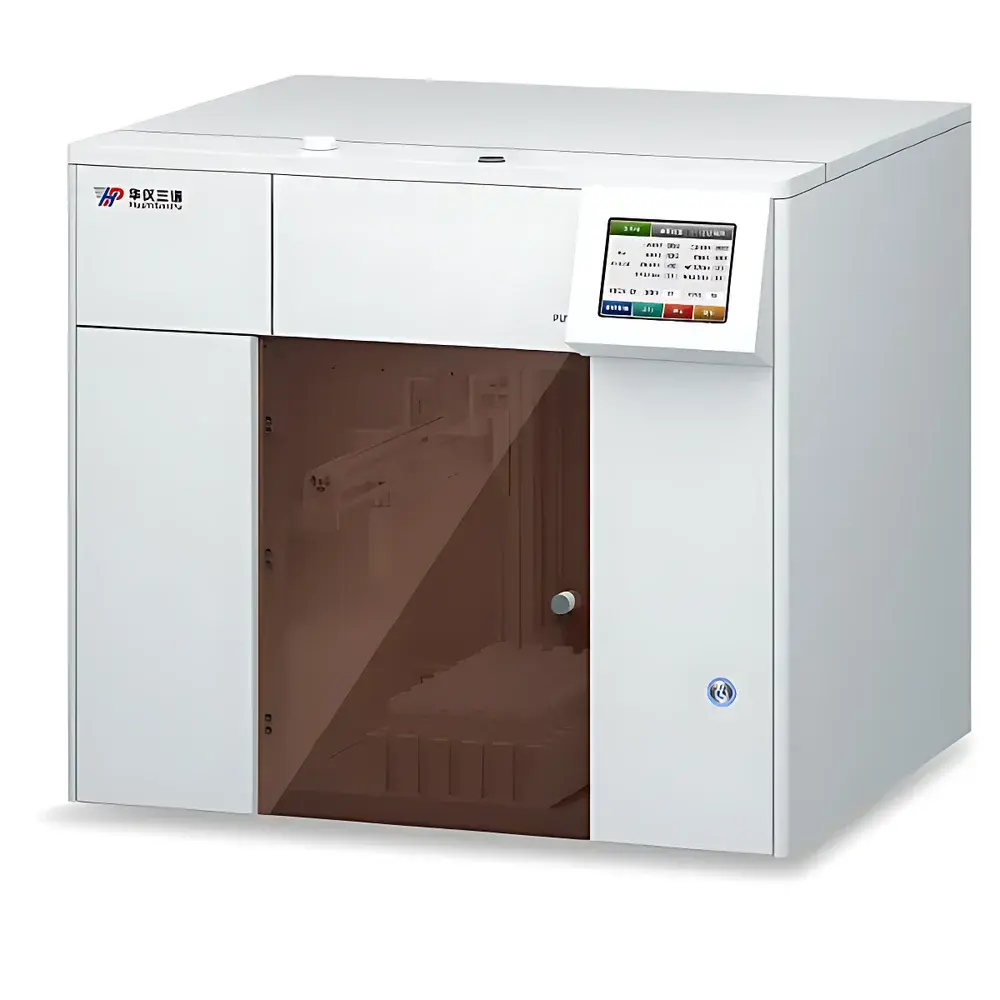
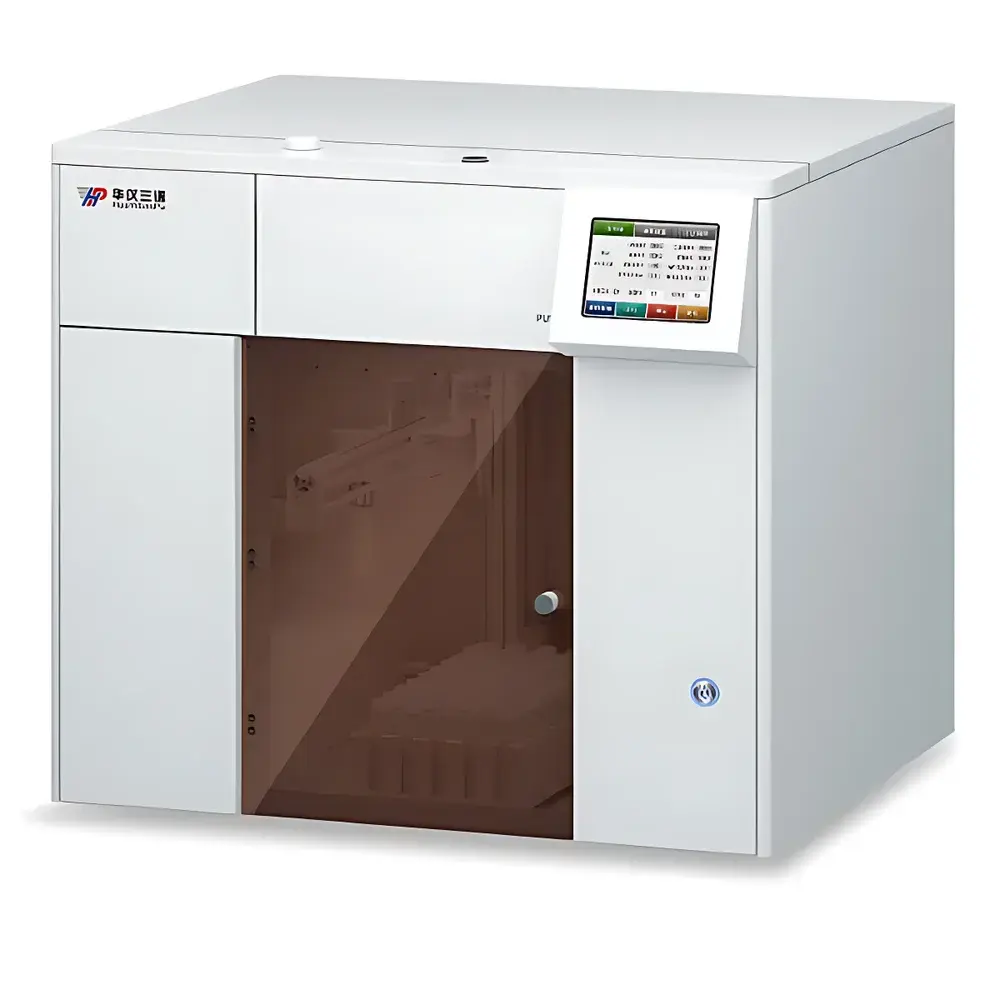
Huayisanpu PTC-50 Automated Purge and Trap Concentrator
| Brand | Huayisanpu |
|---|---|
| Origin | Beijing, China |
| Model | PTC-50 |
| Sample Capacity | 50 positions |
| Injection Precision | RSD < 10% |
| Trap Temperature Range | Ambient to 380 °C |
| Purge Vial Heating Range | Ambient to 250 °C |
| Vial Cooling Range | 4–10 °C |
| Cold Trap Temperature Range | Ambient to −40 °C |
| Water Removal Trap Range | Ambient to −30 °C |
| Desorption Rate | >2000 °C/min |
| Water Trap Desorption Range | Ambient to 150 °C |
| Transfer Line Temperature | Ambient to 250 °C |
| Carrier Gas Pressure Regulation | 0–0.4 MPa |
| Purge Flow Rate | 0–100 mL/min |
| Trap Materials | Stainless steel / quartz / fused silica capillary (configurable) |
| Programmable External Events | 15 |
| Timing Resolution | 0.1–99 min (accuracy <0.1%) |
| Power Consumption | <1000 VA |
| Dimensions (H×W×D) | 580 × 640 × 850 mm |
| Weight | ~50 kg |
Overview
The Huayisanpu PTC-50 Automated Purge and Trap Concentrator is a fully integrated, laboratory-grade sample preparation system engineered for trace-level volatile organic compound (VOC) analysis in environmental, regulatory, and industrial chemistry applications. It operates on the principle of dynamic headspace extraction: inert gas (typically helium or nitrogen) purges VOCs from aqueous or solid-phase samples into a cryogenically cooled trap, where analytes are adsorbed and concentrated. Following desorption—via rapid resistive heating—the analytes are transferred quantitatively and with minimal band broadening to a coupled gas chromatograph (GC) or GC–mass spectrometer (GC–MS). Designed for water and soil matrices (per EPA Method 502.2, 524.2, 624, and ISO 15681-2), the PTC-50 supports method-compliant workflows under GLP and regulated environmental testing frameworks.
Key Features
- Fifty-position autosampler carousel enabling unattended batch processing of up to 50 standard 40 mL purge vials—ideal for high-throughput environmental monitoring labs.
- Independent thermal control across six critical zones: purge vial heater (ambient to 250 °C, ±0.5 °C accuracy), cold trap (ambient to −40 °C, ±1 °C), water removal trap (ambient to −30 °C), trap desorption zone (ambient to 380 °C, ±0.5 °C), water trap desorption (ambient to 150 °C), and transfer line (ambient to 250 °C).
- High-speed thermal desorption with programmable ramp rates exceeding 2000 °C/min—achieved via low-voltage resistive heating architecture that ensures thermal stability and eliminates hot-spot formation during analyte release.
- Configurable trap hardware: interchangeable stainless steel, quartz, or fused silica capillary traps; customizable sorbent packing (e.g., Tenax TA, Carbopack B/C, Carboxen 1000) to match analyte polarity and volatility profiles.
- Precise pneumatic control: digitally regulated carrier gas pressure (0–0.4 MPa), adjustable purge flow (0–100 mL/min with real-time feedback), and programmable external events (15 independent timed actions per run, resolution 0.1 min, timing error <0.1%).
- Integrated vial cooling module maintaining sample temperature between 4 °C and 10 °C—critical for minimizing analyte loss during extended batch runs and preserving labile compounds.
Sample Compatibility & Compliance
The PTC-50 accommodates liquid samples (groundwater, surface water, wastewater) and solid-phase matrices (soil, sediment, sludge) following EPA-approved sample pretreatment protocols—including homogenization, spiking, and pH adjustment. Its modular design allows direct integration with autosamplers from major GC vendors (Agilent, Thermo Fisher, Shimadzu) via TTL/relay-triggered synchronization (<2 s latency). The system conforms to key regulatory requirements: compatible with EPA Methods 502.2 (halogenated hydrocarbons), 524.2 (purgeable aromatics and halocarbons), 624 (VOCs in water), and ISO 15681-2 (determination of VOCs in water by purge-and-trap GC–MS). All thermal and timing parameters are logged with timestamped audit trails, supporting 21 CFR Part 11–compliant data integrity when paired with validated LIMS or chromatography data systems (CDS).
Software & Data Management
Controlled via a dedicated Windows-based interface, the PTC-50 software provides full method programming—including multi-step temperature ramps, flow profiles, trap conditioning cycles, and automated backflush sequences. Each method stores complete instrument configuration metadata (trap type, sorbent lot, calibration date), ensuring traceability. Raw thermal and pressure logs are exported in CSV format for QA/QC review. Audit trail functionality records user logins, method edits, run starts/stops, and error alerts—retained for ≥18 months per internal retention policy. Remote monitoring is supported via Ethernet TCP/IP, enabling centralized fleet management in multi-instrument laboratories.
Applications
- Regulatory compliance testing for drinking water (EPA 524.2), wastewater discharge permits (NPDES), and Superfund site characterization (RCRA waste screening).
- VOC profiling in soil vapor intrusion studies and landfill leachate monitoring.
- Method development for emerging contaminants (e.g., 1,4-dioxane, chlorinated solvents, benzene analogues) requiring sub-pptr detection limits.
- Quality control in pharmaceutical manufacturing where residual solvent analysis (ICH Q3C) demands rigorous purge-and-trap reproducibility (RSD <2.5% demonstrated under optimized GC coupling).
- Research applications in geochemistry and atmospheric science involving stable isotope-labeled VOC tracers and kinetic desorption modeling.
FAQ
What sample types can the PTC-50 process without derivatization or pre-extraction?
Aqueous samples (up to 25 mL), homogenized soils (1–10 g in 40 mL vials), and digested sediments—all compliant with EPA Method 5035B for solid-phase purging.
Is the cold trap capable of cryofocusing below −30 °C?
Yes—the primary cold trap achieves −40 °C using a closed-cycle thermoelectric cooler, eliminating reliance on liquid nitrogen or mechanical refrigerants.
Can trap desorption be synchronized with GC oven ramping?
Yes—TTL output signals trigger GC start, split/splitless valve switching, and detector activation with sub-second timing fidelity.
Does the system support dual-trap configurations for water management?
Yes—optional dual-stage trapping (primary analytical trap + secondary water-removal trap) is supported via configurable plumbing and independent temperature zoning.
What maintenance intervals are recommended for routine operation?
Trap regeneration every 100 runs; purge line bake-out weekly; cold trap cleaning quarterly; full pneumatic leak check semiannually per ISO/IEC 17025 preventive maintenance guidelines.





