
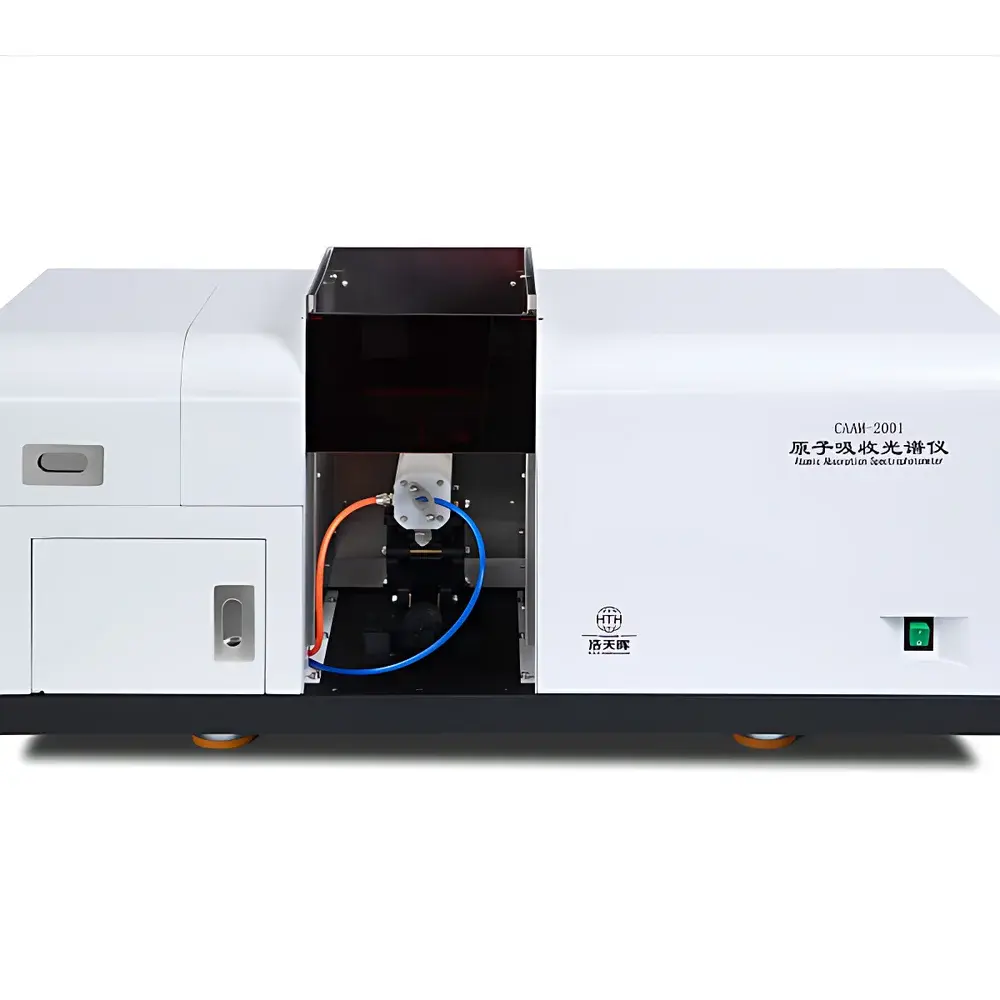
Huayisanpu CAAM-2001C Flame Atomic Absorption Spectrophotometer (6-Lamp Turret)
| Brand | Beijing Huayisanpu |
|---|---|
| Origin | Beijing, China |
| Model | CAAM-2001C |
| Detection Elements | Na, K, Mg, Ca, Cr, Mn, Fe, Co, Ni, Pt, Au, Cu, Ag, Zn, Cd, Pb, Bi, Li |
| Detection Limit | 0.002 µg/mL (for Cu) |
| Atomizer Temperature Control Range | +15 °C to +35 °C |
| Grating | 1800 lines/mm |
| Wavelength Range | 190–900 nm |
| Spectral Bandwidth | 0.1, 0.2, 0.4, 1.0, 2.0 nm (auto-selectable) |
| Wavelength Accuracy | ±0.15 nm |
| Baseline Drift (static) | ≤±0.002 A/30 min |
Overview
The Huayisanpu CAAM-2001C Flame Atomic Absorption Spectrophotometer is a precision laboratory instrument engineered for quantitative elemental analysis of metals in liquid samples using flame atomic absorption spectroscopy (FAAS). Based on the Beer–Lambert law, the system atomizes analyte solutions in an air–acetylene flame, generating ground-state free atoms that absorb characteristic radiation from hollow cathode lamps. The CAAM-2001C employs a high-resolution Czerny–Turner monochromator with an 1800-line/mm grating and five selectable spectral bandwidths (0.1–2.0 nm), enabling optimal resolution and signal-to-noise ratio across the 190–900 nm UV–VIS range. Designed for routine compliance-driven laboratories, it supports ASTM D1688 (copper in water), ISO 11171 (metal contaminants in fuels), and USP heavy metals testing protocols. Its architecture integrates flame atomization with automated lamp management, background correction via deuterium arc, and robust safety interlocks — all calibrated and validated per GLP and ISO/IEC 17025 requirements.
Key Features
- Six-position automatic lamp turret with dual high-stability power supplies, enabling seamless switching between hollow cathode lamps without manual realignment
- Flame atomization system featuring a titanium alloy burner head, metal-sheathed high-efficiency glass nebulizer, and explosion-resistant polymer雾化室 (nebulization chamber)
- Deuterium background correction capable of compensating up to 1.0 A absorbance, ensuring accuracy in complex matrices with spectral interference
- Full PC-based automation: auto-ignition, flame optimization, lamp current/voltage control, wavelength scanning, and peak acquisition
- Integrated safety architecture including acetylene leak detection, flame-out sensing, gas pressure monitoring, coolant flow verification, and automatic shutdown upon fault condition
- Optical system with ≤0.05 nm wavelength repeatability and ±0.15 nm absolute accuracy — traceable to NIST SRM standards
- Compliance-ready firmware supporting audit trails, user access levels, and electronic signature capability per FDA 21 CFR Part 11 (when deployed with validated CAAM2001 Workstation V16.1.1)
Sample Compatibility & Compliance
The CAAM-2001C is optimized for aqueous and dilute acid-digested samples (e.g., HNO₃, HCl extracts) compatible with EPA Method 200.7, ISO 11885, and GB/T 5750.6–2023. It accommodates standard 16-mm borosilicate sample tubes and interfaces directly with optional flow-injection hydride generation modules for As, Se, Sb, Bi, Te, and Hg analysis. All wet chemistry pathways adhere to ISO/IEC 17025:2017 clause 7.2 (method validation) and support uncertainty estimation per EURACHEM/CITAC Guide. Instrument qualification includes IQ/OQ documentation packages aligned with GMP Annex 15 and WHO TRS 992. Calibration verification follows daily bracketing with NIST-traceable multi-element standards (e.g., SPS-SW2, CLMS-1), while performance checks include Cu characteristic concentration (≤0.015 µg/mL/1%), RSD ≤0.5% (n=10), and detection limit confirmation at ≤0.002 µg/mL for Cu.
Software & Data Management
The CAAM2001 Workstation V16.1.1 (Software Registration No. 2016SR178400) provides a fully localized English/Chinese GUI compliant with ICH GCP and 21 CFR Part 11 when configured with digital certificates and role-based permissions. Core functions include: multi-point calibration curve fitting (linear, quadratic, cubic), standard addition quantitation, replicate averaging with RSD calculation, dynamic background subtraction, and auto-wavelength search based on element-specific emission lines. Data export supports CSV, PDF, Excel (.xlsx), and Word (.docx) formats; raw spectra and time-resolved absorbance traces are stored in vendor-neutral .asc format. Audit trail logging records all parameter changes, measurement events, and user actions with timestamps and operator IDs. Software updates are provided free for 10 years post-purchase; legacy data remains accessible across versions via backward-compatible file parsers.
Applications
The CAAM-2001C serves as a primary elemental analyzer in environmental monitoring labs (EPA-certified water/wastewater testing), food safety programs (heavy metal screening per EU Regulation 1881/2006), clinical toxicology (blood/urine Cu, Zn, Pb), geological assay labs (rock digests, ore concentrates), and pharmaceutical QC (catalyst residue testing per ICH Q2(R2)). Documented use cases include: quantification of Cr, Ni, Cu, Zn, Pb, and Cd in solid waste leachates (Tsinghua University Environmental Lab); occupational exposure assessment of Mn, Cr, and Cd in workplace air particulates (Anshan Institute of Occupational Health); and mineral profiling in dietary supplements per AOAC 984.27. Its sensitivity profile enables regulatory compliance at sub-ppb levels for priority metals while maintaining ruggedness for high-throughput routine analysis (>50 samples/day).
FAQ
What sample introduction methods does the CAAM-2001C support?
It natively supports pneumatic nebulization with air–acetylene flame atomization. Optional accessories enable flow-injection hydride generation (for As, Se, etc.) and graphite furnace coupling (retrofit-compatible with CAAM-2001F series upgrades).
Is the instrument compliant with FDA 21 CFR Part 11?
Yes — when operated with CAAM2001 Workstation V16.1.1 under validated configuration (electronic signatures enabled, audit trail active, user roles assigned), it meets Part 11 requirements for electronic records and signatures.
What maintenance intervals are recommended?
Daily: Nebulizer cleaning, burner head inspection, gas line leak check. Weekly: Optical alignment verification, lamp intensity calibration. Annually: Monochromator grating cleaning (by certified technician), nebulizer replacement, and full system performance qualification per ISO 17025.
Can the software generate LIMS-compatible reports?
Yes — exported CSV and XML files contain structured metadata (sample ID, timestamp, operator, method ID, uncertainty estimates) suitable for direct ingestion into major LIMS platforms including Thermo Fisher SampleManager, LabWare LIMS, and STARLIMS.
What warranty and long-term support is provided?
Standard coverage includes 12 months parts/labor warranty, 10 years of free software updates, and 15 years of guaranteed spare parts availability. Extended service contracts include remote diagnostics, annual PQ verification, and priority on-site response within 48 hours in major metropolitan regions worldwide.



