
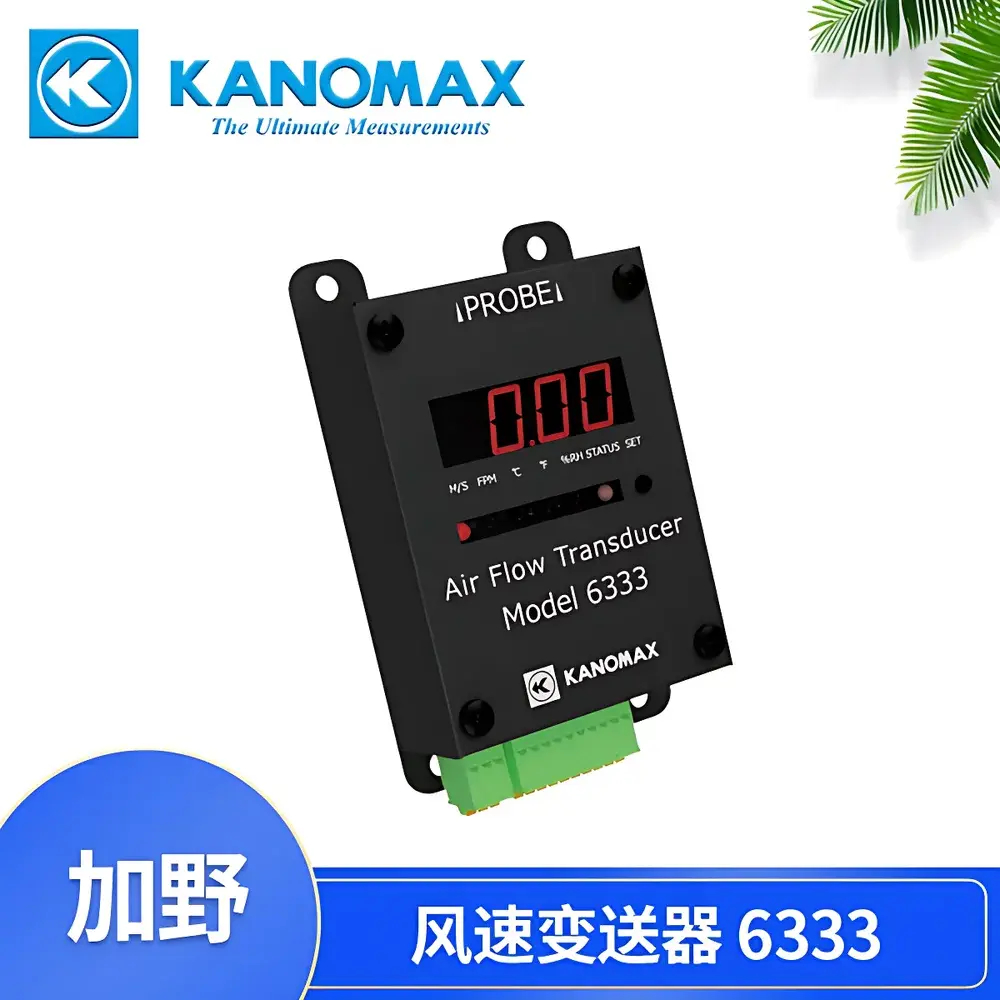
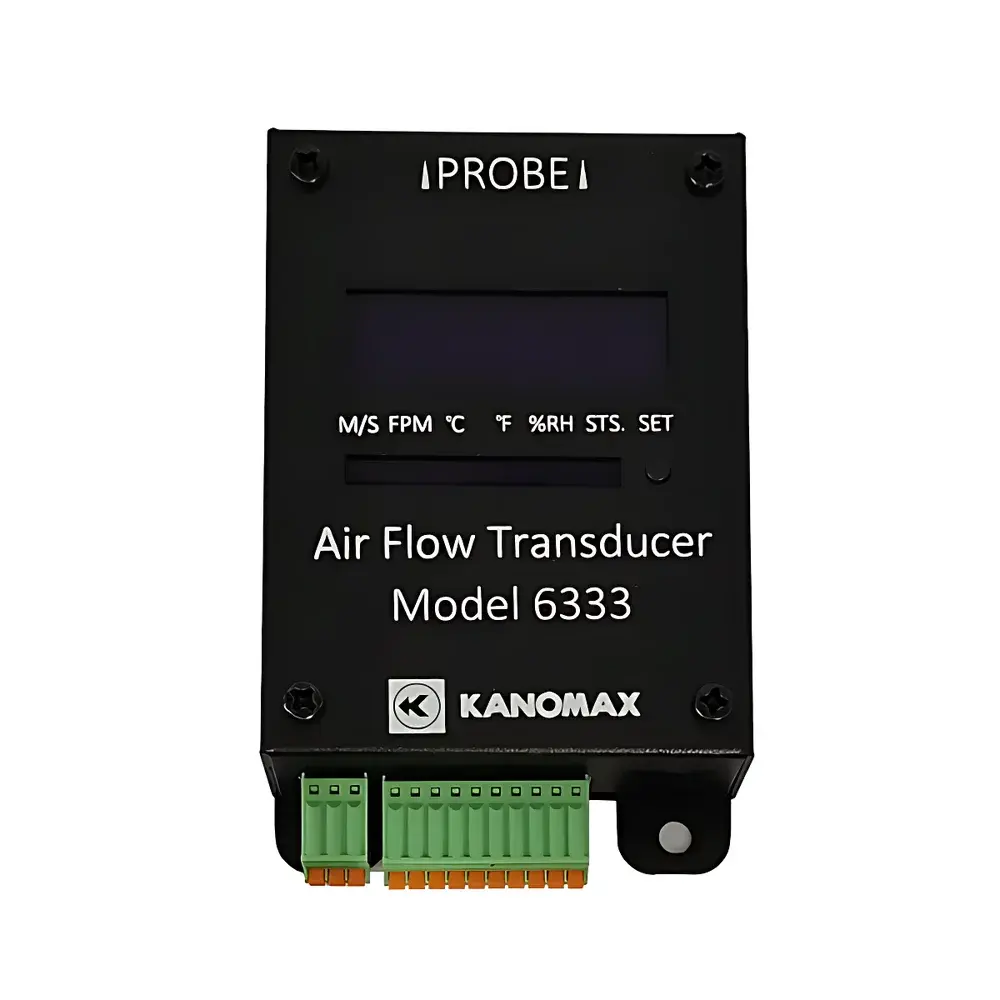
Kanomax 6333-0C Thermal Anemometer Transmitter
| Brand | Kanomax |
|---|---|
| Origin | China (Liaoning) |
| Model | 6333-0C |
| Instrument Type | Thermal Anemometer |
| Resolution | 0.01 m/s (0.01–9.99 m/s), 0.1 m/s (10.0–50.0 m/s) |
| Velocity Range | 0.01–50.0 m/s (dependent on probe selection) |
| Temperature Range | 0–120 °C (probe-dependent) |
| Humidity Range | 5–95 %RH |
| Accuracy | ±2% of reading or ±0.02 m/s (whichever is greater), ±0.5 °C, ±3–5 %RH |
| Operating Environment | 0–60 °C, 2–98 %RH (non-condensing) |
| Storage Environment | −20–70 °C, 2–98 %RH (non-condensing) |
| Analog Output | 4–20 mA or 0–5 V (DIP-switch configurable) |
| Digital Output | RS485 |
| Power Supply | AC 100–240 V / DC 12–24 V |
| Dimensions | 100 × 60 × 25 mm |
| Weight | 200 g |
Overview
The Kanomax 6333-0C Thermal Anemometer Transmitter is a modular, high-fidelity environmental monitoring platform engineered for precise, remote measurement of air velocity, temperature, and relative humidity in industrial, HVAC, cleanroom, and research applications. Based on constant-temperature anemometry (CTA), the system employs thermally sensitive probes that maintain a stable sensor temperature differential to quantify convective heat loss—directly correlating to airflow velocity with high linearity and low drift. Unlike cup or vane anemometers, thermal sensing enables sub-meter-per-second resolution down to 0.01 m/s and rapid response times (as fast as 1 second for 90% step response at 1 m/s), making it suitable for laminar flow characterization, duct balancing, fume hood validation, and low-velocity containment verification. The transmitter body (Model 6333-0C) functions as a universal interface—accepting any of 15 interchangeable probe variants—thereby decoupling sensor selection from signal conditioning hardware and supporting application-specific configuration without system redesign.
Key Features
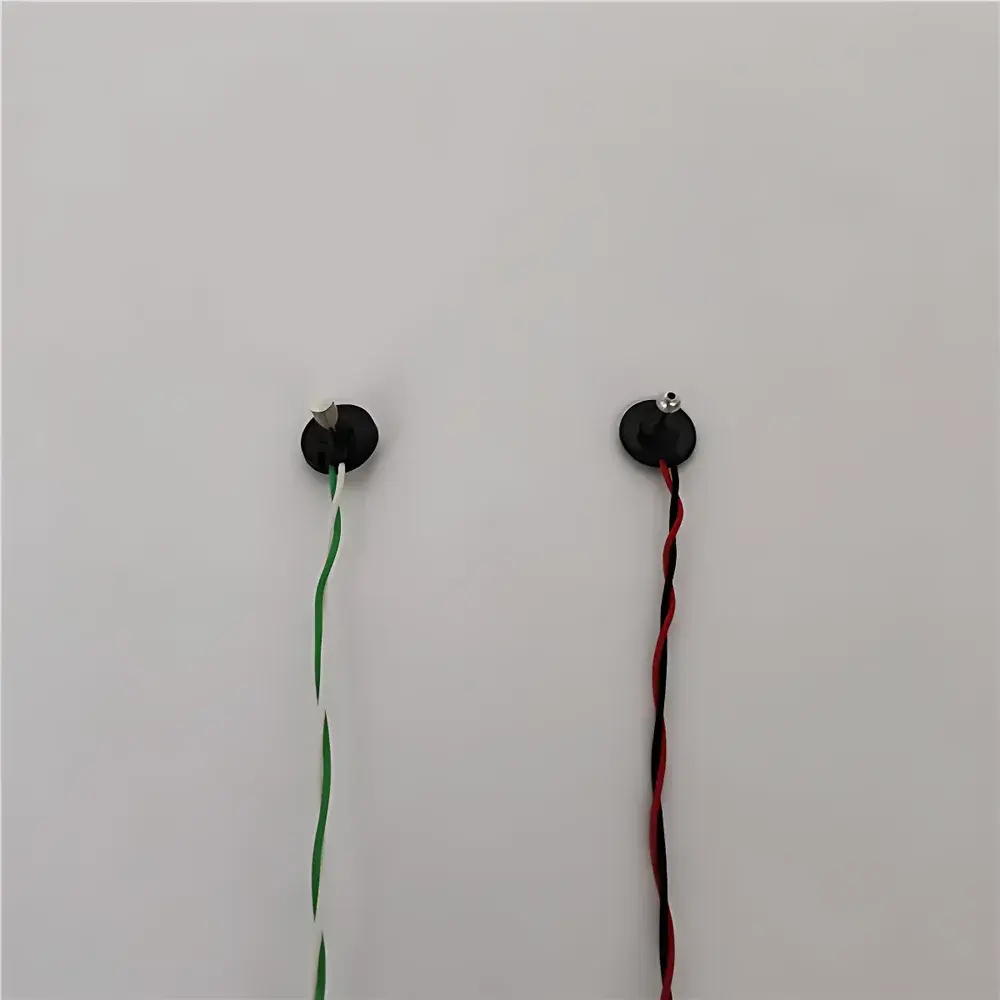
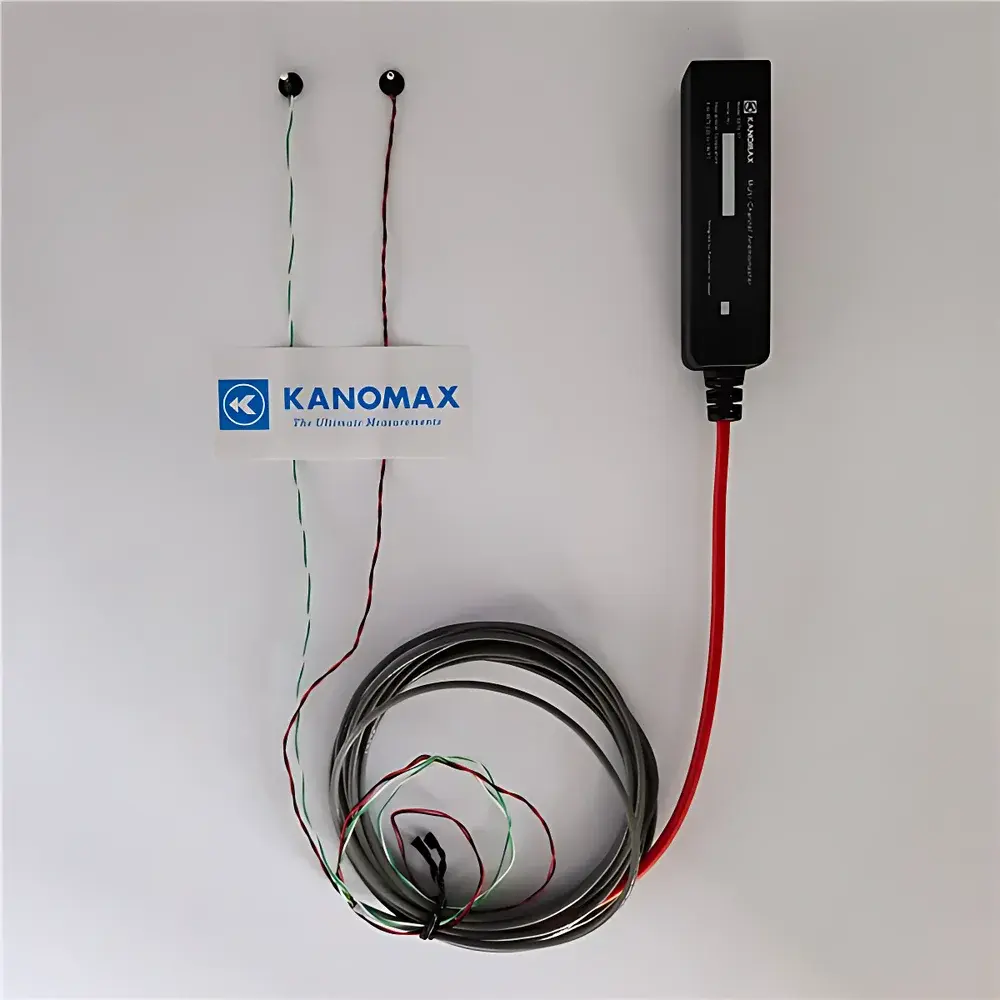
- Modular probe architecture: 15 standardized, cross-compatible probes—including directional and omnidirectional variants—enabling optimized deployment across velocity ranges (0.01–50.0 m/s), temperature extremes (up to 120 °C), and spatial constraints (including ultra-compact probes for confined ductwork or micro-environments).
- Multi-parameter output capability: Simultaneous analog (4–20 mA or 0–5 V, user-selectable via DIP switches) and digital (RS485 Modbus RTU) outputs support integration into SCADA, BMS, and PLC systems without external signal converters.
- Temperature-compensated sensing: All probes integrate integrated temperature sensors and apply real-time thermal compensation algorithms to maintain velocity accuracy across ambient shifts—critical for long-term stability in variable-condition environments.
- Flexible power and installation: Operates on wide-range AC (100–240 V) or DC (12–24 V) input; supports DIN-rail mounting (optional 6333-70 kit), vehicle-mounted mobile testing, and battery-backed field deployments via compatible adapters (e.g., 6333-10 AC adapter).
- Scalable multi-point monitoring: Up to four 6333-0C units can be daisy-chained over RS485, enabling synchronized 4-channel data acquisition from distributed locations using a single host interface.
Sample Compatibility & Compliance
The 6333-0C accommodates diverse sampling scenarios through its probe ecosystem: low-velocity probes (e.g., 0975-00) for cleanroom airflow mapping; high-temperature probes (e.g., 0976-05) rated to 120 °C for oven or exhaust duct monitoring; and miniature-profile probes (e.g., 0972-00) for insertion into narrow grilles or filter housings. Each probe undergoes factory calibration traceable to NIST-traceable standards, with documented uncertainty budgets per ISO/IEC 17025 practices. While not inherently certified for hazardous locations, the system complies with IEC 61000-4 immunity standards (ESD, surge, EFT) and meets CE marking requirements for EMC and LVD. When paired with optional software (6333-40), audit trails, user access controls, and data export formats (CSV, Excel) support GLP/GMP-aligned documentation workflows.
Software & Data Management
The optional Kanomax 6333-40 Windows 10-compatible software provides full-featured data acquisition and visualization. It supports real-time plotting of up to three parameters (velocity, temperature, RH) per channel, configurable averaging intervals (1 s to 60 min), statistical summaries (min/max/mean/std dev), and time-stamped export to Excel (.xlsx) or CSV. The interface offers tri-language support (English, Japanese, Chinese) and enables dual-mode operation: standalone logging or continuous streaming to a central database. All data files include embedded metadata (probe ID, calibration date, operator ID), satisfying basic FDA 21 CFR Part 11 readiness requirements when deployed with system-level electronic signature and audit trail protocols.
Applications
- HVAC commissioning and TAB (Testing, Adjusting, Balancing) — quantifying supply/return airflow, diffuser performance, and room air change rates per ASHRAE Standard 111.
- Cleanroom and isolator qualification — verifying unidirectional airflow uniformity, velocity profiles, and ISO 14644-3 compliance at critical work surfaces.
- Industrial process monitoring — tracking drying oven airflow, exhaust stack velocity, and fume hood face velocity per ANSI Z9.5 and EN 14175.
- Environmental chamber validation — characterizing internal air circulation patterns and thermal gradients during stability studies.
- Research-grade fluid dynamics — capturing transient low-velocity phenomena in wind tunnels, boundary layer studies, or indoor air quality (IAQ) investigations.
FAQ
What probe options are available for the 6333-0C, and how do I select the appropriate one?
The system supports 15 interchangeable probes, categorized by velocity range (0.01–25/30/50 m/s), temperature rating (up to 120 °C), directionality (directional vs. omnidirectional), and physical profile (standard or miniaturized). Selection depends on required minimum detectable velocity, maximum operating temperature, spatial constraints, and whether directional sensitivity is needed.
Does the 6333-0C require periodic recalibration, and what is the recommended interval?
Annual calibration is recommended under typical industrial use. Kanomax provides accredited calibration services with NIST-traceable certificates; users may perform functional checks using reference calibrators per ISO 17025 guidelines.
Can the analog output transmit multiple parameters simultaneously?
Yes—via programmable DIP switches, the unit can output single-parameter (e.g., velocity only) or multiplexed analog signals (e.g., velocity + temperature on 4–20 mA, humidity on 0–5 V), subject to channel isolation and load limitations.
Is the 6333-40 software validated for regulated environments?
The software itself is not 21 CFR Part 11 validated out-of-the-box; however, its audit trail, electronic signature, and data integrity features enable validation by end users following internal SOPs aligned with GxP requirements.
What is the maximum cable length between the transmitter and probe?
Standard probe cables range from 0.5 m to 40 m (models 1580-30 through 1580-35); extended lengths beyond 40 m are possible with shielded twisted-pair cabling and noise mitigation, though signal integrity should be verified per installation site EMC conditions.
Related Products







