
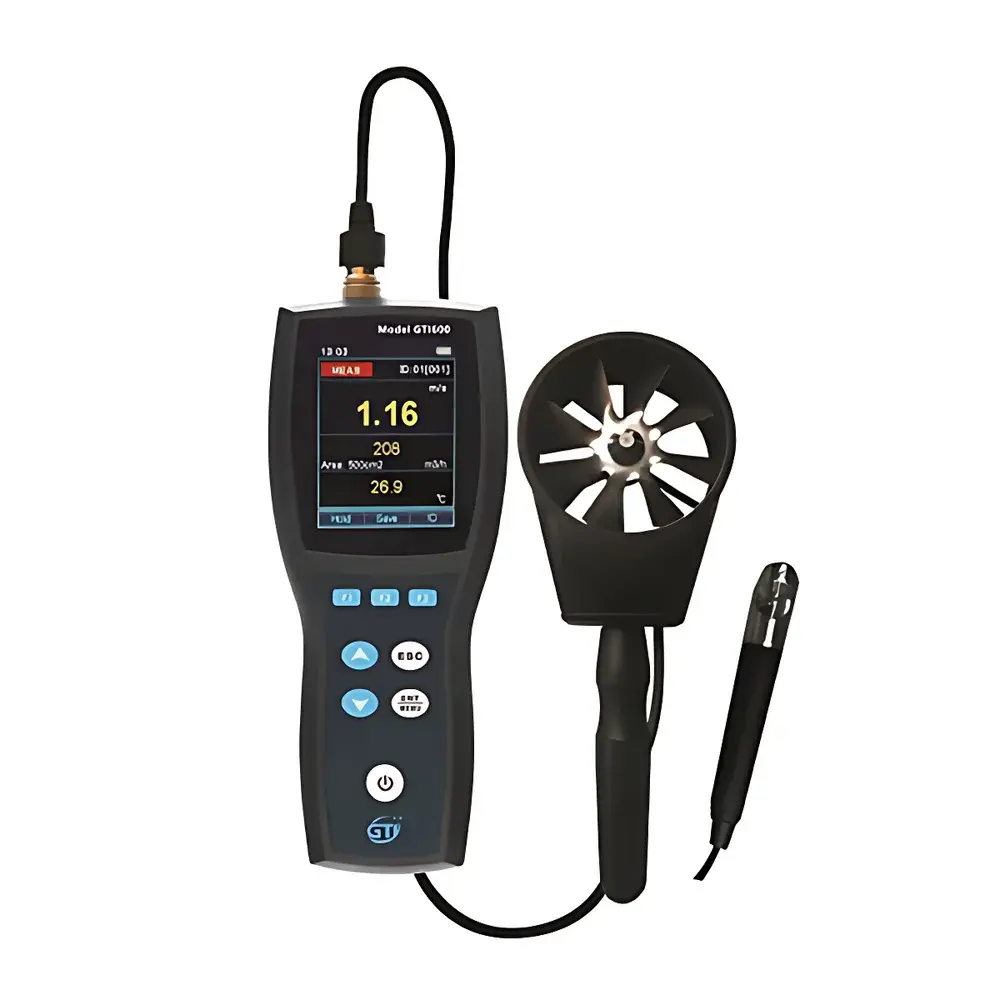
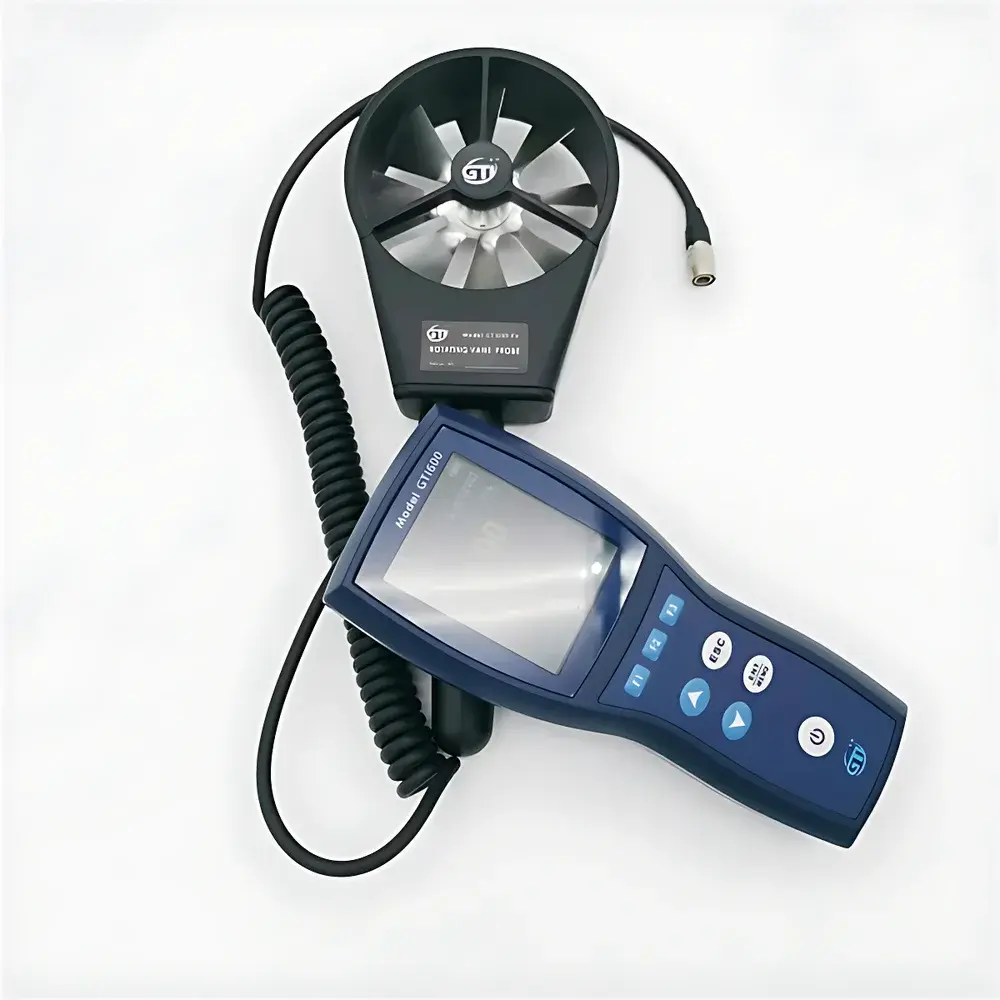
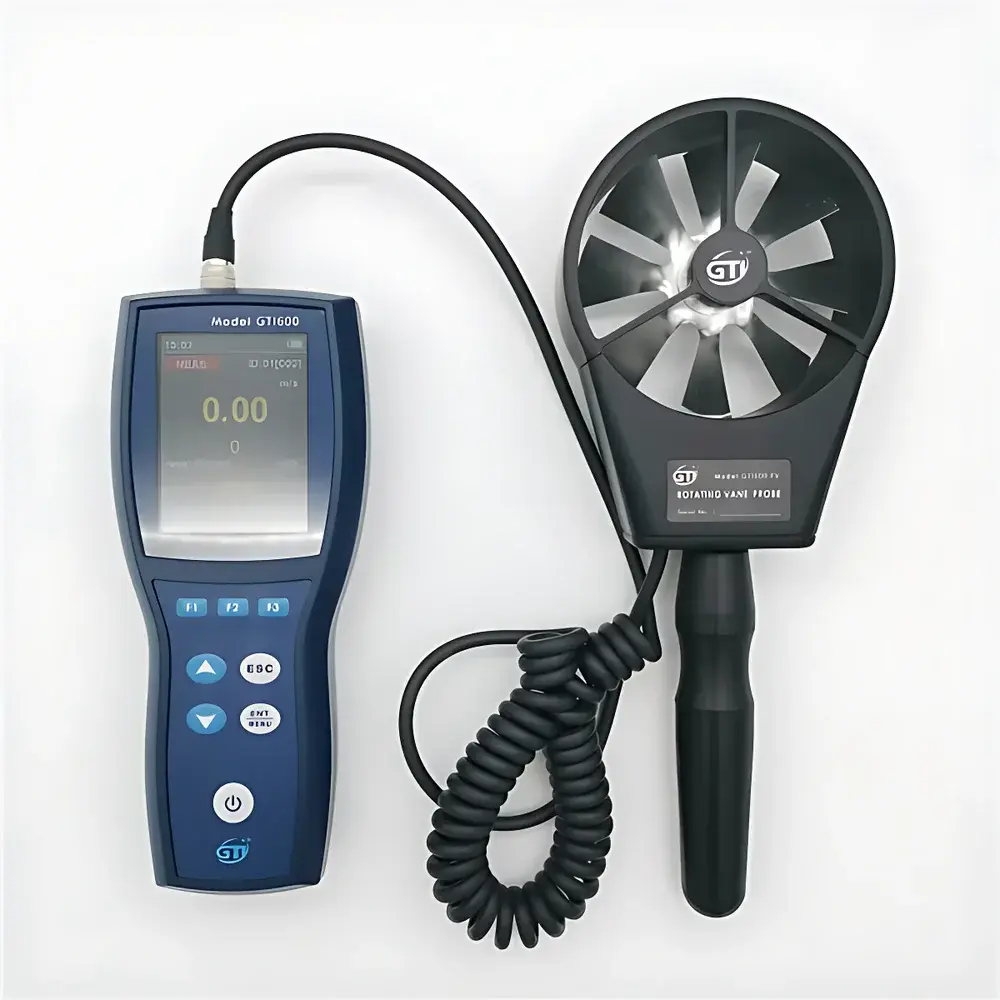
Kanomax 6822/6824 Vane Anemometer
| Brand | Kanomax |
|---|---|
| Origin | Liaoning, China |
| Manufacturer Type | Authorized Distributor |
| Country of Origin | China |
| Model | 6822 / 6824 |
| Instrument Type | Vane Anemometer |
| Resolution | 0.01 m/s |
| Measurement Range | 0.2–20.0 m/s |
| Accuracy | ±3% of reading or ±0.1 m/s (whichever is greater) |
| Operating Temperature | −20 to +100 °C |
| Operating Humidity | 5.0–95.0 %RH |
| Temperature Accuracy | ±1.0 °C |
| Probe Diameter | 70 mm |
| Power Supply | 3 × AA batteries |
| Battery Life | Approx. 150 hours |
| Dimensions (W×H×D) | 81 × 165 × 38 mm |
| Weight | 175 g (including batteries) |
| Air Volume Range | 0–9,999 CFM |
Overview
The Kanomax 6822 and 6824 Vane Anemometers are precision-engineered handheld instruments designed for reliable, field-deployable measurement of air velocity, temperature, and volumetric airflow in HVAC systems, cleanrooms, industrial ducts, and environmental monitoring applications. These devices operate on the principle of rotational torque conversion: airflow imparts angular momentum to a calibrated vane rotor, whose rotational speed is linearly correlated to local air velocity under laminar-to-turbulent transition conditions typical of low- to mid-velocity regimes (0.2–20.0 m/s). The integrated thermistor sensor enables simultaneous temperature acquisition, while the built-in cross-sectional area input function allows real-time calculation of volumetric flow rate (CFM) when duct geometry—rectangular, circular, or irregular—is entered manually. Designed for robustness in variable ambient conditions, the instruments maintain operational integrity across −20 to +100 °C and 5–95% RH, making them suitable for both indoor commissioning and outdoor industrial site surveys.
Key Features
- Vane-based sensing architecture optimized for directional airflow measurement at outlet grilles, diffusers, and duct terminations
- High-resolution display with 0.01 m/s velocity resolution and dual-parameter readout (e.g., velocity + temperature)
- Manual cross-section entry support for rectangular, round, and custom duct geometries—enabling immediate CFM computation without external software
- Thermistor-integrated probe with ±1.0 °C accuracy across full operating range (−20 to +100 °C)
- Compact, ergonomic housing (81 × 165 × 38 mm) and lightweight design (175 g with batteries) for extended handheld use
- Long-duration power management: up to 150 hours of continuous operation on three standard AA alkaline cells
- IP42-rated enclosure providing protection against limited dust ingress and vertically dripping water—suitable for non-submerged field environments
Sample Compatibility & Compliance
The 6822/6824 series is compatible with standard HVAC airflow measurement protocols requiring point-velocity sampling per ASTM D1897 and ISO 16813. Its vane probe (70 mm diameter) conforms to ASHRAE Guideline 12–2020 recommendations for probe size relative to duct dimensions (>1/10 of duct height for representative sampling). While not certified to IEC 61000-4 electromagnetic immunity standards, the instrument meets basic functional reliability requirements for Class II portable measuring equipment under EN 61326-1. It supports GLP-compliant data recording workflows when used with optional PC interface cables and time-stamped manual logs. Calibration traceability follows NIST-traceable reference standards via Kanomax’s authorized service centers, with recommended recalibration intervals of 12 months or after 200 hours of cumulative use in abrasive or high-humidity environments.
Software & Data Management
The 6822/6824 operates as a standalone instrument with no embedded memory or wireless connectivity. All measurements are displayed in real time and must be recorded manually or transcribed into external documentation systems. Optional RS-232 or USB-to-serial adapters (sold separately) enable ASCII-formatted data streaming to PCs running third-party spreadsheet or laboratory information management systems (LIMS). No proprietary software is bundled; however, Kanomax provides publicly accessible CSV export templates compatible with Microsoft Excel and MATLAB for post-processing statistical analysis (e.g., mean velocity, turbulence intensity estimation via repeated point sampling). Audit trails require user-maintained logbooks per ISO/IEC 17025 Clause 7.7, as the device lacks FDA 21 CFR Part 11-compliant electronic signature or audit trail functionality.
Applications
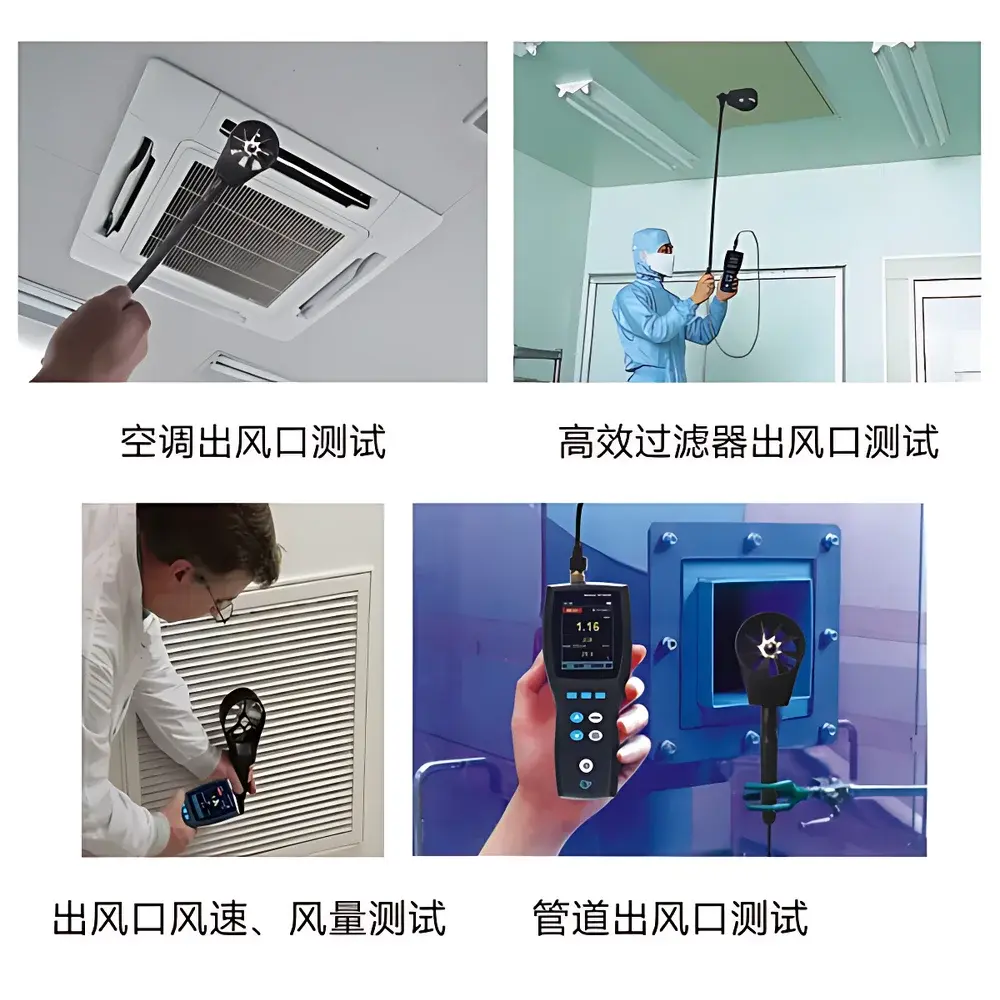
- HVAC system balancing and commissioning—measuring supply/return air velocities at registers and duct branches
- Cleanroom airflow uniformity verification per ISO 14644-3 Annex B guidelines
- Industrial exhaust hood face velocity assessment for OSHA 1910.145 and ANSI Z9.5 compliance
- Environmental chamber validation where temperature-stabilized airflow profiles are critical
- Educational laboratory use for fluid mechanics instruction involving Bernoulli’s principle and continuity equation validation
- Building envelope leakage screening using depressurization-induced airflow correlation techniques
FAQ
What is the recommended calibration interval for the Kanomax 6822/6824?
Kanomax recommends annual calibration or after 200 hours of active use in environments with particulate loading, condensation, or thermal cycling exceeding ±10 °C/hour.
Can the instrument measure airflow in round ducts with diameters less than 100 mm?
Yes, but probe insertion depth and positioning must follow ISO 16813 Annex A guidance: minimum distance from duct wall ≥ 0.1 × duct diameter, and sampling points distributed per log-Tchebycheff method for ducts < 300 mm.
Does the device support metric units exclusively, or can it output CFM and °C simultaneously?
The unit defaults to SI units (m/s, °C, m³/h), but CFM and °F are selectable via mode toggle; however, mixed-unit displays (e.g., m/s + °F) are not supported.
Is the vane probe replaceable or serviceable in the field?
The vane assembly is a sealed, factory-calibrated module; replacement requires return to an authorized Kanomax service center to preserve metrological integrity.
How does temperature compensation affect velocity accuracy at extremes of the operating range?
The internal algorithm applies polynomial correction coefficients derived from thermistor-vane coupling characterization; velocity error remains within ±3% up to 85 °C, with marginal drift (<±0.2 m/s) observed above 90 °C due to bearing thermal expansion.
Related Products







