
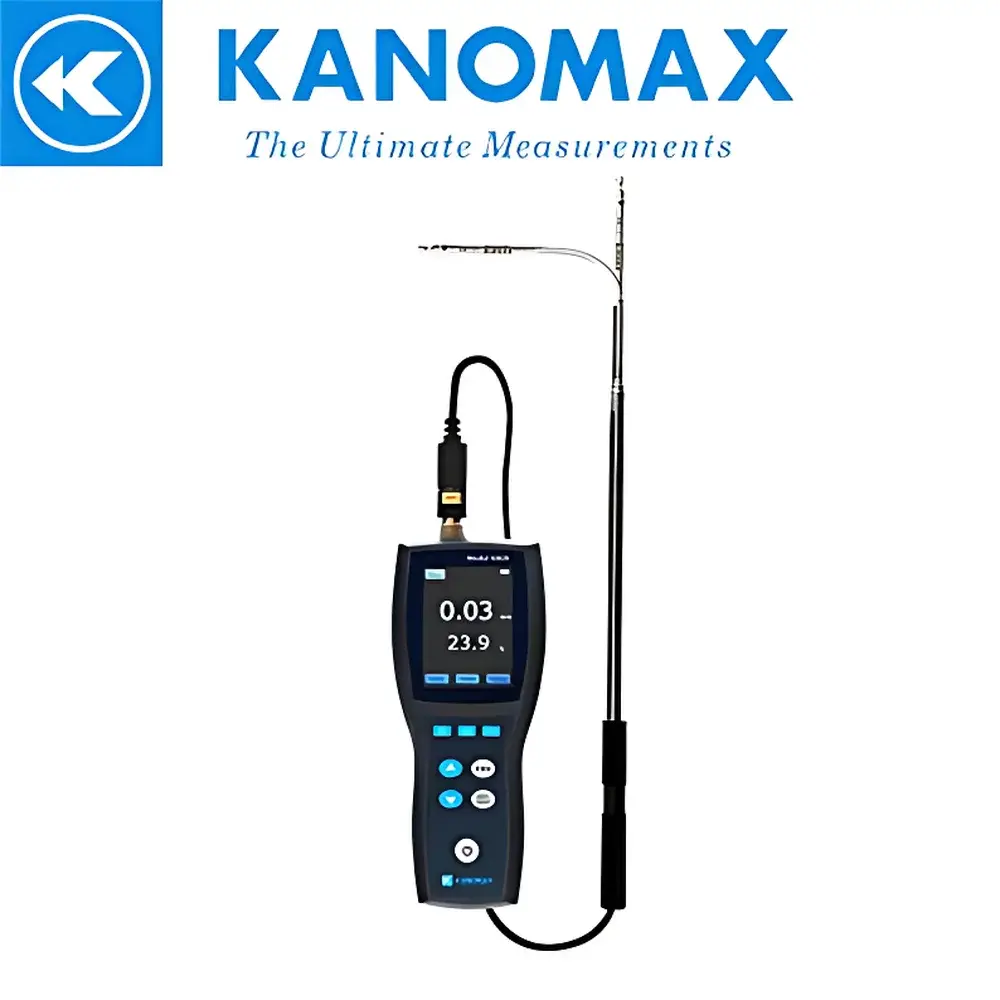
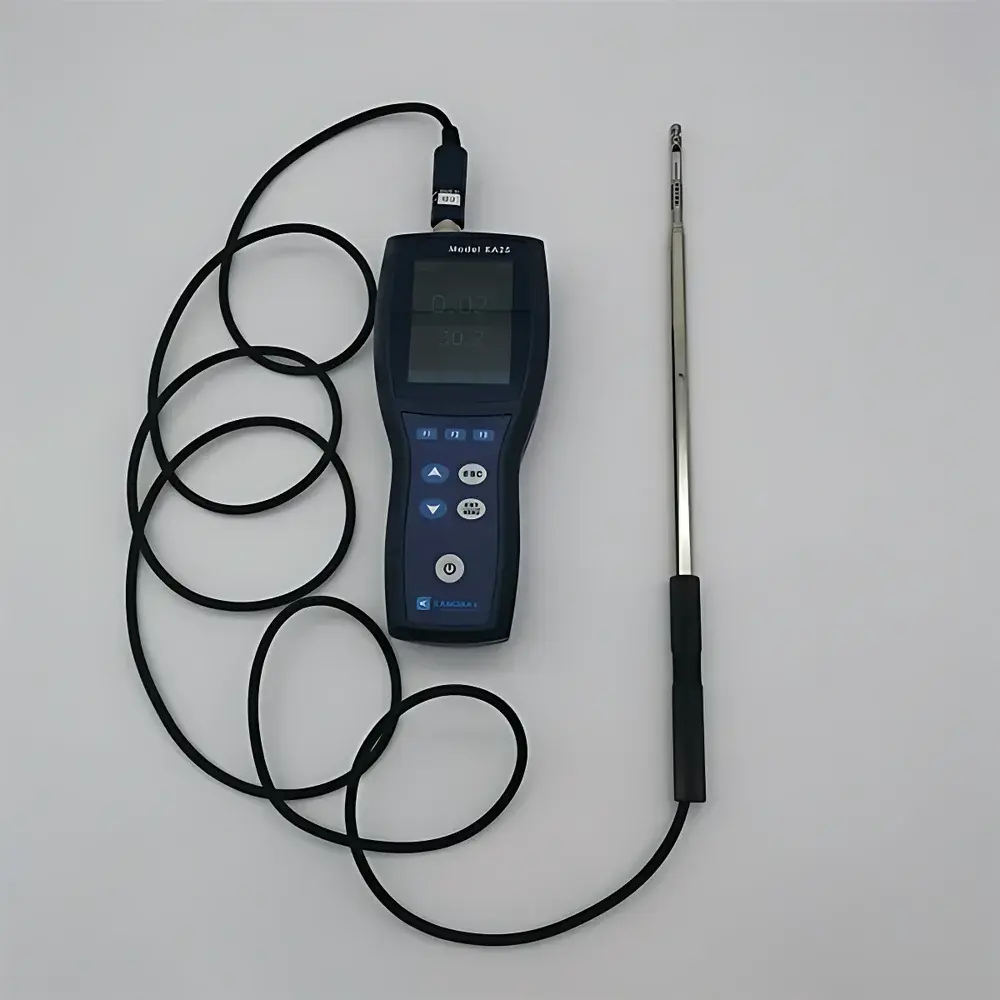
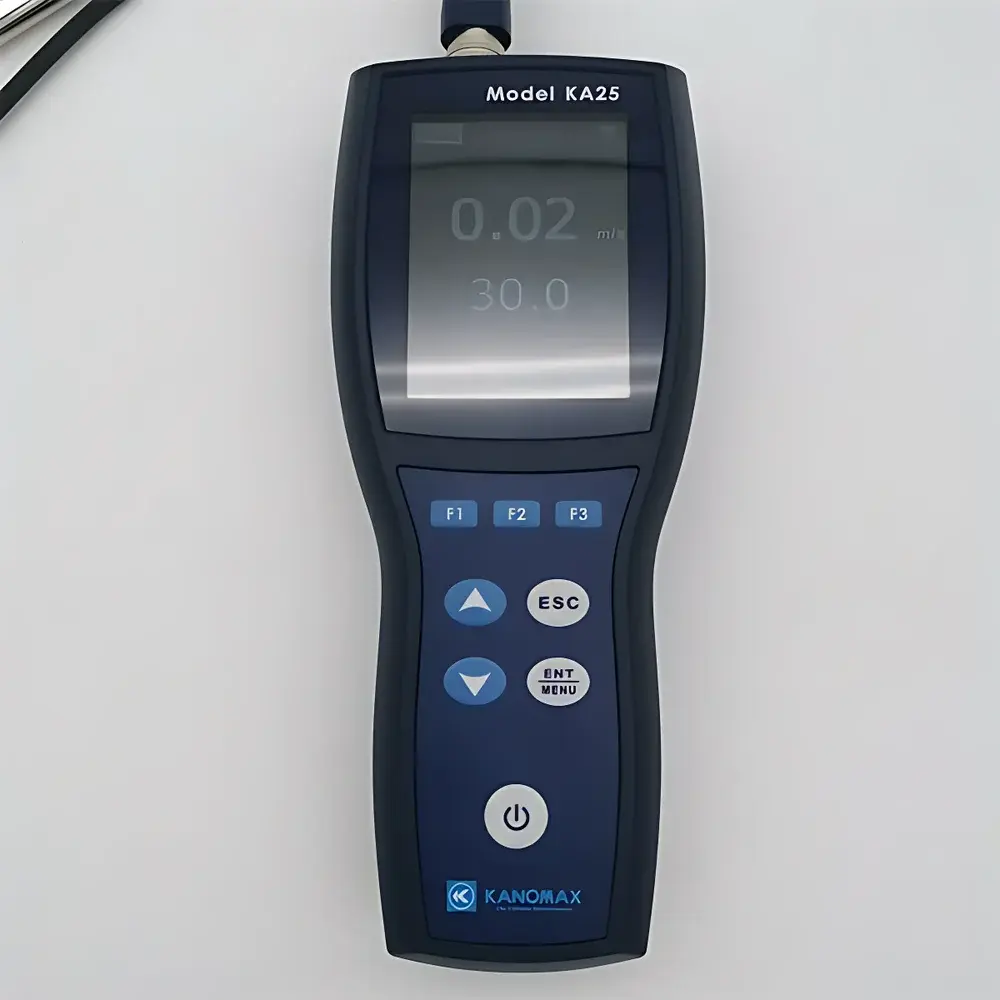
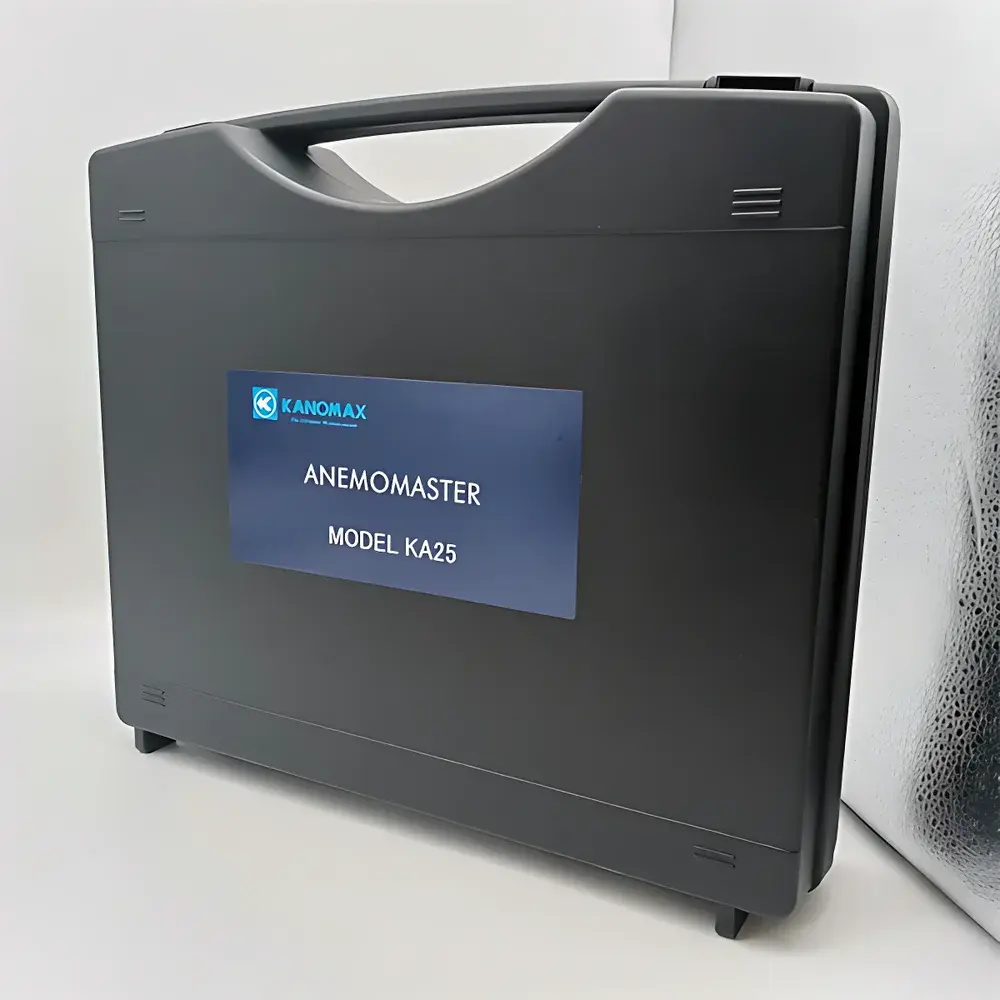
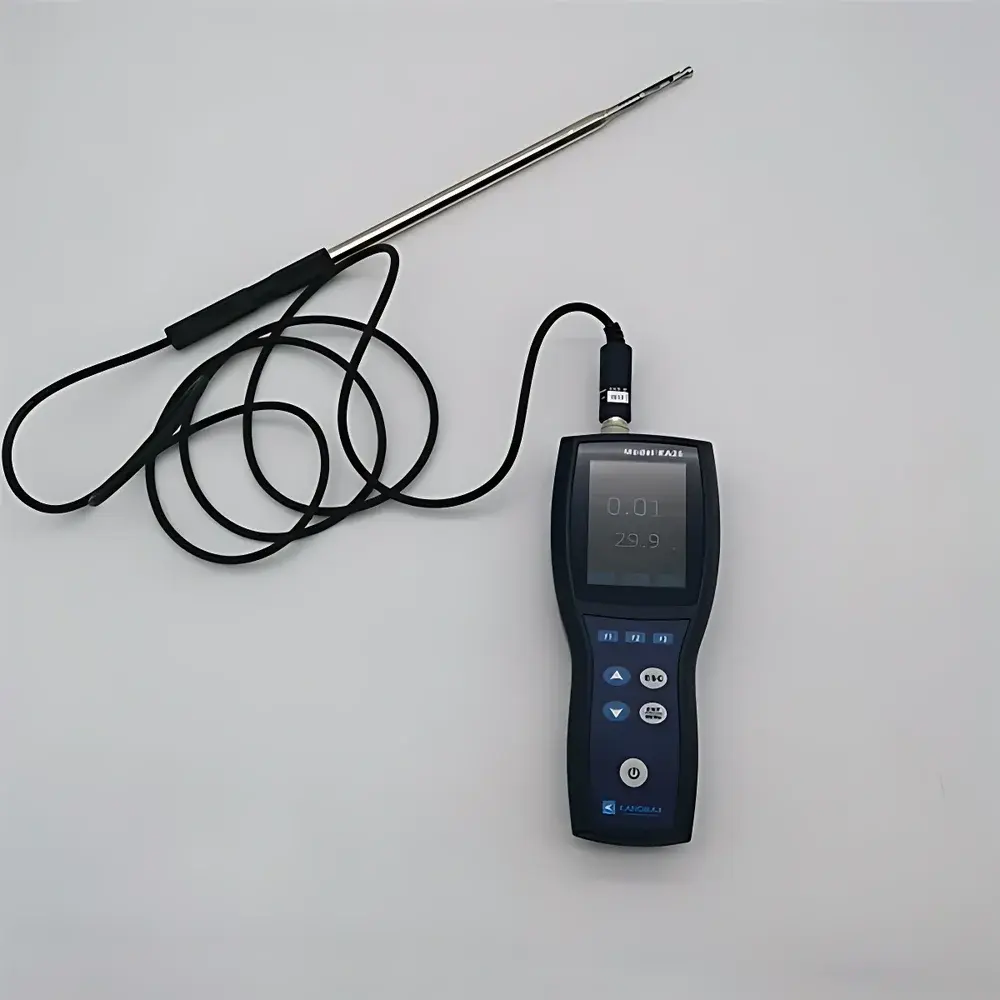
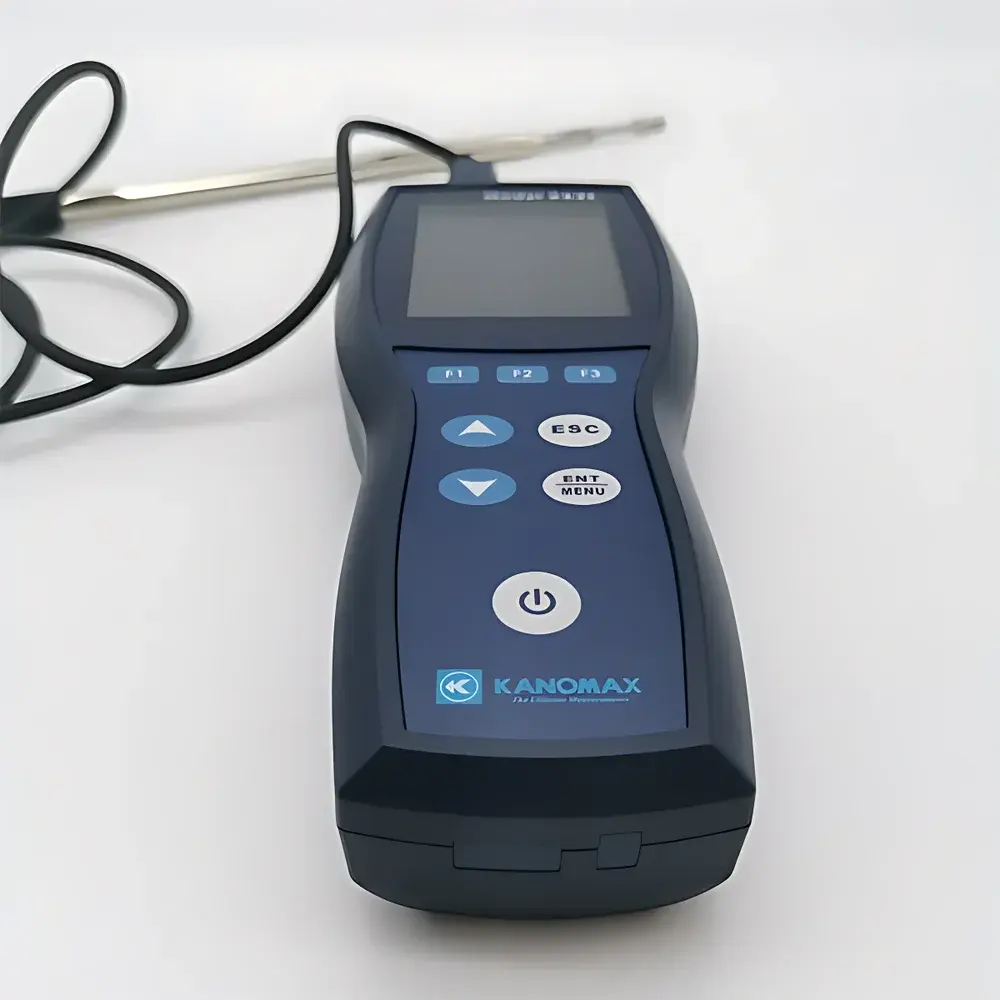
Kanomax KA25 Portable Thermal Anemometer
| Brand | Kanomax |
|---|---|
| Origin | Japan |
| Model | KA25 |
| Instrument Type | Thermal Anemometer |
| Velocity Range | 0.01–20.0 m/s |
| Velocity Resolution | 0.01 m/s |
| Velocity Accuracy | ±(3% of reading + 0.03 m/s) |
| Temperature Range | −20 to +70 °C |
| Temperature Accuracy | ±0.5 °C (at v > 0.5 m/s) |
| Temperature Resolution | 0.1 °C |
| Response Time (Velocity) | ~1 s (90% response at 1 m/s) |
| Response Time (Temperature) | ~30 s (90% response at 1 m/s) |
| Air Volume Calculation | Yes (rectangular & circular ducts, 0.1–255.0 cm dimensions) |
| Data Hold, Min/Max/Avg Statistics, Adjustable Time Constant (1/5/10/20 s), Auto Power-Off (3/5/10 min), Backlit LCD (3-level), Battery Life | ~15 h (4 × AA alkaline), Weight: ~220 g (body only), Dimensions (body): 200 × 85 × 40 mm, Probe: Ø6 mm (sensor) / Ø14 mm (handle) × 294–1060 mm (telescoping & flexible), Cable Length: 2000 mm, Operating Environment (body): 5–40 °C, Storage Temp: −20–60 °C |
Overview
The Kanomax KA25 Portable Thermal Anemometer is a precision-engineered handheld instrument designed for real-time, in-situ measurement of air velocity and ambient temperature in HVAC commissioning, indoor air quality (IAQ) assessment, cleanroom validation, and industrial ventilation audits. Based on constant-temperature anemometry (CTA), the KA25 employs a thermally sensitive platinum resistance sensor housed in a fine-wire probe. As airflow cools the heated element, the instrument dynamically adjusts current to maintain a fixed sensor temperature — the required power correlates directly with mass flow rate, enabling accurate velocity determination across low-to-moderate flow regimes (0.01–20.0 m/s). Its compact, ergonomic design integrates seamlessly into field workflows, supporting rapid deployment without external calibration sources or PC connectivity.
Key Features
- Thermal sensing principle optimized for clean-air applications — minimal drift and high reproducibility under stable thermal conditions
- Telescoping and flexible probe (Ø6 mm sensor tip, Ø14 mm handle) with 294–1060 mm extension range for access to ducts, grilles, and confined spaces
- Simultaneous dual-parameter acquisition: air velocity and temperature, both displayed in real time on a three-level backlit LCD
- On-device air volume calculation for rectangular and circular ducts — users input cross-sectional dimensions (0.1–255.0 cm), and the unit computes volumetric flow (m³/h) automatically
- Configurable time constant (1 s, 5 s, 10 s, or 20 s) to balance responsiveness and signal smoothing per application requirements
- Statistical functions including minimum, maximum, and average values over user-defined sampling intervals
- Data hold mode for freezing instantaneous readings during measurement; auto power-off options (3/5/10 minutes) conserve battery life
- Robust mechanical architecture: IP-rated probe housing, shock-absorbing body casing, and 220 g total weight (excluding batteries) for extended handheld use
Sample Compatibility & Compliance
The KA25 is validated for use with clean, dry, non-corrosive air — it is not rated for particulate-laden, humid (>80% RH), or chemically aggressive environments. While no formal ISO/IEC 17025 calibration certificate is bundled, the device conforms to general metrological practices aligned with ASTM D5465 (Standard Test Method for Measuring Air Velocity in Ventilation Ducts) and supports traceable verification via NIST-traceable reference anemometers. Its temperature compensation algorithm ensures velocity accuracy remains within specification (±(3% of reading + 0.03 m/s)) across the full operating range (−20 to +70 °C probe environment). The instrument meets CE marking requirements for electromagnetic compatibility (EMC Directive 2014/30/EU) and low-voltage safety (LVD Directive 2014/35/EU).
Software & Data Management
The KA25 operates as a standalone field instrument with no proprietary software dependency. All measurements are processed and displayed locally; no data export interface (e.g., USB, Bluetooth, or RS-232) is included. This architecture eliminates cybersecurity risks and simplifies compliance with regulated environments where uncontrolled data transfer is restricted (e.g., pharmaceutical cleanrooms operating under FDA 21 CFR Part 11 Annex 11 guidelines). Users maintain full control over data integrity: recorded min/max/avg values and manually held readings remain visible until cleared. For laboratories requiring electronic record retention, manual transcription into validated LIMS or Excel-based QA templates is recommended — consistent with GLP-compliant documentation workflows.
Applications
- HVAC system balancing and commissioning — quantifying supply/return air velocities at diffusers and registers
- Cleanroom ISO 14644-3 airflow uniformity mapping and face velocity verification across HEPA filters
- Industrial exhaust hood performance testing per ANSI/ASHRAE 110
- Indoor environmental quality (IEQ) surveys in offices, schools, and healthcare facilities
- Validation of laminar flow cabinets and biosafety cabinets (BSCs) per NSF/ANSI 49
- Energy audit support — identifying air leakage paths and estimating infiltration rates via traverse measurements
- Educational laboratory use for fluid mechanics and thermodynamics instruction
FAQ
What is the recommended recalibration interval for the KA25?
Kanomax recommends annual verification against a traceable reference standard in accordance with internal QA protocols or organizational metrology schedules.
Can the KA25 measure gas other than air?
No — the sensor calibration is specific to dry, clean air. Using it with CO₂, nitrogen, or other gases introduces unquantified error due to differing thermal conductivity and heat capacity.
Is the probe waterproof or washable?
The probe is not submersible or IP67-rated; cleaning must be performed with a soft, dry cloth or isopropyl alcohol-dampened swab — avoid solvents or ultrasonic baths.
Does the KA25 support averaging across multiple duct locations?
Yes — the built-in statistical engine calculates real-time min/max/avg over continuous measurement sessions; however, spatial averaging across discrete points requires manual logging and post-processing.
How does temperature affect velocity accuracy?
The unit applies automatic temperature compensation. At velocities above 0.5 m/s, temperature uncertainty contributes ±0.5 °C to overall error propagation — this is factored into the stated velocity accuracy specification.
Related Products







