
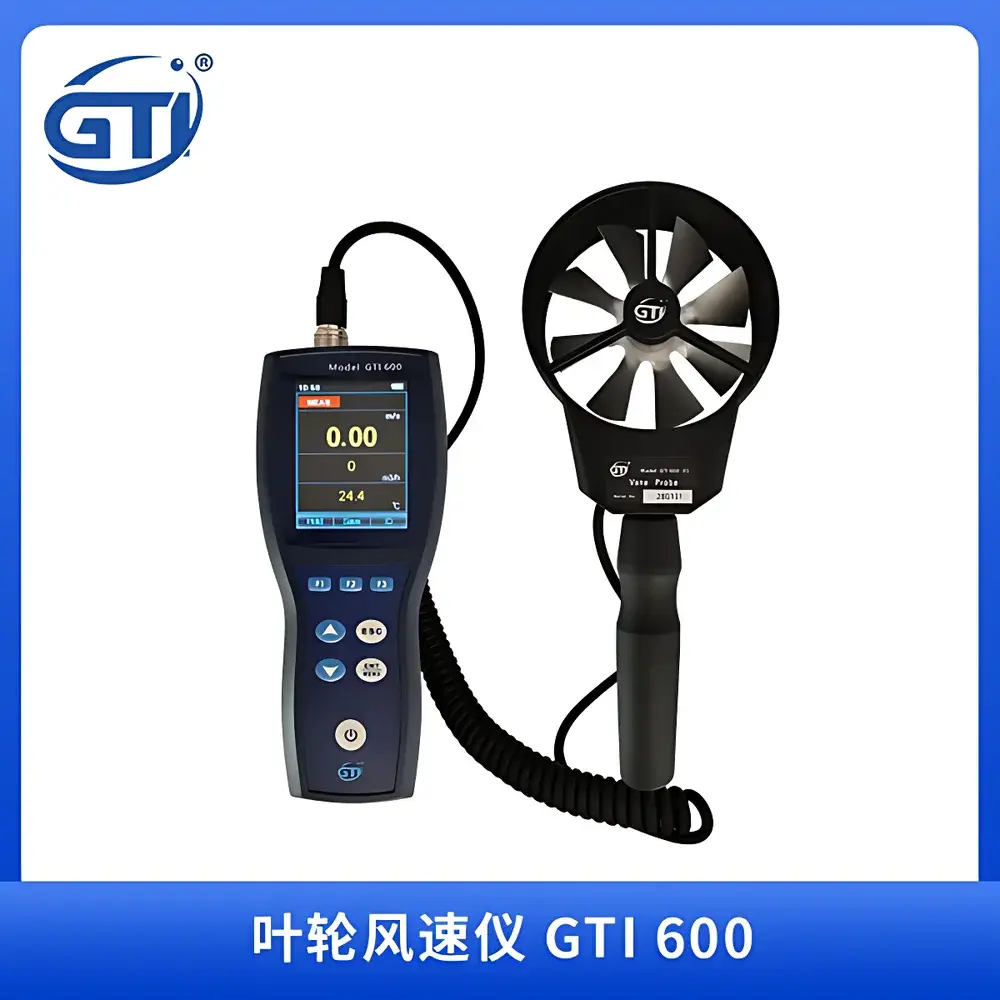
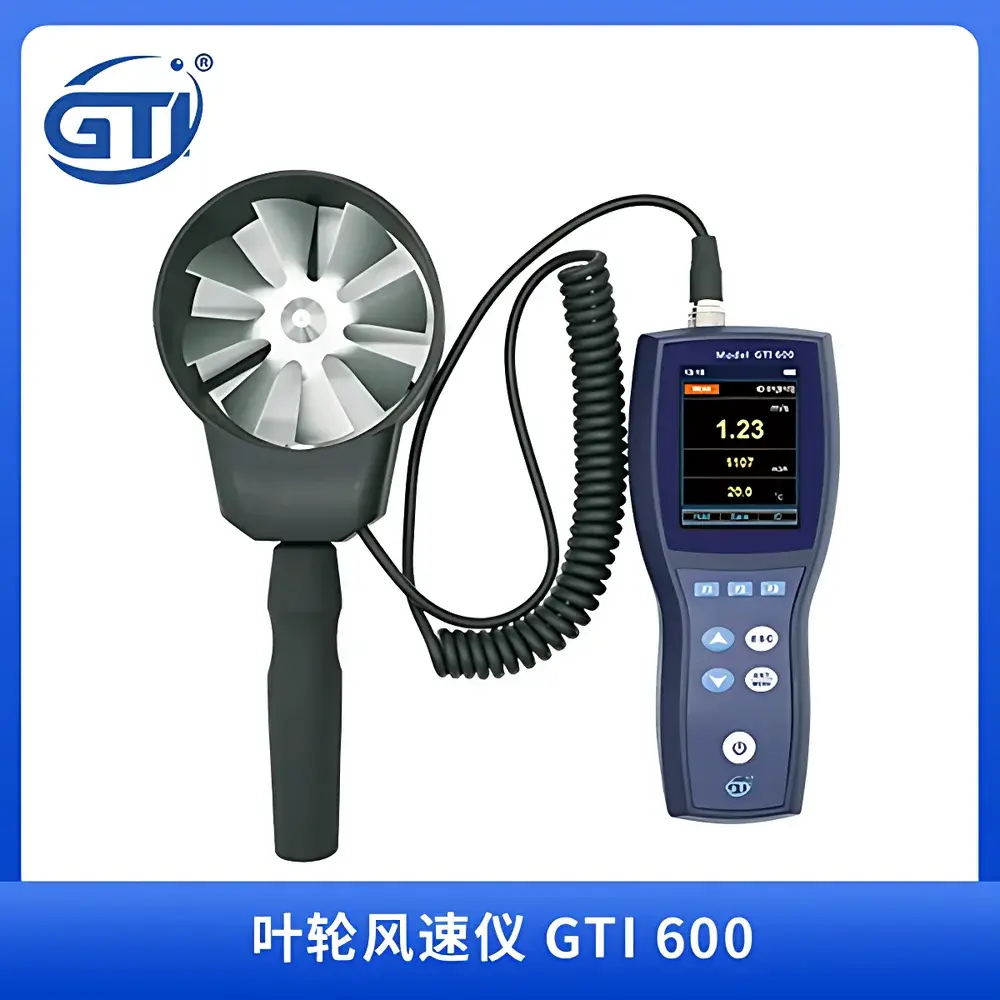
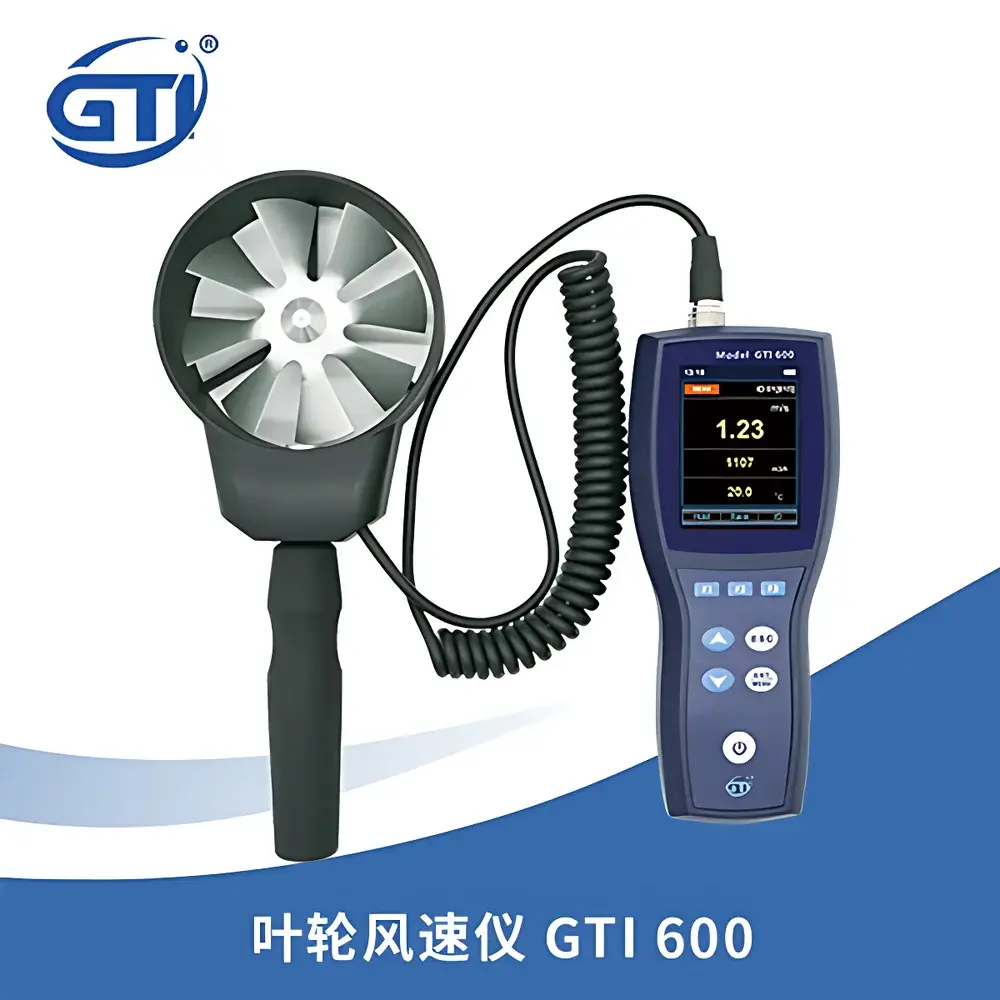
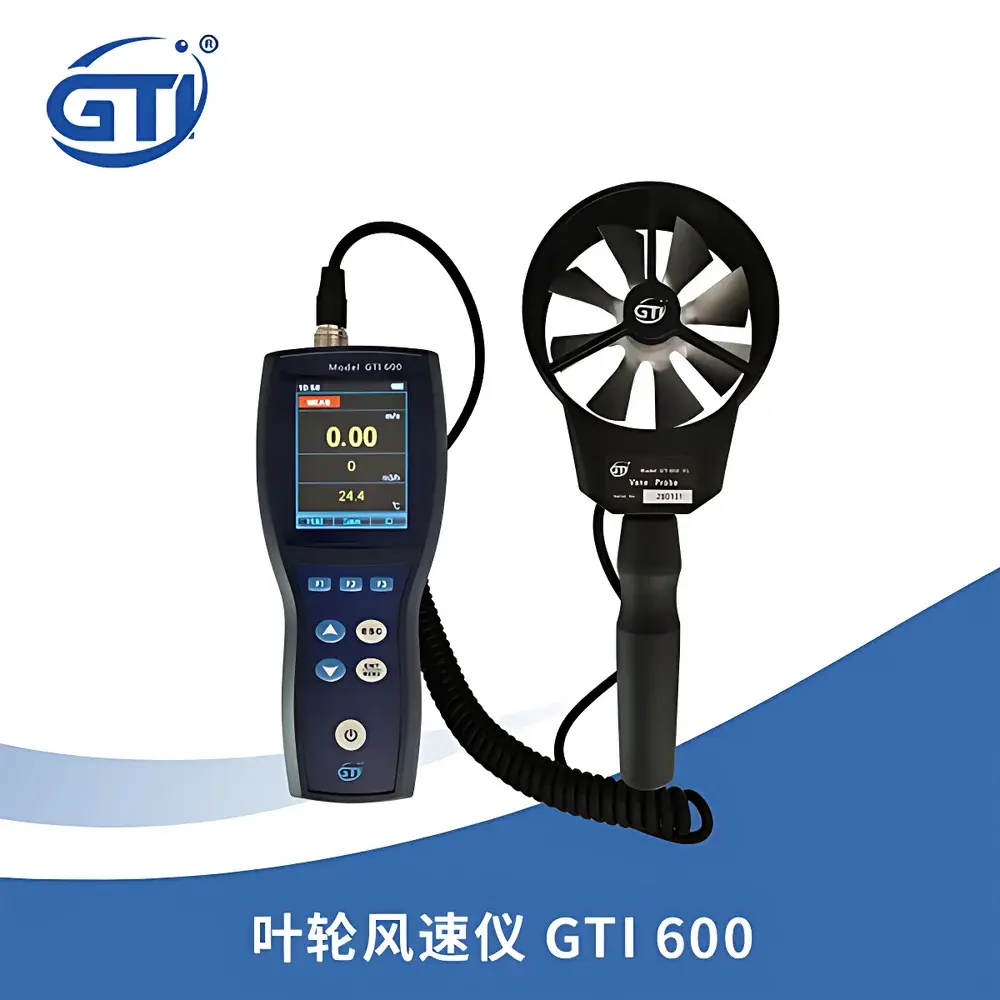
GTI GTI600 Vane Anemometer
| Brand | GTI |
|---|---|
| Origin | Liaoning, China |
| Manufacturer Type | Authorized Distributor |
| Country of Origin | China |
| Model | GTI600 |
| Instrument Type | Vane Anemometer |
| Wind Speed Range (FV100) | 0.30–35 m/s |
| Wind Speed Range (FV70) | 0.10–35 m/s |
| Wind Speed Range (FV14) | 0.80–25 m/s |
| Accuracy | ±3% ±0.1 m/s (low range), ±1% ±0.3 m/s (high range) |
| Wind Speed Resolution | 0.01 m/s |
| Temperature Range | 0–60 °C |
| Temperature Accuracy | ±0.5 °C |
| Temperature Resolution | 0.1 °C |
| Data Storage Capacity | 10,000 records |
| Power Supply | 4 × AA batteries or AC adapter |
| Operating Temperature | 0–60 °C |
| Storage Temperature | −20–60 °C |
| Weight | ~600 g |
Overview
The GTI GTI600 Vane Anemometer is a precision-engineered handheld instrument designed for reliable, real-time measurement of air velocity and temperature in HVAC commissioning, environmental validation, and indoor air quality (IAQ) assessment. Utilizing rotating vane sensor technology—based on calibrated angular momentum transfer principles—the GTI600 delivers high reproducibility across turbulent, low-velocity, and spatially heterogeneous airflow fields. Its modular sensor architecture supports three interchangeable vane probes (FV14, FV70, FV100), each optimized for distinct flow regimes: the FV14 for high-velocity, low-turbulence ducts; the FV70 for general-purpose grilles and diffusers; and the FV100 for low-velocity, high-sensitivity applications such as laminar flow hoods and cleanroom supply terminals. The device computes volumetric airflow (m³/h) in real time when geometric input (circular or rectangular duct dimensions) is entered, eliminating manual calculation errors and supporting ISO 16813-compliant ventilation verification protocols.
Key Features
- Triple-sensor compatibility: Interchangeable FV14, FV70, and FV100 vane probes with mechanical extension rods enabling flexible positioning in confined or angled ducts, ceiling grids, and filter banks.
- Dual-parameter simultaneous acquisition: Synchronized wind speed (m/s) and ambient temperature (°C) readings displayed concurrently with volumetric flow rate (m³/h) derived from user-defined duct geometry.
- Adaptive measurement modes: Selectable instantaneous sampling or moving-average mode (1–120 s window) to suppress transient turbulence-induced variance—critical for ASHRAE 111-2022 compliant airflow uniformity testing.
- Statistical data processing: On-device computation of min/mean/max values across multi-point traverses, supporting EN 13779 and ISO 14644-3 traverse reporting requirements.
- Robust data management: Local storage of up to 10,000 timestamped records with retention lock function; export via USB flash drive in CSV format for traceable post-processing in Excel or validated LIMS environments.
- Intuitive human interface: Backlit LCD with contextual icons indicating battery status, duct type selection, hold mode, and active sensor identification—designed for glove-compatible operation in field conditions.
Sample Compatibility & Compliance
The GTI600 accommodates diverse airflow geometries through its dual duct-type input (circular and rectangular), accepting user-entered dimensions in millimeters or inches. It meets functional performance criteria aligned with ISO 8540-2 (air velocity instrumentation), ASTM D1072-20 (standard test method for air velocity in ducts), and EN 12599 (ventilation system testing procedures). While not certified to IEC 61000-4 electromagnetic immunity standards out-of-box, its analog sensor interface and isolated power path ensure stable operation in typical laboratory and facility environments. The instrument supports GLP-aligned workflows via timestamped, non-editable data logs and does not implement FDA 21 CFR Part 11 electronic signature functionality—intended for engineering verification rather than regulated GxP release testing.
Software & Data Management
No proprietary software installation is required. Data export occurs directly via USB mass-storage protocol to standard FAT32-formatted USB drives. Each record includes: date/time stamp, sensor ID (FV14/FV70/FV100), measured wind speed (m/s), temperature (°C), calculated airflow (m³/h), duct type, and dimensional inputs. Files are structured as comma-separated values (CSV) with UTF-8 encoding and header rows compliant with common data ingestion pipelines. For audit readiness, users may manually annotate exported files with project IDs or location tags prior to archival. Firmware updates—distributed as signed binary packages—are applied via USB without external tools.
Applications
- HVAC system balancing and TAB (Testing, Adjusting, Balancing) per ASHRAE Guideline 1–2021
- Diffuser and grille performance validation in commercial and healthcare facilities
- Filter face velocity mapping for HEPA and ULPA installations per ISO 14644-3
- Room air change rate (ACH) estimation in pharmaceutical cleanrooms and biosafety labs
- Occupant thermal comfort surveys per ISO 7730 and ANSI/ASHRAE Standard 55
- Exhaust hood face velocity verification in chemical fume hood certification (ANSI/AIHA Z9.5)
FAQ
What sensor types are supported, and how do they differ in application?
The GTI600 accepts three vane sensors: FV14 (optimized for 0.8–25 m/s, compact profile for tight ducts), FV70 (0.1–35 m/s, balanced sensitivity for grilles and registers), and FV100 (0.3–35 m/s, large-diameter rotor for low-velocity stability in laminar zones).
Does the GTI600 support calibration certificate traceability to NIST or other national standards?
The instrument ships with a factory calibration report referencing internal reference standards; third-party accredited calibration (e.g., ISO/IEC 17025) is available upon request and must be specified at time of order.
Can airflow calculations be performed for irregular or non-standard duct shapes?
No—only circular and rectangular cross-sections are supported. For oval, elliptical, or custom geometries, users must approximate using equivalent hydraulic diameter methods externally.
Is the device suitable for outdoor use under rain or high humidity?
It is rated for IP54 ingress protection (dust-resistant and splash-proof), making it appropriate for sheltered outdoor locations but not for direct rainfall exposure or condensing environments.
How is battery life affected during continuous logging versus spot measurement?
With alkaline AA batteries, typical runtime is >20 hours in intermittent use (5 sec/sample); continuous logging reduces this to ~12 hours due to LCD backlight and memory write cycles.
Related Products







