
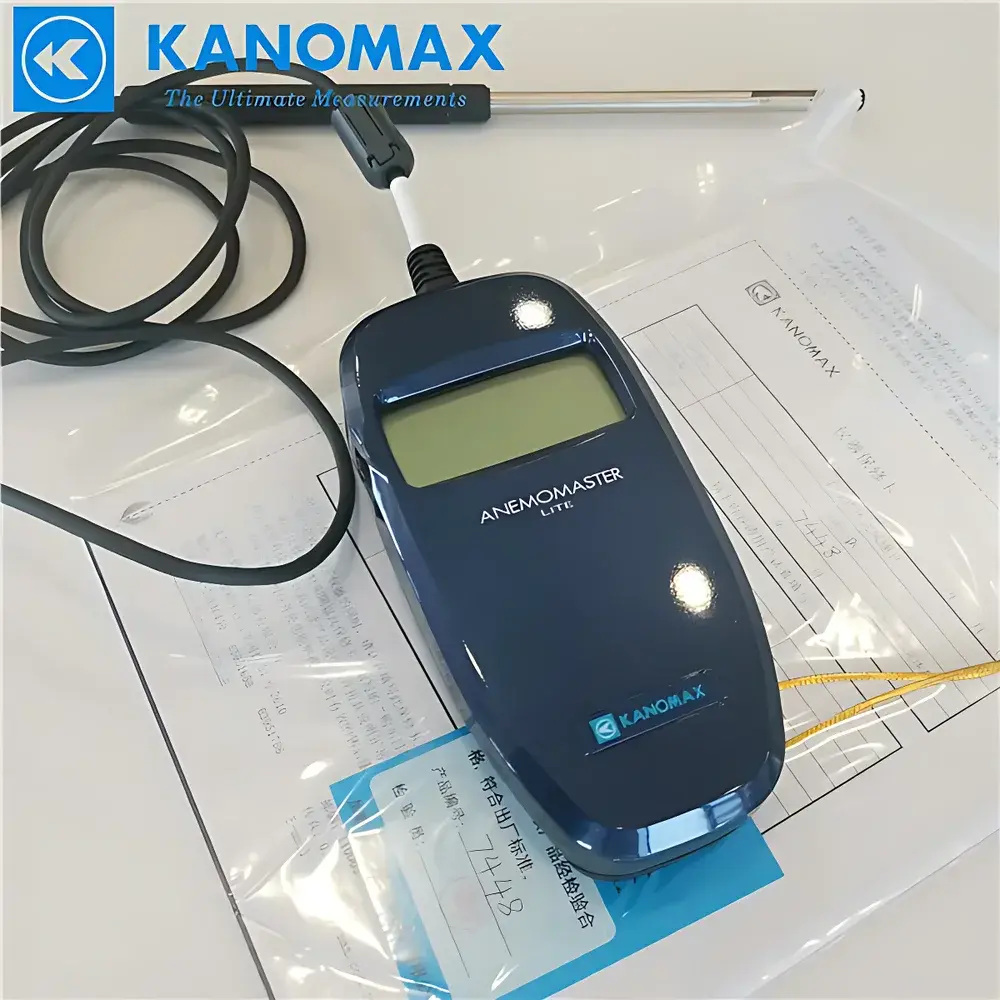
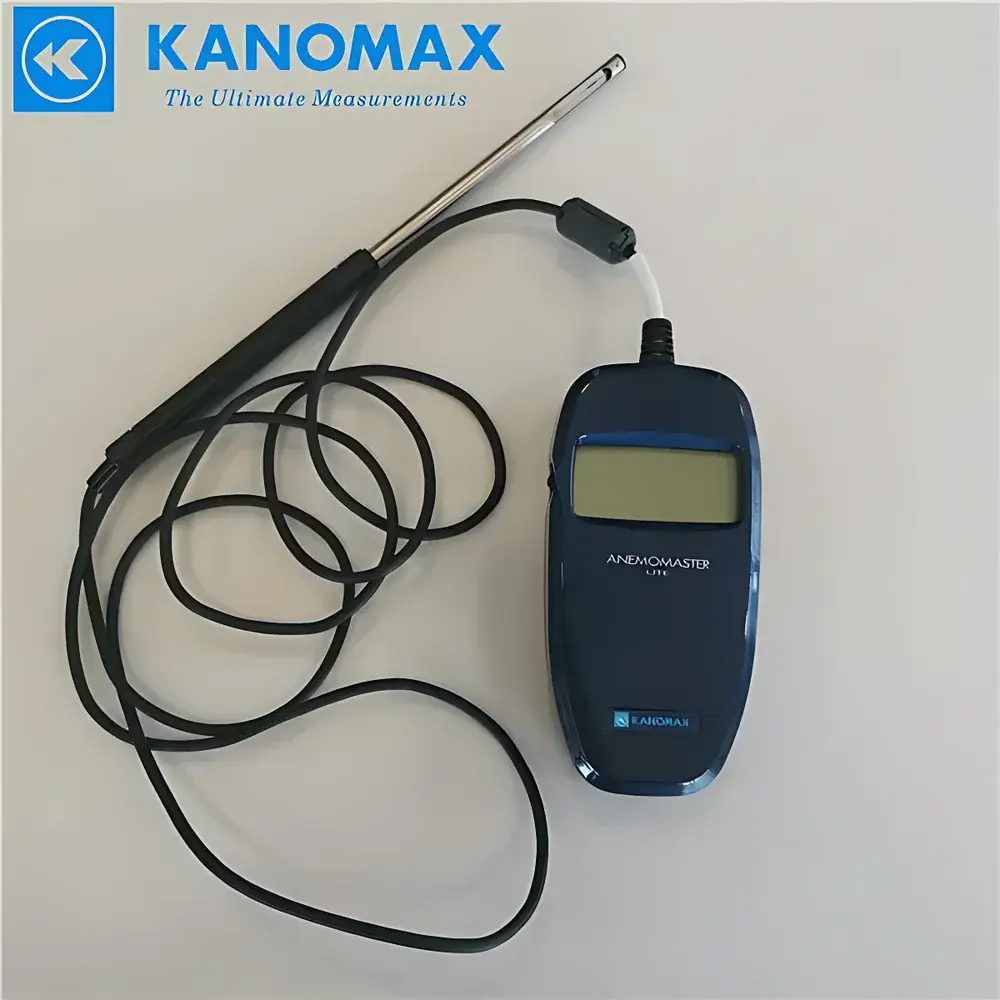
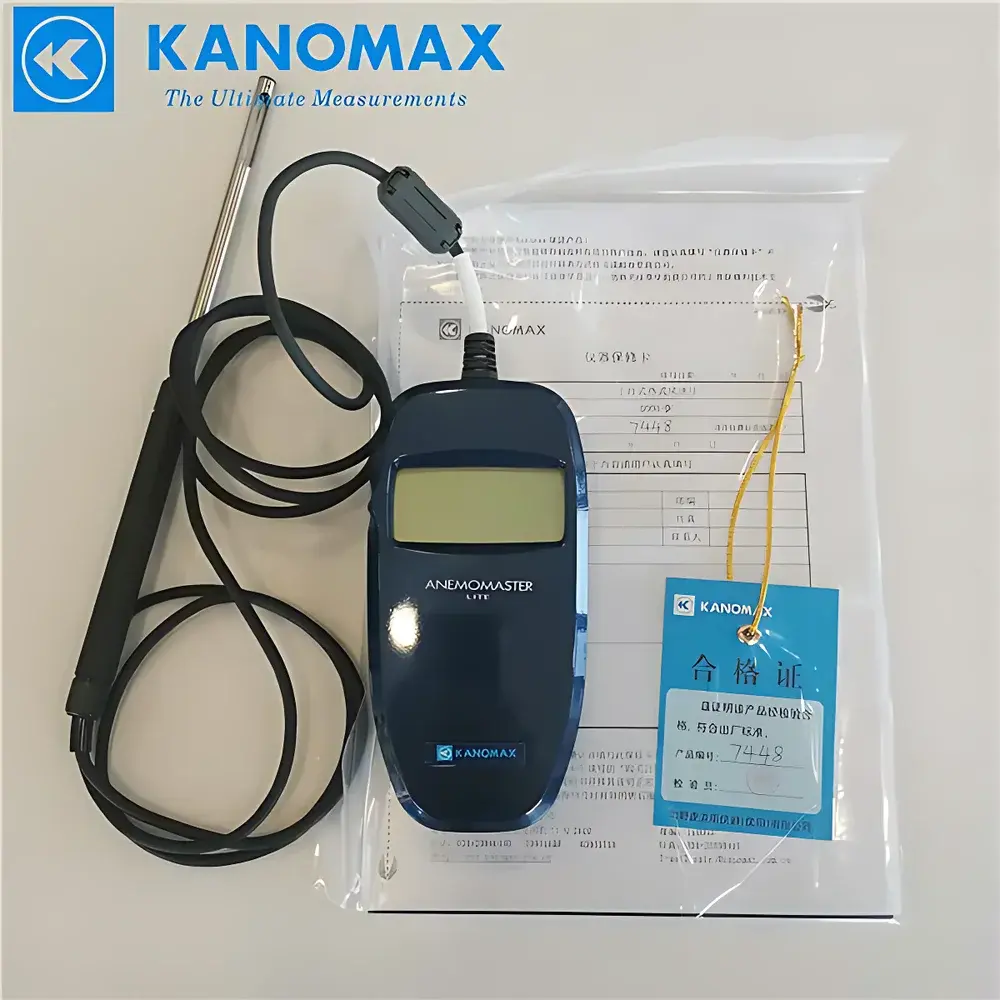
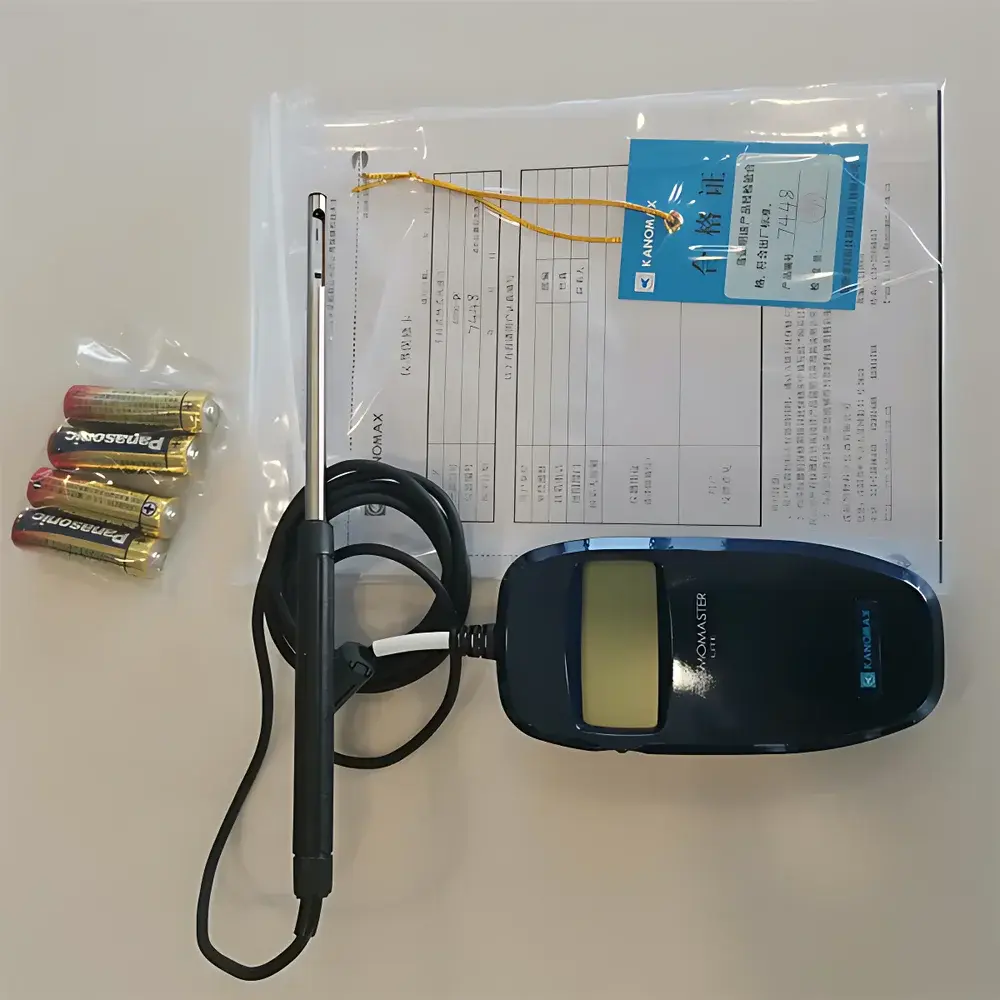
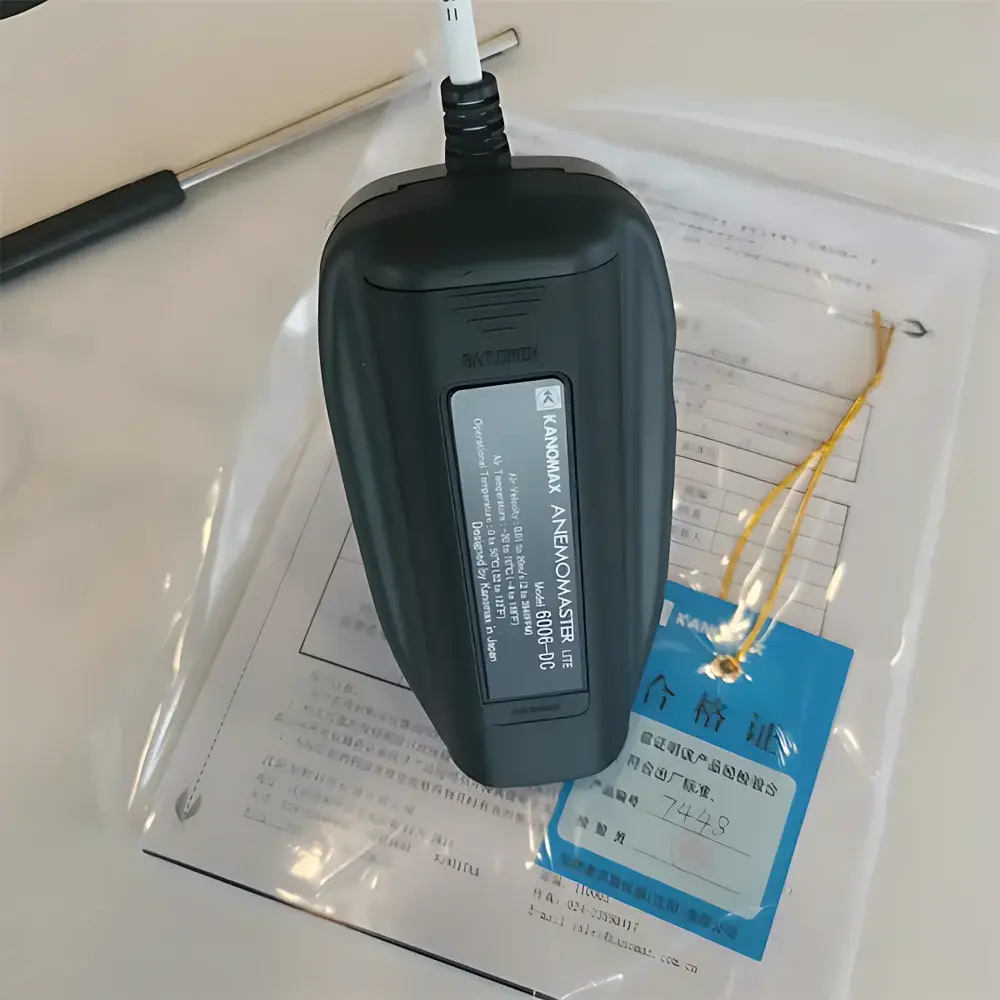
Kanomax 6006 Hot-Wire Anemometer
| Brand | Kanomax |
|---|---|
| Origin | Japan |
| Model | 6006 |
| Instrument Type | Hot-wire Anemometer |
| Measurement Range | 0.01–20.0 m/s |
| Resolution | 0.01 m/s (0.01–9.99 m/s), 0.1 m/s (10.0–20.0 m/s) |
| Accuracy | ±5% of reading (wind speed), ±1°C (temperature) |
| Operating Temperature | −20 to +70°C (air), 0 to +50°C (probe), +5 to +40°C (main unit) |
| Operating Humidity | 20–85% RH |
| Response Time | <1 s (90% for wind speed at 1 m/s), <30 s (90% for temperature at 1 m/s) |
| Display | Dual-parameter (wind speed + temperature), selectable units (m/s/°C or fpm/°F), FAST/SLOW averaging (1 s / 5 s), battery level indicator (4-segment), hold function |
| Probe Dimensions | Ø6.1 mm (Ø10.6 mm at sensor tip) × 205 mm |
| cable | Ø3.3 mm × ~1.5 m |
| Main Unit Dimensions | 60 × 120 × 34 mm |
| Weight | ~180 g (including batteries) |
| Storage Temperature | −10 to +50°C |
Overview
The Kanomax 6006 Hot-Wire Anemometer is a precision-engineered, portable thermal anemometer designed for reliable, real-time measurement of low-velocity airflows in environmental, HVAC, cleanroom, and industrial hygiene applications. Based on constant-temperature anemometry (CTA) principle, the instrument employs a fine platinum wire sensor heated to a fixed temperature above ambient. As airflow passes over the wire, convective cooling alters its resistance—this change is precisely measured and converted into wind speed using calibrated thermal transfer algorithms. Integrated temperature compensation circuitry ensures stable accuracy across the operational range (−20 to +70°C ambient), with optimal performance maintained between 10 and 40°C per ISO 7726 and ASTM D1078 standards for thermal comfort and ventilation assessment.
Key Features
- Single-button operation for intuitive start/stop, unit switching, and data hold—minimizing operator training requirements and field errors.
- Interchangeable probe design with factory-traceable calibration certificates; each probe maintains NIST-traceable accuracy without recalibration upon replacement.
- Dual-parameter simultaneous display: wind speed (0.01–20.0 m/s) and ambient temperature (−20 to +70°C) with 0.1°C resolution.
- Configurable averaging modes: FAST (1-second moving average) for transient flow analysis or SLOW (5-second moving average) for stabilized readings in ductwork or laminar flow hoods.
- Unit conversion via DIP switch: m/s & °C or fpm & °F—supporting compliance with both SI and imperial reporting requirements in multinational facilities.
- Robust mechanical architecture: lightweight (180 g including batteries), IP54-rated housing, and retractable probe cable (1.5 m) optimized for confined-space access and repetitive field use.
Sample Compatibility & Compliance
The Kanomax 6006 is validated for use in ambient air under standard atmospheric pressure (86–106 kPa). It is not intended for corrosive, explosive, or particulate-laden gas streams without optional filtration accessories. The probe’s stainless-steel sheath and ceramic insulation ensure compatibility with non-aggressive indoor and outdoor environments. Device firmware and hardware conform to IEC 61000-4 electromagnetic immunity standards and meet CE marking requirements for portable measuring instruments. While not intrinsically safe, it complies with ISO 16813 for indoor air quality (IAQ) monitoring and supports documentation traceability required under ISO/IEC 17025 accredited laboratory practices when used with certified calibration records.
Software & Data Management
The 6006 operates as a standalone, battery-powered field instrument with no embedded memory or PC interface. All measurements are viewed in real time only—no internal logging or export capability. For audit-ready documentation, users must manually record values or integrate with external data loggers via analog output (optional accessory). Though lacking USB or Bluetooth connectivity, its consistent repeatability (±5% of reading, per ISO 9951 Annex B) and dual-parameter output support manual entry into LIMS or QA/QC spreadsheets compliant with FDA 21 CFR Part 11 when paired with controlled procedural documentation. Calibration intervals are recommended annually or after 200 hours of cumulative use, aligned with GLP maintenance schedules.
Applications
- HVAC system commissioning and balancing—verifying supply/return grilles, diffuser performance, and duct velocity profiles per ASHRAE Guideline 12.
- Cleanroom certification—mapping laminar airflow uniformity in ISO Class 5–8 environments per ISO 14644-3.
- Industrial hygiene assessments—quantifying local exhaust ventilation (LEV) capture velocities at hood faces per OSHA Technical Manual Section III: Chapter 3.
- Building envelope diagnostics—detecting infiltration/exfiltration rates at windows, doors, and penetrations during blower door testing.
- Educational laboratories—teaching fundamental principles of convective heat transfer and fluid dynamics in undergraduate engineering curricula.
FAQ
What is the minimum measurable wind speed?
The instrument resolves down to 0.01 m/s, making it suitable for low-velocity applications such as cleanroom laminar flow verification and thermal comfort studies.
Does the probe require recalibration after replacement?
No—each probe is individually calibrated at the factory and retains its certificate of calibration; interchangeability is guaranteed without user recalibration.
Can the device be used outdoors in rain or high humidity?
It is rated IP54 (dust-protected and splash-resistant), permitting short-term outdoor use in dry or light-moisture conditions—but prolonged exposure to condensation or direct precipitation is not recommended.
Is temperature compensation active across the full −20 to +70°C range?
Compensation is continuously applied, though specified accuracy (±5% of reading) is guaranteed only within the 10–40°C ambient range per manufacturer validation reports.
What battery type does the unit use, and what is typical service life?
Two AAA alkaline batteries power the device; under normal intermittent use, battery life exceeds 100 hours, with four-segment low-battery indication enabling proactive replacement.
Related Products







