
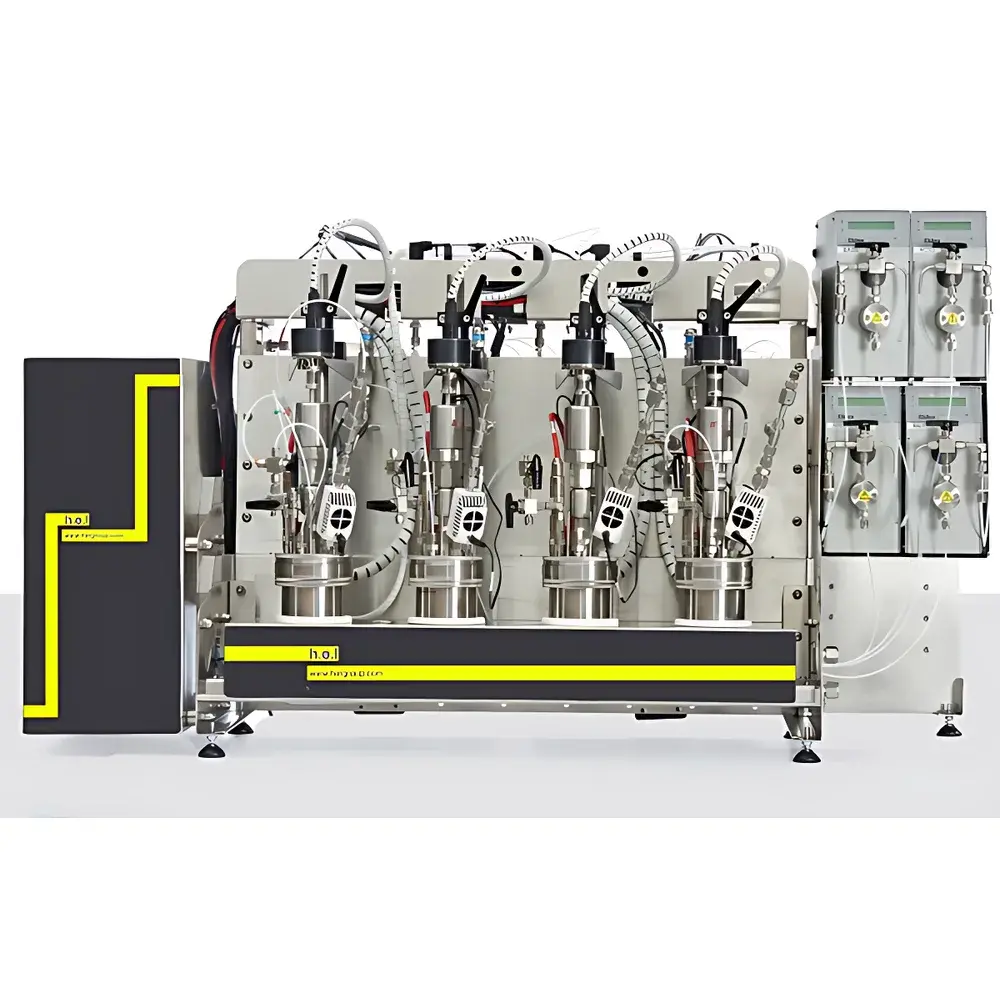
HEL AutoMATE High Pressure & Custom Modular Parallel Synthesis Platform
| Brand | HEL (UK) |
|---|---|
| Origin | United Kingdom |
| Model | AutoMATE High Pressure & AutoMATE Custom |
| Reactor Type | Tubular & Batch Reactor |
| Working Volume | 10–1000 mL |
| Operating Pressure | 0–10 MPa (0–100 bar, configurable up to 200 bar) |
| Temperature Range | −80 °C to 250 °C (oil bath), up to 500 °C with external circulator |
| internal heating | RT to 250 °C |
| Stirring Options | Magnetic, overhead mechanical, or dual-mode |
| Stirring Speed | 0–2000 rpm (magnetic: max torque 800 N·cm |
| overhead | max torque 80 N·cm) |
| Liquid Dosing | HPLC-grade precision pump (0.01–50 mL/min, high-pressure) |
| Gas Dosing | Mass flow controller (MFC), pressure-regulated, or volumetric metering |
| Solid Dosing | Auger feeder (350/500 mL capacity) |
| Interface Ports | Up to 5 per reactor head (customizable) for probes (pH, FTIR, turbidity, particle size), condensers, sampling, and reagent addition |
| Compliance | Designed for GLP/GMP environments |
Overview
The HEL AutoMATE High Pressure and AutoMATE Custom platforms constitute a fully integrated, modular parallel synthesis system engineered for rigorous chemical process development under controlled, reproducible, and scalable conditions. Based on Couette-type fluid dynamics and precision thermal management principles, the system enables simultaneous execution of multiple independent reactions—each with distinct temperature, pressure, agitation, dosing, and analytical monitoring profiles. Unlike conventional batch reactors or sequential synthesizers, the AutoMATE architecture implements true parallelism through physically isolated reaction zones (2, 4, 6, or 8 stations), each equipped with dedicated control loops and sensor interfaces. This design facilitates statistically robust experimental design (DoE), kinetic profiling, catalyst screening, safety evaluation (e.g., adiabatic temperature rise, gas evolution), and direct translation from lab-scale discovery to pilot-scale process validation. The platform is purpose-built for applications demanding high-pressure hydrogenation, oxidation, fluorination, polymerization, and continuous-flow hybrid operation—where material compatibility, thermal inertia minimization, and real-time parameter fidelity are non-negotiable.
Key Features
- Modular Reaction Architecture: Configurable station count (2–8) with independent thermal, pressure, and agitation control per zone—enabling cross-condition comparisons without compromise in reproducibility.
- Dual Thermal Management: Integrated electric heating jackets (RT–250 °C, ±0.1 °C stability) paired with optional external cryo- or high-temp oil circulation (−80 °C to 500 °C), including active quench capability for exotherm mitigation.
- Multi-Mode Agitation: Selectable magnetic stirring (up to 2000 rpm, 800 N·cm torque), overhead mechanical drive (2000 rpm, 80 N·cm), or synchronized dual-mode operation—compatible with viscous, heterogeneous, or gas-liquid systems.
- Gravimetric & Volumetric Dosing: Independent reagent channels with zero cross-contamination: HPLC-grade piston pumps (high-pressure), fast-fill syringe pumps (ambient), and precision balance-coupled feeding (±0.01 g resolution) for liquids; MFC-controlled gas delivery and auger-based solid dosing (350/500 mL).
- Intelligent Reactor Heads: Standardized multi-port reactor lids (3 ports for HP, 5 for ambient) support concurrent integration of FTIR, pH, turbidity, and particle size probes—enabling in situ reaction monitoring aligned with ICH Q5 and Q8 guidelines.
- Corrosion-Resistant Construction: Wetted parts fabricated from 316 stainless steel, Hastelloy C-276, or custom alloys; dynamic seals and gaskets employ chemically inert elastomers (e.g., Kalrez®, PTFE) validated for extended exposure to halogenated solvents, strong acids, and anhydrous reagents.
Sample Compatibility & Compliance
The AutoMATE platform accommodates diverse sample classes—including air/moisture-sensitive organometallics, thermally labile biocatalysts, highly exothermic nitrations, and supercritical fluid-mediated reactions—across volume ranges from 10 mL (micro-optimization) to 1000 mL (pre-pilot scale). Reaction vessels include borosilicate glass (Pyrex®) for transparency and visual monitoring (10–750 mL), as well as pressure-rated alloy autoclaves (10–300 mL, rated to 60–200 bar). All configurations meet ISO 10218-1 (robotic safety), PED 2014/68/EU (pressure equipment), and ATEX Directive 2014/34/EU for hazardous area operation when specified. System-level documentation supports GLP audits and FDA 21 CFR Part 11 compliance when deployed with HEL’s optional GxP software suite, which provides electronic signatures, role-based access control, and immutable audit trails for all parameter changes and event logs.
Software & Data Management
Control and data acquisition are managed through HEL’s proprietary Symmetry software—a Windows-based, object-oriented interface supporting method-driven experiment sequencing, real-time multivariate visualization (temperature vs. pressure vs. dosing rate vs. probe signal), and automated report generation in PDF or CSV. The software architecture separates hardware abstraction layers from user-defined protocols, enabling seamless firmware updates without workflow disruption. Raw sensor data (including timestamped FTIR spectra, pH drift curves, and torque transients) are stored in HDF5 format for interoperability with MATLAB, Python (via h5py), or commercial chemometrics packages. Optional modules include DoE wizard integration (JMP/Design-Expert export), PAT (Process Analytical Technology) dashboarding, and secure cloud synchronization for multi-site collaboration—fully compliant with ISO/IEC 27001 data handling requirements.
Applications
- Catalyst screening and ligand optimization under varied H2, CO, or O2 partial pressures
- Kinetic modeling of heterogeneous catalytic hydrogenations using in situ IR and calorimetric correlation
- Thermal hazard assessment (ARC, RC1) via controlled adiabatic ramping and gas evolution quantification
- Continuous–batch hybrid synthesis (e.g., telescoped Grignard formation followed by quench and crystallization)
- Formulation development for pharmaceutical intermediates under strict ICH climate and impurity profile constraints
- Polymerization kinetics studies across monomer feed ratios, initiator concentrations, and chain-transfer agents
- Electrochemical synthesis optimization with integrated potentiostat interfacing and pH-stat control
FAQ
What pressure ratings are available for the AutoMATE High Pressure configuration?
Standard models support up to 100 bar (10 MPa); custom variants extend to 200 bar with reinforced alloy vessels and enhanced dynamic sealing assemblies.
Can the system operate under inert atmosphere while performing real-time FTIR analysis?
Yes—reaction heads integrate purgeable optical pathways and sealed probe feedthroughs compatible with diamond ATR cells and fiber-optic transmission probes.
Is remote monitoring and control supported outside the local network?
Symmetry software supports TLS-encrypted remote desktop sessions and RESTful API access for integration into enterprise LIMS or MES environments.
How is calibration traceability maintained for gravimetric dosing modules?
Integrated balances are certified to ISO/IEC 17025 standards; calibration certificates reference NIST-traceable mass standards, with automated recalibration prompts triggered by usage thresholds or time intervals.
Does HEL provide application-specific method templates for common reaction classes?
Yes—validated SOP libraries are supplied for hydrogenation, Suzuki coupling, amide bond formation, and nitration, including pre-configured safety interlocks and fail-safe shutdown logic.



