
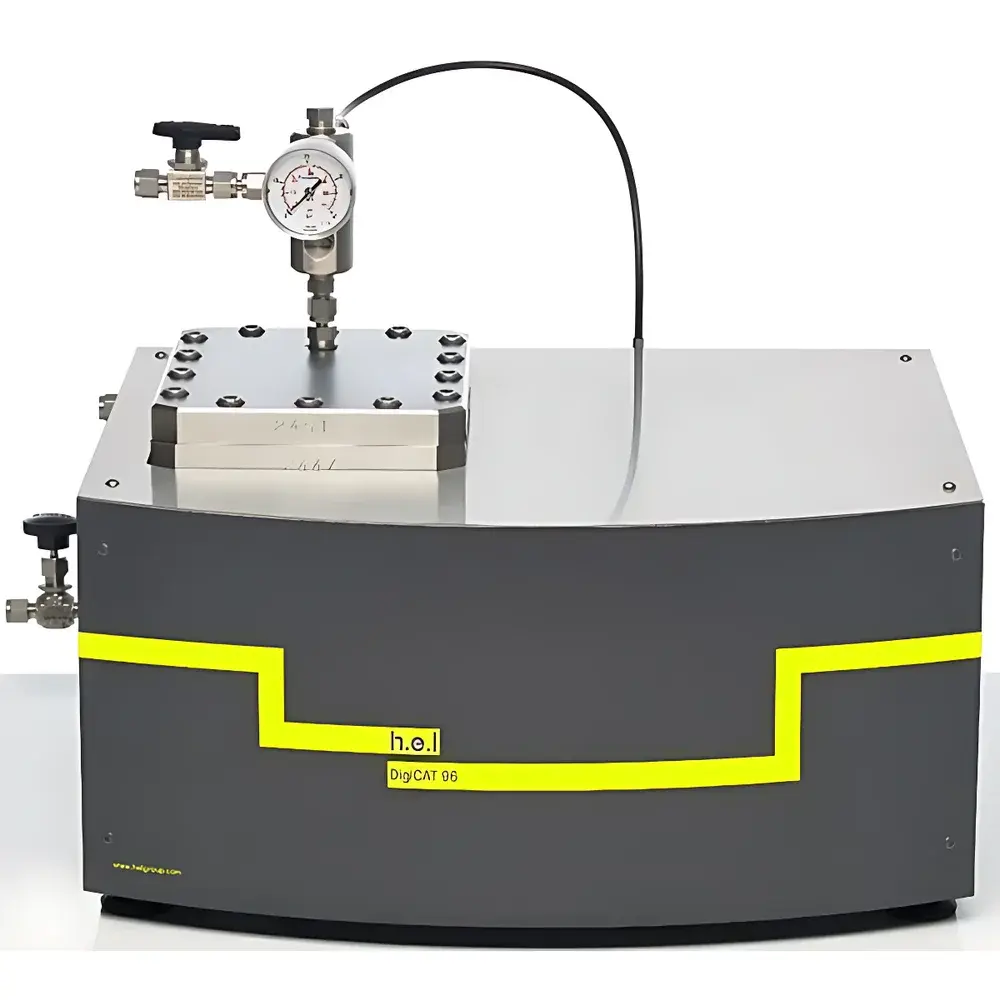
HEL DigiCAT 96 High-Throughput Automated High-Pressure Catalyst Screening Platform
| Brand | HEL |
|---|---|
| Origin | UK |
| Model | DigiCAT 96 |
| Max. Reaction Pressure | 100 bar |
| Max. Reaction Temperature | 200 °C |
| Catalyst Loading Volume | 1 mL per vial |
| Throughput | 96 parallel reactors |
| Heating Block Material | Aluminum |
| Stirring | Synchronized magnetic stirring per vial |
| Safety Valve Setpoint | ~35 bar (standard configuration) |
| Dimensions (W×D×H) | 350 × 300 × 400 mm |
| Pressure Vessel Dimensions | 125 × 85 × 60 mm |
| Control Interface | PC-connected software with real-time monitoring and automated sequence programming |
| Actuation | Solenoid feed & vent valves |
| Temperature Control | PID-regulated, sensor-integrated aluminum heating block |
| Compliance | Designed to meet CE marking requirements for laboratory pressure equipment (PED 2014/68/EU applicable to < 200 bar systems under Category I) |
Overview
The HEL DigiCAT 96 is a precision-engineered high-throughput automated catalyst screening platform designed for early-stage heterogeneous and homogeneous catalyst development under controlled high-pressure and elevated-temperature conditions. It operates on the principle of parallel batch reaction kinetics, enabling statistically robust comparative evaluation of up to 96 discrete catalytic formulations simultaneously—each within individual 1 mL HPLC vials—under rigorously matched thermobaric conditions. Unlike conventional single-reactor systems, the DigiCAT 96 ensures uniform thermal coupling via a monolithic aluminum heating block mounted directly beneath the reactor array, while synchronized magnetic stirring across all positions eliminates inter-vial shear variability—a critical factor in kinetic reproducibility for gas–liquid–solid triphasic reactions common in hydrogenation, oxidation, and CO₂ hydrogenation studies. The system supports operation up to 100 bar and 200 °C, with standard safety architecture compliant with EU Pressure Equipment Directive (PED 2014/68/EU) Category I classification for low-risk pressure apparatus.
Key Features
- 96-position parallel reactor configuration using standard 1 mL HPLC vials—enabling direct compatibility with downstream analytical workflows (e.g., GC, HPLC, NMR sample handling)
- Uniform temperature distribution across all reactors achieved via integrated PID-controlled aluminum heating block with embedded Pt100 sensors and active thermal feedback
- Synchronized magnetic stirring for each vial, driven by a single motor-coupled magnetic drive assembly—ensuring identical rotational dynamics without mechanical cross-talk
- Automated pressure management with solenoid-controlled feed and vent valves, programmable via PC interface for multi-step pressurization/depressurization sequences
- Real-time digital monitoring of temperature and pressure per experimental run, with configurable alarm thresholds and automatic shutdown protocols
- Modular safety design including a certified pressure relief valve set at ~35 bar (standard), with optional upgrade paths for full 100 bar-rated vessel configurations
Sample Compatibility & Compliance
The DigiCAT 96 accommodates standard 12 × 32 mm crimp-top or screw-cap HPLC vials, supporting both sealed and septum-pierced configurations for inert gas purging or continuous gas introduction. Catalyst loading is performed manually prior to sealing, with typical loadings ranging from 1–50 mg depending on catalyst density and reaction stoichiometry. The platform is compatible with common catalytic substrates including aryl halides, alkenes, carbonyls, and gaseous reagents (H₂, CO, O₂, syngas). All wetted components are constructed from chemically resistant stainless steel (316 SS) and PTFE-lined seals. The system conforms to CE marking requirements under the Machinery Directive 2006/42/EC and PED 2014/68/EU for laboratory-scale pressure equipment. While not intrinsically rated for ATEX environments, it may be deployed in ISO Class 7 or better fume hoods when handling flammable gases.
Software & Data Management
Control and data acquisition are managed through HEL’s proprietary DigiCAT Control Software, running on Windows-based PCs via USB or Ethernet connection. The software provides scriptable method templates for temperature ramps, pressure holds, gas dosing sequences, and timed sampling triggers. All process parameters—including timestamped temperature, pressure, valve status, and heating power—are logged at user-defined intervals (default: 1 Hz) into encrypted CSV and SQLite databases. Audit trails comply with ALCOA+ principles, supporting GLP-compliant documentation. Optional integration with LIMS platforms is available via HL7 or REST API extensions. Data export supports direct import into MATLAB, Python (pandas), and JMP for multivariate kinetic analysis and DoE modeling.
Applications
- Rapid ranking of transition-metal complexes (e.g., Pd, Ni, Ru, Ir) in cross-coupling reactions under industrially relevant H₂ pressures
- Structure–activity relationship (SAR) mapping for supported metal nanoparticles (e.g., Pd/C, Pt/Al₂O₃) in selective hydrogenations
- Thermal stability assessment of organocatalysts under prolonged 150–200 °C operation
- Gas–solid–liquid reaction optimization for electrocatalyst precursors (e.g., CO₂-to-methanol screening)
- Accelerated deactivation studies via repeated cycling under fixed T/P conditions
- Support for QbD (Quality by Design) workflows in pharmaceutical process R&D where catalyst selection impacts impurity profiles
FAQ
What is the maximum allowable working pressure for the standard DigiCAT 96 configuration?
The base system includes a safety relief valve preset at ~35 bar; however, the reactor manifold and vial holders are mechanically rated for continuous operation up to 100 bar. Custom pressure-rated vessels and enhanced sealing kits are available upon request.
Can the system perform sequential gas addition (e.g., H₂ followed by CO) across different wells?
Yes—via programmable solenoid valve sequencing in the software, users can define independent gas delivery timelines per group of wells, enabling combinatorial gas-phase reaction design.
Is calibration traceable to national standards?
Temperature sensors are factory-calibrated against NIST-traceable references; pressure transducers are supplied with UKAS-accredited calibration certificates (optional add-on).
Does the platform support unattended overnight operation?
Yes—integrated hardware watchdog timers, redundant thermal cutoffs, and automatic emergency venting ensure safe extended runs. Full logging enables post-run forensic analysis of any deviation.
How is stirring speed controlled and verified?
Stirring is mechanically synchronized and non-variable; speed is fixed at an empirically optimized rate (~600 rpm) to ensure turbulent mixing in 1 mL volumes without vortexing or splashing—no user adjustment is provided, ensuring inter-run consistency.



