
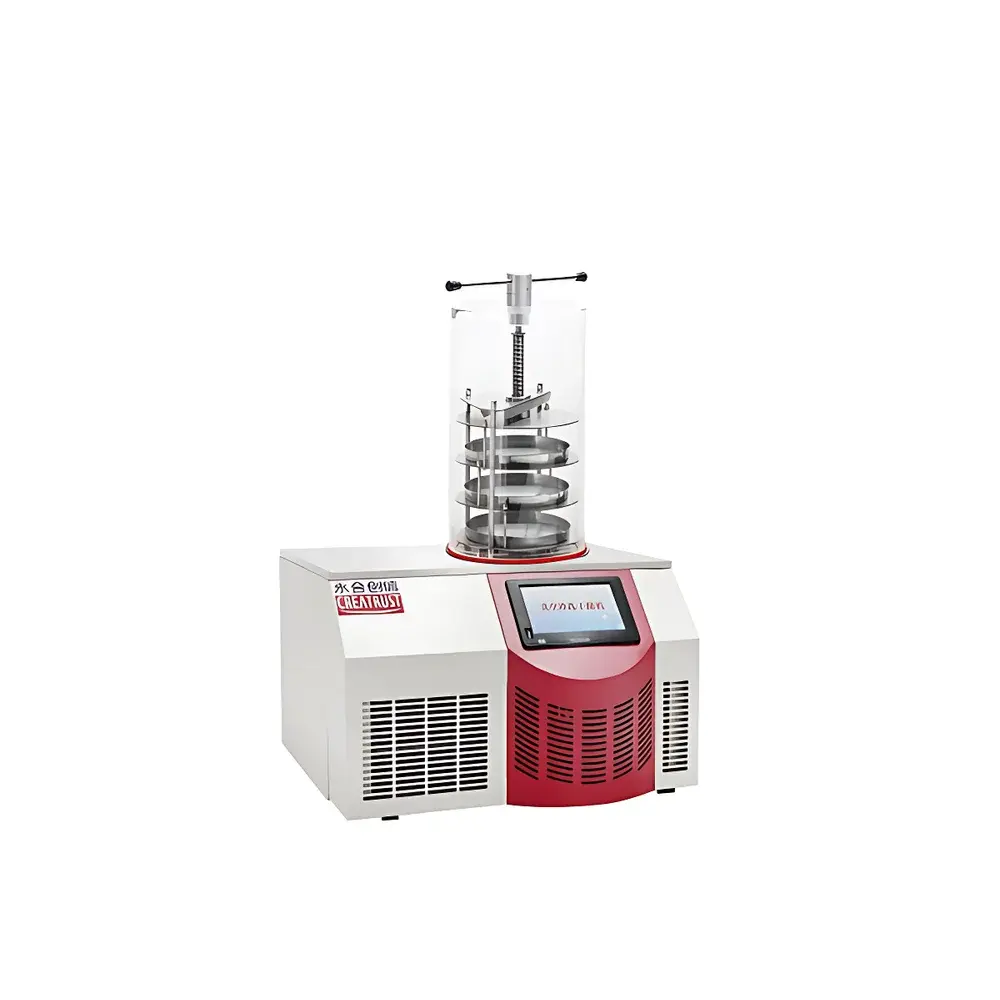
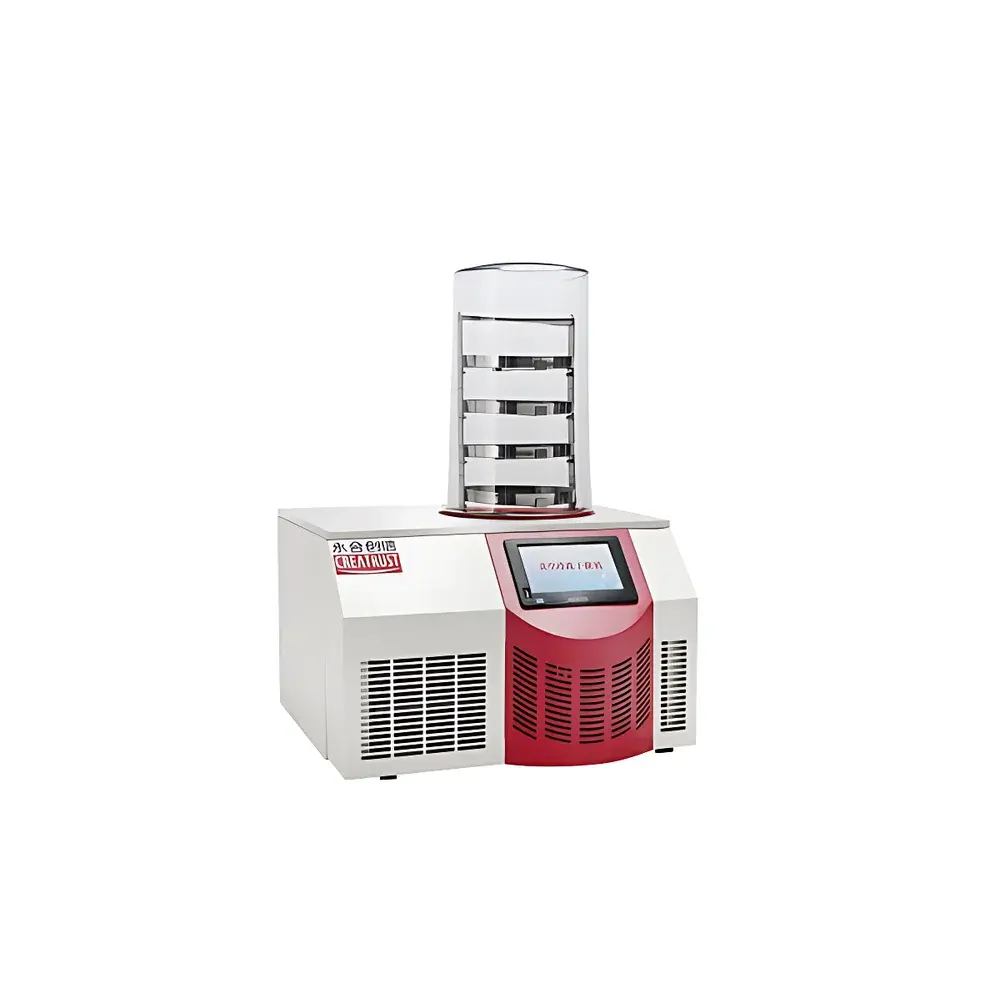
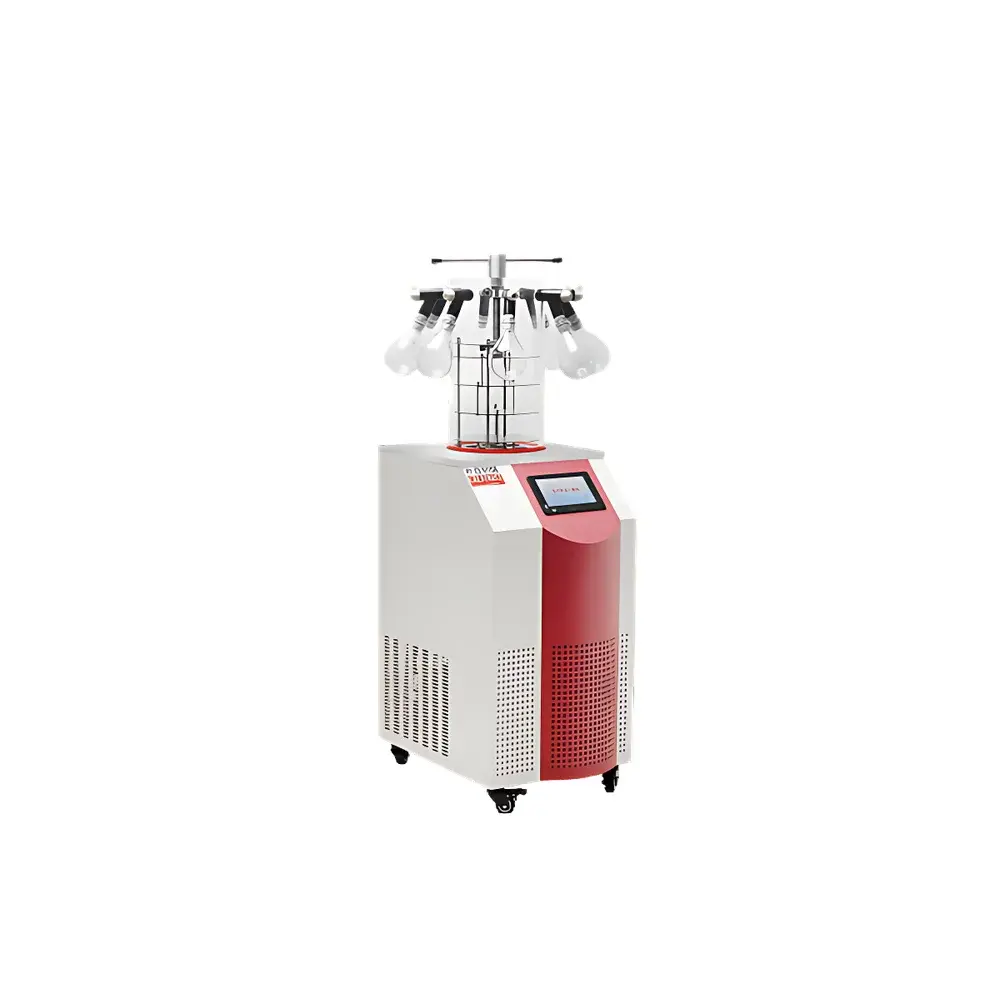
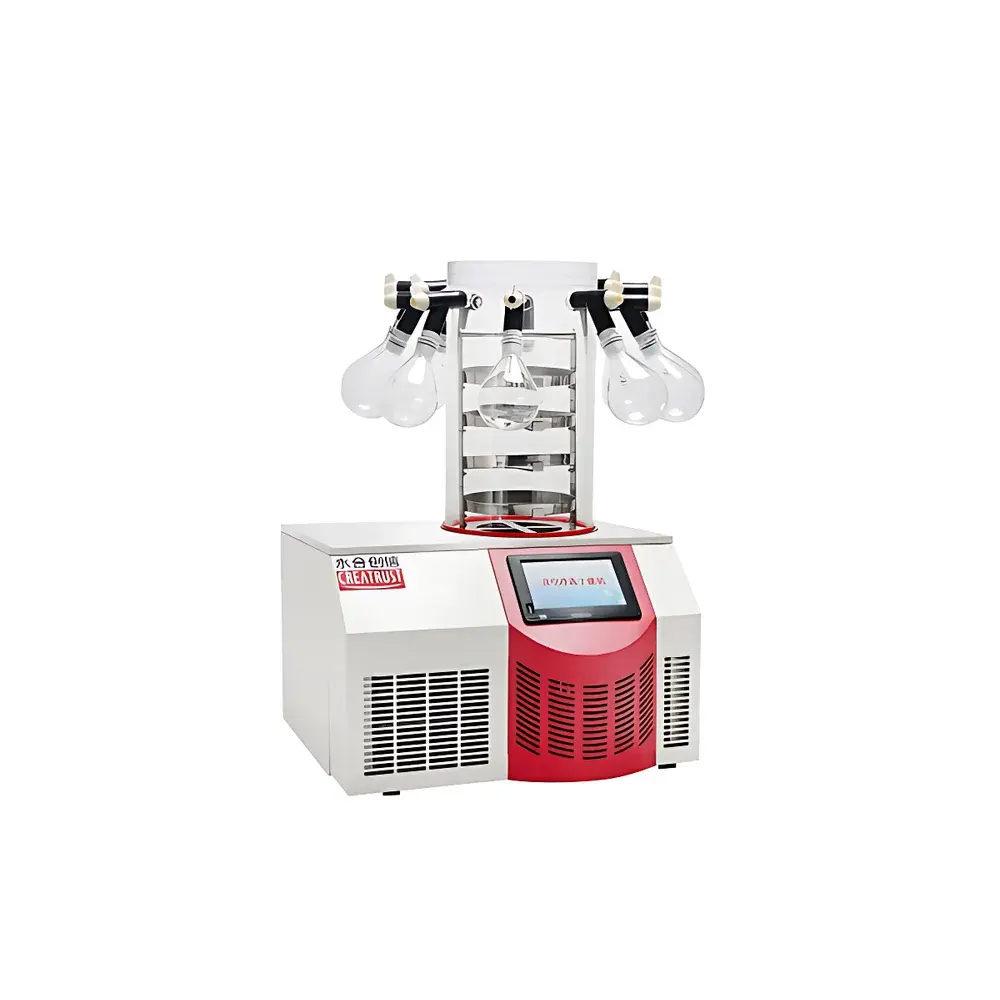
CREATRUST CTFD-10 Series Laboratory Benchtop Freeze Dryer
| Brand | CREATRUST |
|---|---|
| Origin | Shandong, China |
| Manufacturer Type | Authorized Distributor |
| Country of Origin | China |
| Model | CTFD-10 Series |
| Application Scope | Pilot-Scale R&D |
| Shelf Area | 0.09 m² (CTFD-10P/10PT) / 0.12 m² (CTFD-10S/10T) |
| Ultimate Vacuum | <10 Pa |
| Condenser Capacity | 3 kg/24 h |
| Condenser Temperature | ≤−60 °C |
| Dimensions (W×D×H) | 582×541×374 mm (standard) / 684 mm (with manifold) |
| Max. Sample Volume (vials, 12 mm φ) | 920 mL (CTFD-10P) or 690 mL (CTFD-10PT) |
| Shelf Heating | Optional electric shelf heating (for process optimization) |
| Defrost | Electric condenser defrost (optional) |
| Display | 7-inch color TFT touchscreen with real-time curve + numeric display of shelf temp, condenser temp, and chamber pressure |
| Data Logging | USB interface for exportable CSV logs with timestamped temperature/pressure history |
Overview
The CREATRUST CTFD-10 Series is a benchtop laboratory freeze dryer engineered for reproducible, scalable lyophilization in research, quality control, and pilot-scale development environments. Based on the fundamental principles of sublimation under high vacuum and controlled thermal input, this system removes water from thermolabile samples—such as proteins, vaccines, probiotics, and diagnostic reagents—while preserving structural integrity, biological activity, and long-term stability. Designed for compact installation in standard biosafety cabinets or lab benches, the CTFD-10 accommodates diverse sample formats including vials, flasks, and bulk trays. Its modular configuration—offering Standard (S), Manifold (P), Stoppering (T), and Manifold+Stoppering (PT) variants—enables seamless transition from analytical method development to early-stage process qualification.
Key Features
- High-efficiency dual-stage refrigeration system featuring imported hermetic compressors, achieving ≤−60 °C condenser temperature and stable sub-10 Pa vacuum performance across extended cycles.
- 7-inch capacitive touchscreen interface with synchronized graphical curves and numeric readouts for shelf temperature, condenser temperature, and chamber pressure—enabling real-time monitoring and intuitive parameter adjustment.
- USB data logging capability supports GLP-compliant record retention: time-stamped datasets (temperature, pressure, duration) are exportable as CSV files for audit-ready documentation and trend analysis.
- Optional electric shelf heating (±0.5 °C accuracy) allows precise control of primary drying rates and facilitates empirical optimization of critical process parameters—including shelf ramp profiles and hold durations—for future scale-up.
- Electric condenser defrost function minimizes downtime between batches; optional inert gas backfill valve (N₂ or Ar) enables oxygen-sensitive sample handling and prevents oxidation during chamber venting.
- Robust stainless-steel chamber construction (electropolished interior), validated leak rate <1×10⁻³ Pa·m³/s, compliant with ISO 20514:2021 for lyophilizer integrity testing.
Sample Compatibility & Compliance
The CTFD-10 series supports lyophilization of aqueous-based biologics, pharmaceutical intermediates, food matrices, and clinical specimens. Vial compatibility spans 12–22 mm diameters (up to 920 mL total fill volume in manifold mode), while tray configurations accommodate up to 0.12 m² uniform loading area (CTFD-10S/T). All variants meet ICH Q5C stability guidelines for protein formulation drying and align with USP requirements for sterile product lyophilization validation support. System architecture permits integration into FDA 21 CFR Part 11–compliant workflows when paired with validated third-party electronic lab notebook (ELN) platforms. Documentation packages include Factory Acceptance Test (FAT) reports, IQ/OQ templates, and material certifications per ASTM F838-22 (bacterial retention testing for sterilizing filters used in ancillary vacuum lines).
Software & Data Management
No proprietary software installation is required—the embedded controller manages all cycle execution, alarm logic, and data capture autonomously. Historical records are stored onboard and retrievable via USB mass storage mode. Each log entry includes UTC timestamp, sensor ID, raw analog-to-digital conversion values, and user-defined batch identifiers. Exported CSV files conform to ASTM E2500-22 Annex A2 metadata standards, ensuring interoperability with LIMS and statistical process control (SPC) tools. Audit trails are retained for ≥12 months; manual deletion requires administrator-level credentials and generates immutable log entries per ALCOA+ principles.
Applications
- Vaccine development: Stabilization of live-attenuated strains (e.g., BCG, measles, influenza) and recombinant subunit antigens.
- Biopharmaceutical QC: Residual moisture analysis support, reference standard preservation, and excipient compatibility screening.
- Clinical biobanking: Long-term cryopreservation of serum, plasma, tissue explants (cornea, skin, vascular grafts), and cell suspensions without cryoprotectant-induced artifacts.
- Food science R&D: Encapsulation of probiotics, enzymatic extracts, and natural pigments while retaining functional activity and sensory profile.
- Academic research: Method development for novel formulations (amorphous dispersions, lipid nanoparticles) where thermal degradation must be avoided during drying.
FAQ
What vacuum level is required for effective primary drying of most biologics?
Typical primary drying occurs at 1–10 Pa; the CTFD-10 achieves <10 Pa consistently using its dual-stage oil-lubricated rotary vane pump (pump not included but compatible with Edwards RV8 or similar ISO-KF 25 systems).
Can shelf temperature be programmed independently of condenser operation?
Yes—electric shelf heating (optional) operates independently of condenser cooling, enabling precise control of heat flux during both freezing and drying phases.
Is the system suitable for GMP-regulated environments?
While the base unit is designed for R&D use, it supports GMP alignment through optional IQ/OQ documentation, 21 CFR Part 11–ready data export, and traceable calibration certificates for integrated sensors.
How is condenser frost removal handled between runs?
Electric condenser defrost (optional) melts accumulated ice within 30 minutes without requiring chamber venting or manual intervention—reducing cross-contamination risk and improving throughput.
What vial sizes are supported in manifold mode?
Standard configurations accept 12 mm, 16 mm, and 22 mm diameter glass vials; custom adapters for 8 mm or screw-thread formats are available upon request.



