
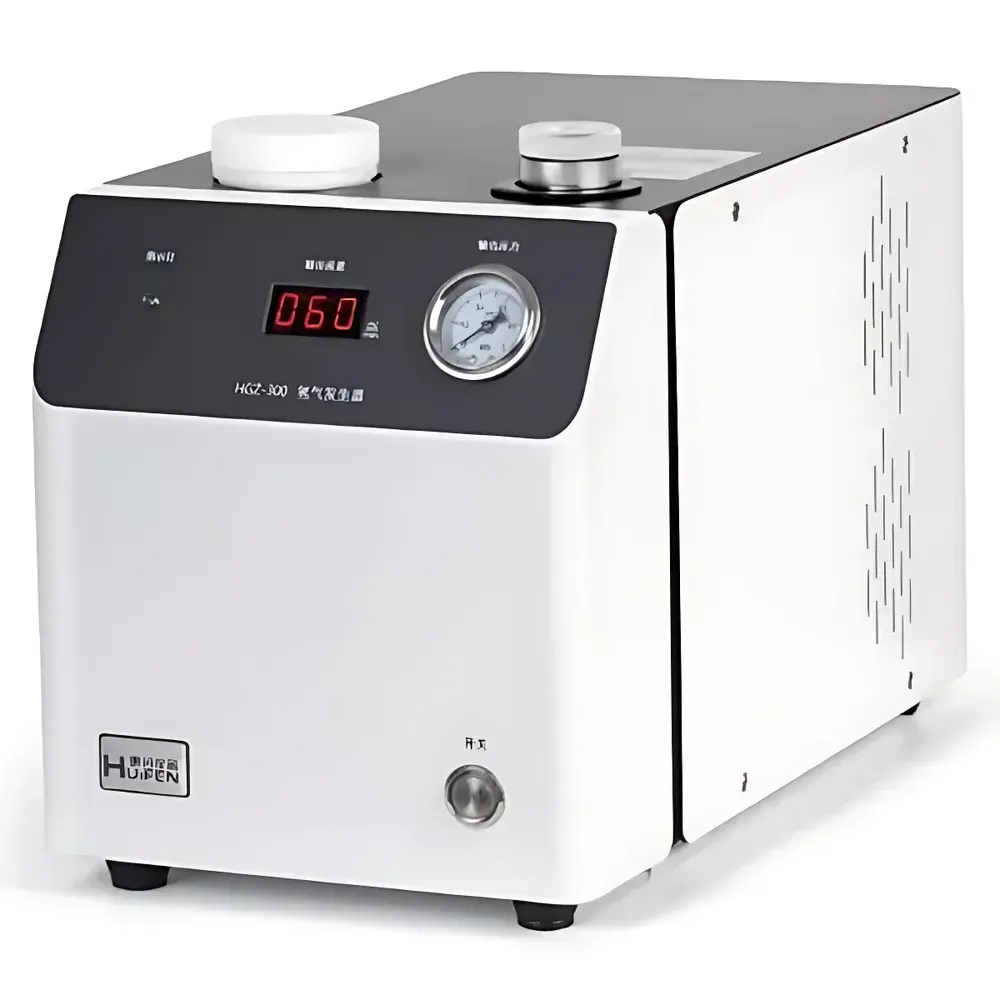
Huifen Instruments HGZ-300 Hydrogen Generator
| Brand | Huifen Instruments |
|---|---|
| Origin | Shandong, China |
| Manufacturer Type | Authorized Distributor |
| Country of Origin | China |
| Model | HGZ-300 |
| Output Flow Rate | 0–300 mL/min |
| Output Pressure | 0.4 MPa (≈58 psi, adjustable up to 116 psi per configuration) |
| Hydrogen Purity | ≥99.999% (v/v, O₂-equivalent residual) |
| Power Consumption | 100–150 W (typical operating range) |
| Input Voltage | 220 V AC, 50 Hz |
| Operating Temperature | 0–40 °C |
| Relative Humidity | <85% RH (non-condensing) |
| Dimensions (L×W×H) | 370 × 180 × 360 mm |
| Weight | 12 kg |
Overview
The Huifen Instruments HGZ-300 Hydrogen Generator is a compact, membrane-based electrolytic hydrogen source engineered for continuous, on-demand supply of high-purity hydrogen gas in analytical laboratory environments. It employs proton exchange membrane (PEM) electrolysis technology—distinct from alkaline or solid polymer electrolyte systems—to dissociate deionized water into hydrogen and oxygen with high current efficiency and minimal thermal load. The integrated design combines water reservoir, electrolysis cell, gas–liquid separation chamber, and pressure-regulated output in a single sealed unit, eliminating the need for external gas cylinders or compressed gas infrastructure. This architecture ensures stable pressure delivery across variable flow demands typical in gas chromatography (GC) carrier gas applications, fuel cell testing, and catalytic reaction studies. Unlike batch-generation systems, the HGZ-300 operates continuously under feedback-controlled current regulation, maintaining consistent purity and pressure without manual intervention beyond periodic deionized water replenishment.
Key Features
- Proton exchange membrane (PEM) electrolysis core delivering ≥99.999% v/v hydrogen purity (O₂-equivalent residual ≤1 ppm), compliant with ASTM D7165 and ISO 8573-1 Class 1 requirements for instrumental gas supply
- Digitally monitored output: LED display shows real-time flow rate (0–300 mL/min) and system pressure (adjustable 0.4–0.8 MPa / 58–116 psi)
- Low-temperature operation: Electrolysis cell maintained below 45 °C during sustained operation, extending membrane lifetime and reducing thermal drift in downstream instrumentation
- Integrated anti-backflow protection: Non-return valve and hydrophobic gas diffusion layer prevent liquid carryover into connected equipment—critical for GC injectors and detectors
- Modular reservoir design: 1.2 L capacity enables >72 hours of uninterrupted operation at 200 mL/min; refill requires only ASTM Type I deionized water (resistivity ≥18.2 MΩ·cm)
- Energy-efficient architecture: Nominal power draw of 100–150 W at rated output, optimized for 220 V / 50 Hz mains supply with built-in overcurrent and overtemperature protection
Sample Compatibility & Compliance
The HGZ-300 is designed for direct integration with gas chromatographs (including Agilent, Thermo Fisher, Shimadzu, and PerkinElmer platforms), hydrogen flame ionization detectors (FID), and laboratory-scale fuel cell test stations. Its output meets ISO 8573-1:2010 Class 1 specifications for particulate, moisture, and oil content when used with recommended inline filtration (e.g., 0.1 µm particulate + molecular sieve trap). The unit complies with IEC 61010-1:2012 safety standards for electrical equipment for measurement, control, and laboratory use. While not certified to UL/CSA or ATEX standards, its low-pressure operation (<0.8 MPa) and sealed electrolyte path satisfy general laboratory risk assessments per ISO/IEC 17025:2017 Annex A.2 for auxiliary gas supply integrity.
Software & Data Management
The HGZ-300 operates as a standalone analog device with no embedded firmware or digital communication interface. All operational parameters—including flow, pressure, and status—are conveyed via front-panel LED indicators and mechanical pressure gauges. For laboratories requiring auditability, optional third-party data loggers (e.g., Omega OM-DAQPRO-5300) may be connected to the analog pressure transducer output (0–5 V DC) to record time-stamped operational history. No proprietary software is required, ensuring compatibility with GLP/GMP workflows where validated, vendor-neutral data acquisition is mandated. The absence of network connectivity eliminates cybersecurity concerns associated with IoT-enabled gas generators.
Applications
- Carrier gas for capillary GC and GC–MS systems requiring ultra-high-purity hydrogen (replacing cylinder-based supply)
- Fuel gas for hydrogen FID detectors, enabling improved sensitivity and reduced baseline noise versus helium or nitrogen alternatives
- Reducing atmosphere generation in small-volume reactors for catalyst activation and surface science experiments
- Calibration gas blending support—used as primary component in dynamic dilution systems for trace H₂ standard preparation
- On-site hydrogen supply for portable fuel cell demonstrators and electrochemical impedance spectroscopy (EIS) test benches
FAQ
What type of water must be used to replenish the reservoir?
Only ASTM Type I deionized water (resistivity ≥18.2 MΩ·cm, total organic carbon <5 ppb) is acceptable. Tap water, distilled water, or reverse-osmosis-only water will cause rapid membrane fouling and irreversible performance degradation.
Can the HGZ-300 be operated intermittently without affecting longevity?
Yes—the PEM stack and control circuitry are rated for cyclic operation (ON/OFF >10,000 cycles). However, full shutdown is recommended if idle for >7 days to minimize membrane hydration loss.
Is external cooling required?
No. The unit relies on passive convection and internal heat-sink design; ambient airflow of ≥0.2 m/s around the rear vent grille is sufficient for thermal management at maximum output.
Does the generator require annual calibration or certification?
No scheduled calibration is specified by the manufacturer. Users performing ISO/IEC 17025-compliant analyses should validate output purity and flow accuracy annually using traceable reference standards (e.g., NIST SRM 2629 for H₂ purity, certified flow calibrators per ISO 6145-1).



