
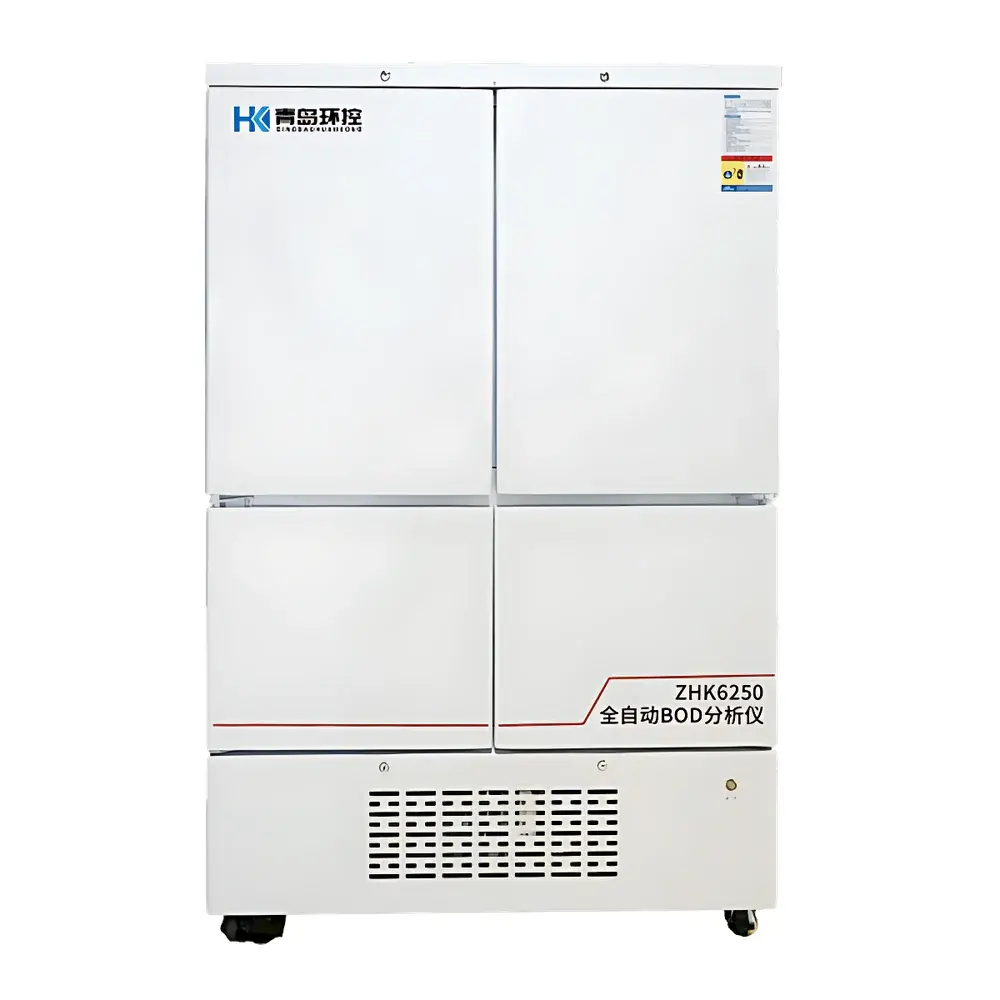
HUANKONG ZHK6250 Automated BOD₅ Analyzer (Microbial Electrode Method)
| Brand | HUANKONG |
|---|---|
| Origin | Shandong, China |
| Manufacturer Type | Direct Manufacturer |
| Product Category | Domestic |
| Model | ZHK6250 |
| Instrument Type | Laboratory BOD Analyzer |
| Principle | Microbial Electrode Method |
| Measurement Range | 2–6000 mg/L |
| Detection Limit | Compliant with HJ 505–2009 |
| Accuracy | ±1% (for samples >20 mg/L) |
| Repeatability | Compliant with HJ 505–2009 |
| Sample Capacity | 132 incubation positions, 60 measurement positions |
| Temperature Control | Dual-zone thermostatic system, maintained at 20.0 ± 0.5 °C |
| Electrode | YSI-type electrochemical dissolved oxygen sensor (optional luminescent DO probe) |
| Calibration | Fully automated zero/span and slope calibration |
| Cleaning | Spray-type electrode and sample vial cleaning system |
| Compliance | Designed and validated per HJ 505–2009, aligned with ISO 5815-1:2016 (BOD determination by microbial electrode method) |
Overview
The HUANKONG ZHK6250 Automated BOD₅ Analyzer is a laboratory-grade instrument engineered for precise, high-throughput determination of five-day biochemical oxygen demand (BOD₅) in surface water, domestic wastewater, and industrial effluents. It implements the microbial electrode method — a rapid, electrochemical alternative to the conventional dilution and incubation technique described in HJ 505–2009 and ISO 5815-1:2016. Unlike standard Winkler titration or manometric respirometry, this method relies on a biofilm-immobilized microorganism layer integrated with a Clark-type dissolved oxygen (DO) electrode. As microorganisms metabolize biodegradable organic matter in the sample, oxygen consumption is detected in real time via the electrode’s current response, enabling direct, continuous BOD estimation without manual endpoint reading. The system eliminates subjective interpretation, reduces analyst intervention, and delivers results within hours rather than days — while maintaining full traceability to the classical 5-day incubation paradigm.
Key Features
- Integrated dual-zone temperature control system: Two independent PID-regulated thermostatic chambers maintain stable 20.0 ± 0.5 °C incubation conditions across all sample positions — critical for reproducible BOD₅ assessment per regulatory requirements.
- Automated reagent handling: High-precision syringe pumps dispense dilution water, seed solution, and buffer with ≤0.5% volumetric error; all fluid paths are chemically resistant (PTFE, PEEK) and pressure-monitored for occlusion detection.
- 132-position incubation carousel with 60 concurrent measurement slots: Supports staggered batch processing, mid-run sample addition, and offline incubation — ideal for environmental testing labs operating under ISO/IEC 17025 or EPA-compliant QA/QC protocols.
- YSI-compatible electrochemical DO sensor with automatic thermal, barometric, and salinity compensation: Optional luminescent DO probe available for extended service life and reduced maintenance frequency.
- Self-cleaning architecture: Integrated spray-nozzle system cleans electrodes and vial interiors between runs using deionized water or configurable rinse solution — preventing carryover and cross-contamination in multi-matrix workflows.
- Comprehensive fault diagnostics: Real-time monitoring of lid actuation, robotic arm positioning, valve sequencing, temperature sensor redundancy (dual RTD), and reagent volume thresholds — all logged with timestamps for GLP audit trails.
Sample Compatibility & Compliance
The ZHK6250 accommodates undiluted, diluted, seeded, and inoculated samples per HJ 505–2009 Annex A methodologies. It supports non-dilution, dilution-only, seeding-only, and combined dilution/seeding modes — automatically selecting appropriate algorithms based on user-defined sample classification. All measurements comply with the kinetic validity criteria defined in ISO 5815-1:2016 (e.g., linear response phase ≥4 h, residual DO ≥2 mg/L). The instrument’s firmware embeds mandatory quality checks: blank drift verification, electrode response stability validation (>95% signal recovery after calibration), and incubation time logging synchronized to NIST-traceable RTC. Data output conforms to ASTM D5210–18 metadata standards, including sample ID, operator ID, instrument serial number, environmental chamber log, and raw sensor current profiles.
Software & Data Management
The embedded Windows-based workstation software provides role-based access control (admin/operator/viewer), electronic signature support, and 21 CFR Part 11–compliant audit logging — recording every parameter change, calibration event, and report generation with immutable timestamps and user attribution. Raw sensor data (nA vs. time), calculated BOD curves, and QC flag annotations are stored in vendor-neutral CSV and PDF/A-2 formats. Remote monitoring and control are enabled via TLS-secured web interface or optional MQTT integration with LIMS platforms (e.g., LabWare, STARLIMS). All reports include uncertainty estimation per GUM (Guide to the Expression of Uncertainty in Measurement) principles, referencing accuracy specifications (±1% for >20 mg/L) and documented repeatability performance.
Applications
The ZHK6250 serves municipal wastewater treatment plants for daily influent/effluent BOD monitoring; environmental consultancies performing NPDES permit compliance testing; industrial facilities conducting pre-discharge verification per local discharge regulations; and academic laboratories studying biodegradation kinetics of emerging contaminants (e.g., pharmaceuticals, surfactants). Its ability to process heterogeneous sample types — from low-BOD drinking water sources (5000 mg/L) — makes it suitable for method validation studies, interlaboratory comparisons, and reference material certification workflows.
FAQ
Does the ZHK6250 replace the standard 5-day incubation method?
No — it implements an accelerated microbial electrode method validated against HJ 505–2009 and ISO 5815-1:2016. Correlation studies must be performed for each lab’s matrix prior to routine adoption.
Can the system operate unattended overnight?
Yes — fully automated sequences (including incubation, measurement, cleaning, and shutdown) are schedulable via the software; safety interlocks prevent operation during door-open or thermal fault conditions.
Is third-party calibration verification supported?
Yes — the instrument exports raw sensor current logs and intermediate calculation steps, enabling independent reprocessing and uncertainty propagation analysis.
What maintenance intervals are recommended for the DO electrode?
Electrode membrane replacement every 6 months (or after 500 assays); electrolyte refill every 3 months; full calibration verification required before each analytical batch.
How is data integrity ensured during power interruption?
Non-volatile memory retains method parameters, calibration history, and active run states; upon restart, the system resumes from last valid checkpoint without data loss.







