
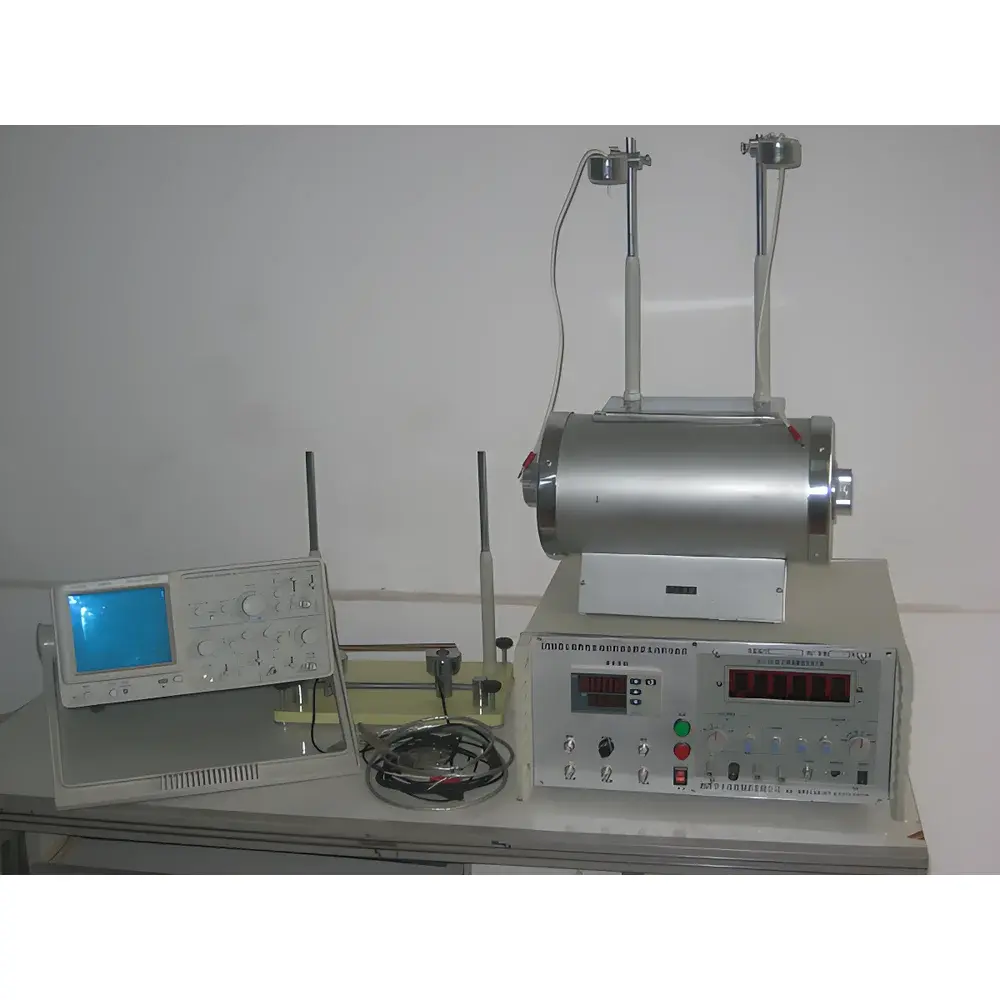
Dynamic Elastic Modulus and Damping Internal Friction Analyzer DTM-II
| Origin | Hunan, China |
|---|---|
| Manufacturer Type | Authorized Distributor |
| Origin Category | Domestic (PRC) |
| Model | DTM-II |
| Price | USD 7,000 (FOB) |
| Frequency Range | 100–20 kHz |
| Frequency Resolution | 1 Hz |
| Frequency Accuracy | ±0.5% |
| Dynamic Elastic Modulus Range | Corresponding to measured resonance frequency |
| Modulus Resolution | 0.05 GPa |
| Modulus Accuracy | ±0.1 GPa |
| System Relative Error | ±0.15% |
| Damping/Internal Friction (Q⁻¹) | 1×10⁻⁵ to 0.1 |
| Test Temperature | Ambient to 1750 °C |
| Shear Modulus Measurement | Yes |
| Poisson’s Ratio Calculation | Yes |
| Data Interface | RS-232/USB (optional) |
| Display Modes | Resonance Frequency, Dynamic Elastic Modulus, Spectral Plot, Damping Index |
Overview
The Dynamic Elastic Modulus and Damping Internal Friction Analyzer DTM-II is a precision instrument engineered for non-destructive mechanical characterization of solid materials using the resonant vibration method. It operates on the fundamental principle of free-free or supported-bar resonance, where a specimen—typically a rectangular bar, cylinder, or disk—is excited acoustically or electromagnetically, and its natural flexural, longitudinal, or torsional resonance frequencies are detected with high spectral fidelity. From these experimentally determined resonance modes, the system calculates dynamic elastic modulus (E), shear modulus (G), Poisson’s ratio (ν), and internal friction (Q⁻¹, also referred to as damping loss factor), all in strict accordance with ASTM E1876–22 (“Standard Test Method for Dynamic Young’s Modulus, Shear Modulus, and Poisson’s Ratio by Impulse Excitation of Vibration”) and ISO 12680–1:2015 (“Refractory products — Determination of dynamic Young’s modulus, shear modulus and Poisson’s ratio by impulse excitation of vibration”). The DTM-II supports both ambient and high-temperature testing up to 1750 °C, enabling thermomechanical property tracking across phase transitions, sintering cycles, or thermal aging protocols.
Key Features
- Non-contact or low-force excitation architecture minimizing measurement-induced stress and preserving sample integrity
- Dual-frequency measurement capability: selectable ranges of 200–5 kHz (standard) and extended 100–20 kHz (high-resolution mode) for fine discrimination of closely spaced resonance peaks
- Real-time spectral analysis with 1 Hz frequency resolution and ±0.5% absolute accuracy, enabling reliable identification of higher-order vibrational modes
- Integrated high-temperature furnace module with programmable ramp/soak profiles and thermocouple feedback (Type S or B), certified for continuous operation at 1750 °C under inert or controlled-atmosphere conditions
- Automated modulus computation engine supporting ASTM E1876-compliant algorithms for E, G, and ν derivation from fundamental and harmonic resonance frequencies
- Quantitative internal friction evaluation via logarithmic decrement or half-power bandwidth methods, yielding Q⁻¹ values from 1×10⁻⁵ to 0.1 with traceable calibration
- Modular sensor interface accommodating piezoelectric accelerometers, laser Doppler vibrometers, or electromagnetic pickups per application requirements
Sample Compatibility & Compliance
The DTM-II accommodates standard geometries defined in GB/T 10700–92, ASTM E1876, and ISO 12680–1: rods (≥3 mm diameter, ≥25 mm length), bars (rectangular cross-sections ≥3×3 mm²), disks (≥10 mm diameter), and irregular sintered compacts with mass ≥2 g. Tested materials include structural metals (Ti-6Al-4V, Inconel 718), oxide and non-oxide ceramics (Al₂O₃, SiC, ZrO₂), carbon-based composites (graphite, C/C), glasses (borosilicate, fused silica), polymers (PEEK, polyimide), and cementitious systems (mortar, refractory castables). All measurement workflows comply with GLP documentation standards; audit trails, user access logs, and electronic signatures are supported when paired with optional compliant software modules aligned with FDA 21 CFR Part 11 requirements.
Software & Data Management
The DTM-II is supplied with proprietary Windows-based acquisition and analysis software featuring real-time FFT spectrum visualization, multi-peak auto-detection, temperature-synchronized data logging, and export to CSV, Excel, or XML formats. Calibration certificates—including frequency reference traceability to NIM (National Institute of Metrology, China) and modulus verification using certified reference standards (e.g., NIST SRM 2822)—are digitally embedded. Raw time-domain waveforms and processed resonance parameters are stored with metadata (operator ID, environmental conditions, furnace setpoint, sample ID), ensuring full data lineage for ISO/IEC 17025-accredited laboratories. Optional API integration enables bidirectional communication with LIMS platforms via TCP/IP or OPC UA.
Applications
- Quality control of sintered ceramic components in aerospace and nuclear applications
- Thermal stability assessment of refractory linings during cyclic heating in metallurgical furnaces
- Microstructural evolution monitoring in metal matrix composites subjected to creep or fatigue
- Viscoelastic transition mapping in high-performance polymers across glass transition (Tg)
- Porosity–stiffness correlation studies in lightweight concrete and foamed ceramics
- Validation of finite element models using experimentally derived E, G, and ν inputs
- Research into anelastic relaxation mechanisms in shape-memory alloys and ferroelectrics
FAQ
What standards does the DTM-II support for dynamic modulus measurement?
ASTM E1876–22, ISO 12680–1:2015, GB/T 10700–92, and DIN 51048–2 are fully implemented in calculation algorithms and reporting templates.
Can the system measure samples under vacuum or reactive atmospheres?
Yes—when integrated with optional sealed high-temperature chambers equipped with gas inlet/outlet ports and pressure monitoring, compatible with Ar, N₂, H₂, or air environments.
Is third-party calibration available?
Yes—factory calibration includes NIM-traceable frequency and temperature verification; annual recalibration services with ISO/IEC 17025-certified reports are offered globally.
Does the software support automated pass/fail evaluation against specification limits?
Yes—user-defined tolerance bands for E, Q⁻¹, or f₀ can trigger visual alerts and generate compliance summary reports per batch or lot.
What sample preparation requirements apply?
Specimens must be geometrically regular, free of surface cracks or machining-induced residual stress, and dimensionally measured to ±0.02 mm prior to testing per ASTM E1876 Section 7.



