
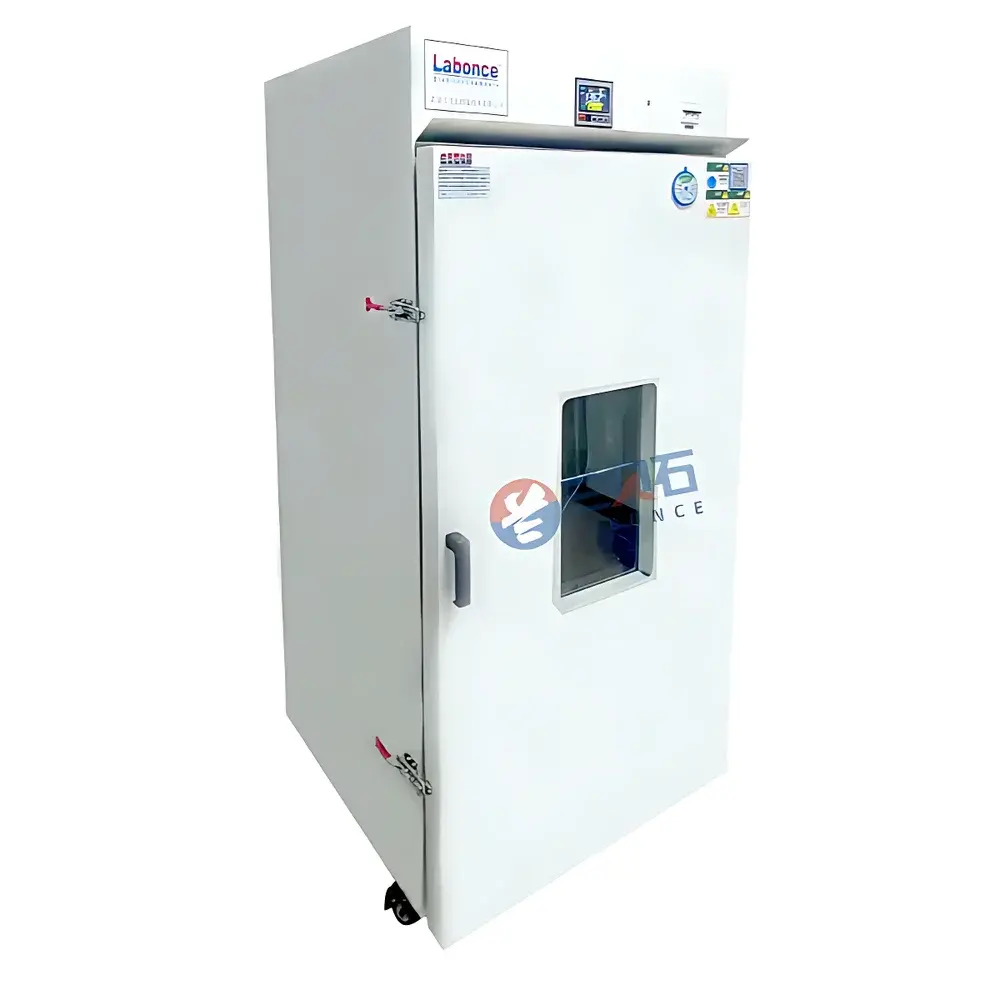
Labonce Labonce-420JM Precision Forced-Air Drying Oven (200 °C)
| Brand | Labonce |
|---|---|
| Model | Labonce-420JM |
| Temperature Range | RT+20 °C to 200 °C |
| Chamber Volume | 420 L |
| Internal Dimensions (W×D×H) | 640 mm × 585 mm × 1355 mm |
| External Dimensions (W×D×H) | 780 mm × 750 mm × 1880 mm |
| Power Supply | AC 380 V ±10%, 50 Hz |
| Heating Power | 3.1 kW |
| Temperature Uniformity | ±3.0 °C (at ≤200 °C) |
| Temperature Fluctuation | ±1.0 °C |
| Standard Shelving | 4 stainless steel shelves (adjustable) |
| Construction | Exterior – powder-coated steel |
| Safety | Independent over-temperature protection circuit |
Overview
The Labonce Labonce-420JM Precision Forced-Air Drying Oven is an industrial-grade, bench- and floor-standing thermal processing instrument engineered for consistent, repeatable heat treatment of samples across research laboratories, quality control facilities, and manufacturing environments. It operates on the principle of forced convection—using a precisely balanced axial fan and optimized air duct architecture to circulate heated air uniformly throughout the chamber. This design ensures minimal thermal stratification and high spatial temperature homogeneity, critical for applications requiring strict adherence to ASTM E145, ISO 17025, and IEC 60068-2-2 (dry heat testing) protocols. With a maximum operating temperature of 200 °C and a spacious 420 L working volume, the Labonce-420JM accommodates large batches or oversized components—such as printed circuit boards, polymer composites, ceramic green bodies, or metal-coated substrates—without compromising thermal fidelity.
Key Features
- Optimized forced-air circulation system with rear-mounted centrifugal blower and multi-directional baffle ducts, delivering <±3.0 °C temperature uniformity across the entire chamber at 200 °C (per internal validation per ISO/IEC 17025 calibration practices)
- Robust dual-layer construction: exterior housing of cold-rolled steel with epoxy-polyester powder coating; interior chamber fabricated from 1.2 mm thick AISI 304 stainless steel for corrosion resistance and easy decontamination
- Digital microprocessor-based temperature controller with LED display, offering real-time setpoint adjustment, ramp-hold programming capability, and auto-tuning PID algorithm for stable thermal regulation
- Dual safety architecture: primary thermostat + independent mechanical over-temperature cut-off (adjustable up to 220 °C), wired in series to interrupt heating power without relying on software logic
- Four (4) standard adjustable stainless steel shelves with reinforced support rails; shelf spacing designed to maintain laminar airflow integrity even at full load
- Energy-efficient insulation: 100 mm thick high-density mineral fiber board (thermal conductivity <0.04 W/m·K), minimizing standby heat loss and reducing operational energy demand
Sample Compatibility & Compliance
The Labonce-420JM supports a broad range of non-volatile, thermally stable sample types—including but not limited to electronic assemblies, pharmaceutical excipients (for residual solvent removal under GMP-aligned drying protocols), metallurgical specimens (for stress-relief annealing), and polymeric test coupons (per ASTM D618 conditioning). Its chamber geometry and airflow profile are validated for compatibility with standard ISO 14644-1 Class 8 cleanroom-compatible accessories (e.g., pass-through ports, HEPA-filtered exhaust adapters). While not certified for hazardous location use (e.g., UL 1203 or ATEX), the unit complies with IEC 61010-1:2010 for electrical safety in laboratory equipment and meets CE marking requirements for EMC (EN 61326-1) and low-voltage directive (2014/35/EU). Documentation includes factory calibration certificate traceable to NIM (National Institute of Metrology, China) standards.
Software & Data Management
The Labonce-420JM operates via embedded firmware without proprietary PC software dependency. However, it features a standard RS-485 communication interface (Modbus RTU protocol) enabling integration into centralized lab management systems (LIMS) or SCADA platforms for remote monitoring, data logging, and audit trail generation. When paired with optional external data loggers (e.g., Omega OM-DAQPRO-5300), users can capture time-stamped temperature profiles compliant with FDA 21 CFR Part 11 requirements—including electronic signatures, user access controls, and immutable record retention. All internal controller events—including door open/close detection, over-temperature alarms, and power interruption recovery—are timestamped and stored in non-volatile memory for GLP/GMP-compliant review.
Applications
- Pre-conditioning of materials prior to tensile, impact, or dielectric testing per ASTM D618 and ISO 291
- Moisture content determination in powders, granules, and bulk solids using gravimetric loss-on-drying methodology (aligned with USP & EP general chapter <731>)
- Stabilization and outgassing of optical components and vacuum-compatible hardware
- Curing of epoxy adhesives, conformal coatings, and solder mask in electronics manufacturing
- Accelerated aging studies of packaging materials and medical device polymers (ISO 11607-1)
- Residual solvent removal from API intermediates under controlled thermal profiles (ICH Q5C)
FAQ
What is the recommended maximum continuous operating temperature?
The Labonce-420JM is rated for continuous operation up to 200 °C. For extended service life and optimal sensor stability, operation above 190 °C is advised only for short-duration processes (<4 hours) with adequate cooling intervals.
Can the oven be used for sterilization or microbiological applications?
No. This unit is not designed for steam sterilization, biological decontamination, or ISO 14644 cleanroom-certified operation. It lacks HEPA filtration, humidity control, and validated lethality cycles required for such applications.
Is third-party calibration support available?
Yes. Labonce provides NIST-traceable calibration services through authorized regional partners. Users may request as-found/as-left reports with uncertainty budgets meeting ILAC-MRA requirements.
How many shelves can be installed simultaneously without affecting airflow performance?
The standard configuration includes four (4) load-bearing shelves. Installing more than four shelves—or using non-standard perforated trays—may disrupt laminar flow patterns and degrade temperature uniformity beyond specification limits.
Does the unit meet requirements for GLP-compliant thermal validation?
Yes. With optional IQ/OQ documentation packages and third-party temperature mapping (per ASTM E2297), the Labonce-420JM supports qualification for GLP-regulated environments when operated within defined process parameters and maintained per scheduled preventive maintenance protocols.



