
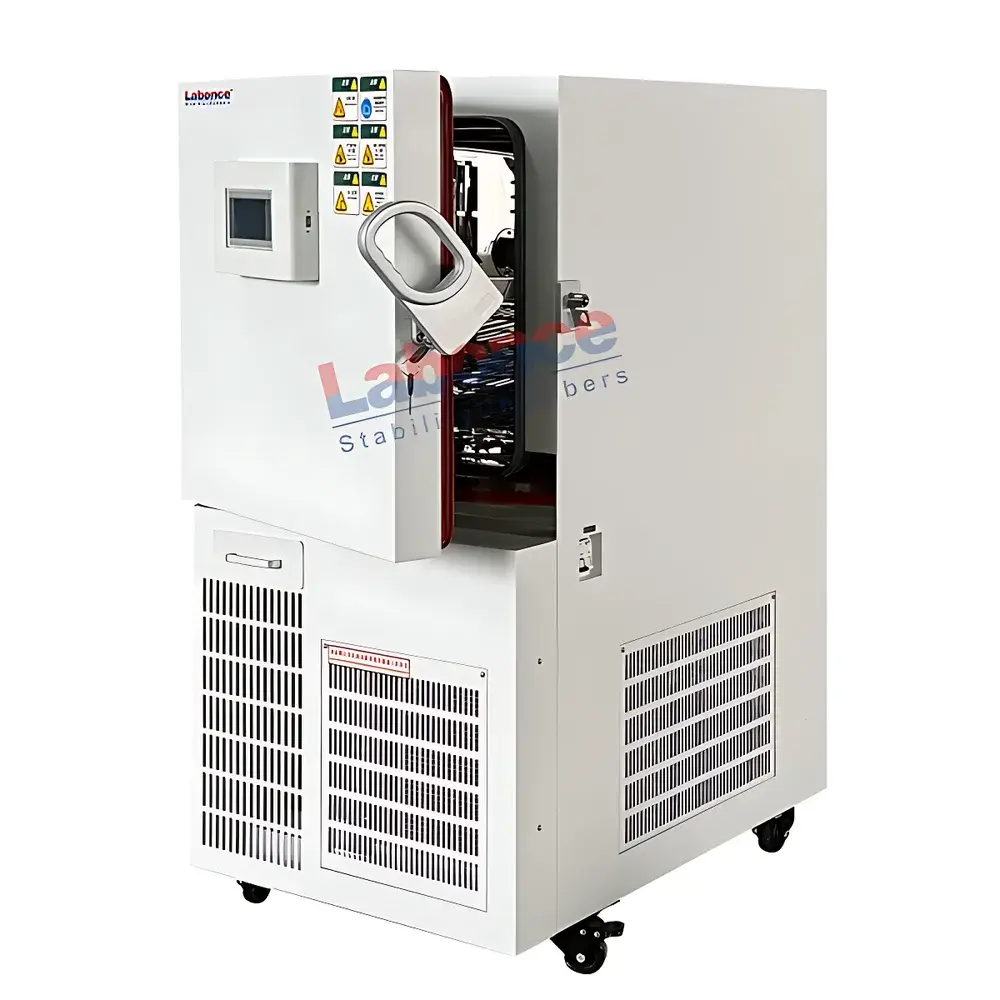
Labonce labonce-250JS High-Low Temperature and Humidity Cycling Chamber
| Brand | Labonce |
|---|---|
| Origin | Beijing, China |
| Manufacturer Type | Direct Manufacturer |
| Model | labonce-250JS |
| Temperature Range | –40 °C to +150 °C (configurable) |
| Humidity Range | 20–98 %RH |
| Internal Volume | 250 L |
| Internal Dimensions (W×D×H) | 650×550×700 mm |
| External Dimensions (W×D×H) | 930×1180×1850 mm |
| Temperature Uniformity | ±2.0 °C |
| Temperature Fluctuation | ±0.5 °C |
| Humidity Accuracy | ±3 %RH (>75 %RH), ±5 %RH (≤75 %RH) |
| Heating Rate | 1–3 °C/min |
| Cooling Rate | 0.7–1 °C/min |
| Control System | Programmable Color Touchscreen Controller with Multi-Step & Constant-Value Modes |
| Data Logging | Internal Electronic Storage with USB Export |
| Safety Protections | Compressor Overheat & High-Pressure Cut-off, Fan Overheat Protection, Independent Over-Temperature Cut-out, Upper/Lower Limit Deviation Alarm |
| Construction | Exterior – Powder-Coated Steel |
| Air Circulation | Optimized Dual-Channel Airflow System |
| Refrigeration | Imported Hermetic Industrial Compressor |
| Optional Accessory | Pin-Type Micro Printer |
| Compliance | GB/T 10592–2008 |
Overview
The Labonce labonce-250JS High-Low Temperature and Humidity Cycling Chamber is an engineered environmental simulation system designed for rigorous reliability validation of electrical, electronic, and electro-mechanical components under controlled thermal and hygrothermal stress conditions. It operates on the principle of forced-air convection combined with precision vapor compression refrigeration and steam-based humidification, enabling stable, repeatable generation of temperature profiles from –40 °C to +150 °C and relative humidity levels between 20 %RH and 98 %RH. The chamber supports both steady-state and dynamic cycling protocols—critical for accelerated life testing, qualification screening per IEC 60068-2 series, and compliance verification against GB/T 10592–2008, the Chinese national standard governing performance requirements for environmental test chambers. Its architecture prioritizes long-term operational stability, minimal thermal gradient deviation across the working volume, and traceable parameter control—key prerequisites for laboratories operating under GLP or ISO/IEC 17025-accredited frameworks.
Key Features
- Optimized dual-channel air circulation system ensures uniform temperature distribution (±2.0 °C deviation across the 250 L work volume) and rapid response during ramp transitions.
- Robust refrigeration subsystem built around a high-efficiency imported hermetic industrial compressor, delivering consistent cooling performance with low acoustic emission (15,000 h).
- AISI 304 stainless steel inner chamber construction resists corrosion from repeated condensation cycles and aggressive test atmospheres, while the powder-coated structural frame provides mechanical durability in industrial lab environments.
- Programmable color touchscreen controller supports up to 99 segments per cycle, with user-defined ramp rates, dwell times, and conditional branching logic—enabling complex profiles such as temperature-humidity cross-coupling sequences per MIL-STD-810H Method 507.6.
- Integrated electronic data logger records timestamped temperature and humidity values at configurable intervals (1–600 s); raw CSV files are exportable via USB interface for post-test statistical analysis and audit trail reconstruction.
- Multi-layer safety architecture includes independent over-temperature cut-out (mechanical backup), compressor high-pressure/overheat protection, fan motor thermal monitoring, and real-time deviation alarms for upper/lower setpoint thresholds.
Sample Compatibility & Compliance
The labonce-250JS accommodates samples up to 650 mm (W) × 550 mm (D) × 700 mm (H), with two standard adjustable stainless steel shelves included. Its sealed internal cavity and non-reactive chamber lining make it suitable for testing PCB assemblies, automotive ECUs, battery modules, optical sensors, polymer enclosures, and medical device housings. The system complies with GB/T 10592–2008 for temperature/humidity uniformity, stability, and recovery time specifications. While not certified to UL or CE for end-product safety, its design principles align with functional safety expectations outlined in IEC 61000-4-27 (environmental testing for EMC immunity support) and supports traceability requirements for FDA-regulated R&D labs performing environmental stress screening per 21 CFR Part 11-compliant data handling when paired with validated software configurations.
Software & Data Management
Data acquisition and control are managed through an embedded Linux-based firmware platform with a 7-inch capacitive touchscreen HMI. The interface supports multi-language operation (English, Simplified Chinese), password-protected parameter editing, and event-triggered logging (e.g., alarm activation, program completion). All recorded datasets include ISO 8601 timestamps, sensor IDs, and calibration metadata. USB export preserves file integrity without proprietary codecs, facilitating import into MATLAB, JMP, or LIMS platforms. Optional pin-type micro printer provides hard-copy output of active program status and real-time readings—useful for shift handovers or unattended overnight runs. Firmware updates are delivered via signed binary packages to ensure version control integrity.
Applications
- Qualification testing of consumer electronics per JEDEC JESD22-A104 (Temperature Cycling) and JESD22-A108 (Bias Humidity Life).
- Thermal shock evaluation of aerospace-grade connectors and avionics packaging under DO-160 Section 4.12.
- Accelerated aging studies of lithium-ion battery cells under combined thermal-hygric stress (e.g., 85 °C / 85 %RH hold).
- Stability assessment of pharmaceutical packaging materials per ICH Q1A(R2) guidelines for long-term and accelerated storage conditions.
- Validation of conformal coating adhesion and delamination resistance on printed circuit boards subjected to cyclic condensation exposure.
- Environmental screening of optical components (lenses, filters, laser diodes) where moisture-induced birefringence or lens fogging must be quantified.
FAQ
What is the maximum allowable sample mass inside the chamber?
The chamber does not specify a strict mass limit; however, thermal load should remain below 1.5 kW to maintain specified ramp rates and uniformity. Users are advised to perform a thermal load calculation based on sample specific heat and expected power dissipation.
Is remote monitoring supported via Ethernet or RS485?
Standard configuration includes only USB and local touchscreen interface. Optional RS485 Modbus RTU module is available for integration into SCADA or building management systems.
Can the system operate continuously at –40 °C and 98 %RH simultaneously?
No. At sub-zero temperatures, saturation humidity drops significantly; sustained operation above 85 %RH is not feasible below 0 °C due to physical condensation limits. The controller enforces physically valid T/RH boundaries in real time.
Does the unit include NIST-traceable calibration certificates?
Factory calibration is performed using reference-grade sensors; full NIST-traceable certification requires optional third-party service at time of installation or annual revalidation.
What maintenance intervals are recommended for the refrigeration system?
Compressor oil and filter-drier replacement is advised every 24 months under continuous operation; evaporator coil cleaning every 6 months in high-particulate environments.



