
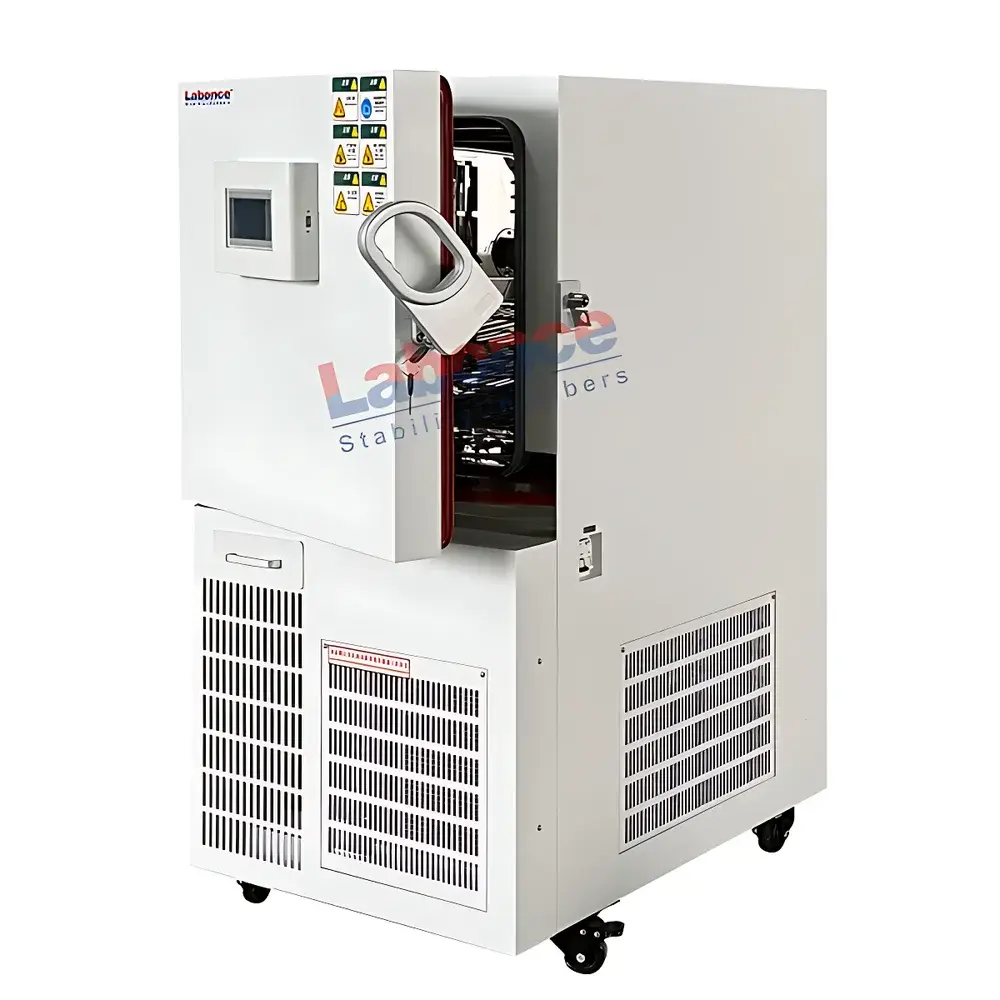
Labonce labonce-100JS High-Low Temperature Alternating Humidity Chamber
| Brand | Labonce |
|---|---|
| Origin | Beijing, China |
| Manufacturer Type | Direct Manufacturer |
| Model | labonce-100JS |
| Temperature Range | -20°C to 150°C (Configurable Options: -40°C or -60°C to 150°C) |
| Humidity Range | 20–98% RH |
| Internal Volume | 100 L |
| Internal Dimensions (W×D×H) | 450×450×500 mm |
| External Dimensions (W×D×H) | 730×1040×1570 mm |
| Standard Shelves | 2 pcs |
| Temperature Uniformity | ±2.0°C |
| Temperature Fluctuation | ±0.5°C |
| Humidity Accuracy | ±3% RH (>75% RH), ±5% RH (≤75% RH) |
| Heating Rate | 1–3°C/min |
| Cooling Rate | 0.7–1°C/min |
| Control System | Programmable Color Touchscreen Controller with Multi-Stage & Constant-Value Modes |
| Data Logging | Internal Electronic Storage with USB Export Capability |
| Safety Protections | Compressor Overheat & High-Pressure Protection, Fan Overheat Protection, Independent Over-Temperature Cut-off, Upper/Lower Limit Deviation Alarms |
Overview
The Labonce labonce-100JS High-Low Temperature Alternating Humidity Chamber is an engineered environmental simulation system designed for rigorous reliability assessment of electrical, electronic, and electromechanical components under controlled thermal and hygrothermal stress conditions. Based on the fundamental principles of thermodynamic equilibrium and forced-convection humidity control, the chamber replicates real-world operational and storage environments—including extreme cold, elevated temperature, and high-humidity exposure—to evaluate material integrity, dimensional stability, solder joint fatigue, insulation resistance degradation, and condensation-induced failure mechanisms. Its architecture complies with the structural and performance requirements specified in GB/T 10592–2008, ensuring traceable metrological validity for qualification testing in R&D, quality assurance, and production release workflows.
Key Features
- Advanced air circulation system with optimized duct geometry ensures uniform temperature distribution (±2.0°C across working volume) and rapid transient response during cycling protocols.
- Double-wall insulated chamber construction: outer casing of powder-coated steel and inner liner of corrosion-resistant AISI 304 stainless steel—designed for long-term chemical and moisture resistance.
- High-efficiency refrigeration circuit featuring a hermetically sealed industrial-grade compressor, enabling continuous operation over extended test durations without performance drift.
- Intuitive programmable color touchscreen controller supporting up to 99 segments per program, with ramp-soak-hold profiles, real-time parameter monitoring, and user-defined alarm thresholds.
- Dual-stage humidity generation system combining ultrasonic humidification and precision Peltier-based dehumidification for stable RH control across the full 20–98% range.
- Comprehensive safety architecture including independent mechanical over-temperature cutoff, compressor discharge temperature monitoring, high-pressure cutout, fan motor thermal protection, and configurable deviation alarms for both temperature and humidity channels.
Sample Compatibility & Compliance
The labonce-100JS accommodates standard-sized PCB assemblies, semiconductor packages, automotive ECUs, battery modules, optical sensors, and polymer-based enclosures—up to 450 mm wide × 450 mm deep × 500 mm tall. Its internal volume (100 L) and dual-shelf configuration support parallel testing of multiple specimens while maintaining spatial representativeness. The chamber meets essential design and calibration criteria referenced in GB/T 10592–2008 and aligns with functional equivalency expectations for IEC 60068-2-1 (cold), IEC 60068-2-2 (dry heat), IEC 60068-2-30 (damp heat, cyclic), and MIL-STD-810G Method 502.6. While not certified to ISO/IEC 17025, its documented temperature/humidity uniformity, stability, and repeatability data support GLP-compliant test reporting when operated within validated operating ranges.
Software & Data Management
Data acquisition and archival are managed through the embedded controller’s non-volatile memory, recording timestamped values for chamber setpoints, actual temperature, relative humidity, and alarm events at user-selectable intervals (1–600 seconds). All logs—including program execution history and fault codes—are exportable via standard USB flash drives in CSV format for post-test analysis in Excel, MATLAB, or LIMS platforms. The controller supports audit trail functionality with operator login credentials and change logging—facilitating compliance with internal QA documentation requirements and preparatory alignment with FDA 21 CFR Part 11 principles where electronic records are retained as primary evidence.
Applications
- Accelerated life testing of consumer electronics under combined thermal-hygric stress (e.g., mobile devices exposed to tropical climates).
- Evaluation of conformal coating adhesion and delamination behavior on printed circuit boards during humidity cycling.
- Qualification of automotive ADAS sensors for cold-start performance and condensation resistance.
- Validation of lithium-ion battery pack thermal management systems across charge/discharge cycles at varying ambient RH.
- Material compatibility screening for medical device housings subjected to sterilization and storage conditions per ISO 11607.
- Pre-compliance verification prior to formal certification testing per JEDEC JESD22-A104 (temperature cycling) and JESD22-A101 (damp heat).
FAQ
What temperature and humidity ranges does the labonce-100JS support?
The standard configuration operates from –20°C to +150°C with humidity control between 20% and 98% RH. Optional low-temperature variants extend the lower limit to –40°C or –60°C.
Is the chamber suitable for testing samples that generate internal heat?
Yes—its forced-air convection system and calibrated load compensation algorithm accommodate modest internal heat dissipation (<50 W), though users should validate thermal gradients with representative dummy loads before critical qualification runs.
Can test programs be edited remotely?
No remote editing is supported; all programming must be performed locally via the front-panel touchscreen interface. However, pre-configured programs may be loaded from USB media.
Does the unit include validation documentation?
Factory calibration certificates for temperature and humidity sensors are provided. IQ/OQ documentation templates are available upon request to support user-led installation and operational qualification.
What maintenance is required to sustain performance accuracy?
Quarterly inspection of condensate drain lines, biannual cleaning of evaporator coils and humidifier reservoirs, and annual recalibration of PT100 sensors and capacitive RH transducers are recommended per the manufacturer’s maintenance schedule.



