
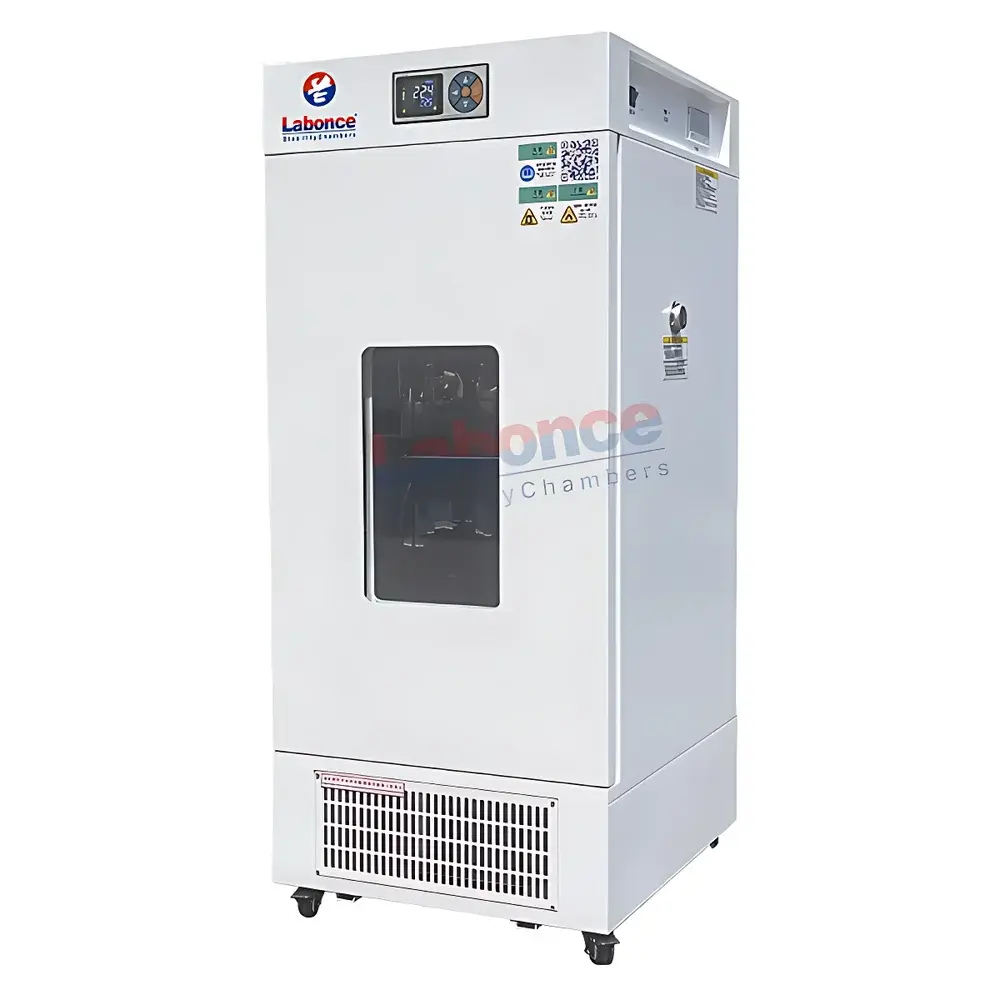
Labonce Labonce-250BI Biochemical Incubator
| Brand | Labonce |
|---|---|
| Model | Labonce-250BI |
| Temperature Range | 0–60°C |
| Chamber Volume | 250 L |
| Internal Dimensions (W×D×H) | 520×460×1050 mm |
| External Dimensions (W×D×H) | 620×690×1650 mm |
| Power Consumption | 0.6 kW |
| Standard Shelving | 3 adjustable stainless steel shelves (8 total positions) |
| Temperature Uniformity | ≤2.0°C at 37°C |
| Temperature Fluctuation | ±0.5°C (high temp) |
| Ambient Operating Range | +5 to +35°C |
| Input Power | AC 220 V ±10%, 50 Hz |
| Compliance | GB/T 28851–2012 |
| Cooling System | Imported hermetic industrial compressor |
| Control Interface | LCD controller with adjustable fan speed |
| Data Logging | Internal electronic storage + thermal dot-matrix printer + USB data export |
| Safety Features | Independent over-temperature protection, compressor overheat/overpressure cut-off, audible alarm |
| Construction | Exterior – powder-coated steel |
| Optional Accessories | UV germicidal lamp, SMS alert module, humidity display, touch-screen controller with 3-tier user permissions and audit trail (BIT variant) |
Overview
The Labonce Labonce-250BI Biochemical Incubator is an engineered environmental control system designed for precise, stable, and reproducible temperature regulation in life science laboratories. It operates on a forced-air convection principle, utilizing a dynamically balanced air circulation system to ensure uniform thermal distribution across the entire chamber volume—critical for applications requiring strict adherence to physiological or regulatory temperature setpoints (e.g., microbial growth, enzyme kinetics, cell line maintenance, and stability testing per ICH Q1 guidelines). Unlike static incubators, the Labonce-250BI integrates a variable-speed axial fan and optimized duct geometry to minimize thermal stratification and achieve ≤2.0°C uniformity at 37°C—a performance benchmark aligned with ISO 13408-2 and USP requirements for biological product handling environments.
Key Features
- Industrial-grade hermetic refrigeration system with imported compressor ensures long-term reliability, low acoustic emission (<52 dB(A)), and consistent cooling capacity across the full 0–60°C operating range.
- Mirror-polished AISI 304 stainless-steel interior chamber eliminates crevices and organic residue retention—supporting routine cleaning validation per GLP Annex 1 and facilitating compliance with FDA 21 CFR Part 11 when paired with audit-trail-capable controllers (BIT option).
- LCD-based microprocessor controller offers intuitive navigation, real-time display of chamber temperature, fan speed adjustment (3 levels), and programmable ramp-soak profiles for multi-stage experiments.
- Dual-stage thermal safety architecture: primary PID-controlled heating/cooling loop + independent mechanical over-temperature cutoff (adjustable up to 65°C), plus compressor thermal overload and high-pressure shutdown circuits.
- Integrated data management suite includes non-volatile internal memory (≥30 days at 1-min logging interval), built-in thermal dot-matrix printer (paper roll included), and USB 2.0 interface for raw CSV export—enabling traceable record retention per ALCOA+ principles.
- Modular design accommodates optional upgrades including UV-C (254 nm) sterilization cycle, remote SMS notification via GSM module, and humidity monitoring (0–95% RH, ±3% accuracy).
Sample Compatibility & Compliance
The Labonce-250BI supports standard microbiological, cell culture, and biochemical workflows involving Petri dishes, multi-well plates (up to 96-well format), Erlenmeyer flasks (≤2 L), and test tubes. Its chamber geometry permits unobstructed airflow around stacked vessels while maintaining uniform thermal exposure. The unit complies with GB/T 28851–2012 “Technical Specifications for Biochemical Incubators” and meets electromagnetic compatibility (EMC) requirements per IEC 61326-1. When equipped with the BIT-series touch controller (optional), it satisfies data integrity criteria under 21 CFR Part 11—including electronic signatures, role-based access control (administrator/operator/user tiers), and immutable audit logs with timestamped operator ID and parameter change history.
Software & Data Management
Data acquisition is handled by an embedded ARM Cortex-M4 controller running deterministic real-time firmware. Temperature readings are sampled every 10 seconds using dual Pt100 sensors (one operational, one redundant), with linearization and cold-junction compensation applied per IEC 60751. All logged values are time-stamped with internal RTC (±2 s/month drift) and stored in encrypted flash memory. Exported USB files contain ISO 8601-formatted timestamps, sensor IDs, and CRC-16 checksums for integrity verification. No cloud connectivity or third-party software dependencies are required—ensuring full data sovereignty and simplifying qualification protocols (IQ/OQ/PQ).
Applications
- Bacterial and fungal cultivation in environmental monitoring (e.g., ISO 6222, ISO 9308-1) and pharmaceutical water system validation.
- Cell proliferation assays and primary tissue culture under controlled normothermic conditions (37°C ±0.5°C).
- Stability studies for diagnostic reagents, vaccines, and biologics per ICH Q5C and WHO TRS 992 Annex 5.
- Enzymatic reaction profiling requiring precise thermal ramping (e.g., polymerase activity assays, ligase optimization).
- Quality control of raw materials in food safety labs (AOAC 977.27, FDA BAM Chapter 4) and agricultural biotechnology R&D.
FAQ
What is the maximum load capacity for shelf loading without compromising temperature uniformity?
The Labonce-250BI maintains specified uniformity with up to 15 kg distributed evenly across three standard shelves. Overloading beyond 20 kg per shelf may impede airflow and degrade performance.
Can the incubator operate continuously at 4°C for cold-adapted organism studies?
Yes—the refrigeration system is rated for sustained operation at 4°C with ambient conditions ≤30°C. Compressor cycling frequency remains within design limits per ISO 8564.
Is calibration certificate included with shipment?
A factory-as-tested calibration report (traceable to NIM China) is provided. On-site IQ/OQ documentation templates and SAT checklists are available upon request.
Does the USB data export support automated parsing in LIMS environments?
CSV output follows ASTM E2500-13-compliant header structure and is compatible with common LIMS platforms (e.g., LabWare, STARLIMS, Thermo Fisher SampleManager) without proprietary drivers.
How often does the UV-C lamp require replacement if used daily?
The optional 254 nm UV lamp has a rated lifetime of 8,000 hours. With 1-hour daily cycles, replacement is recommended every 22 months.





