
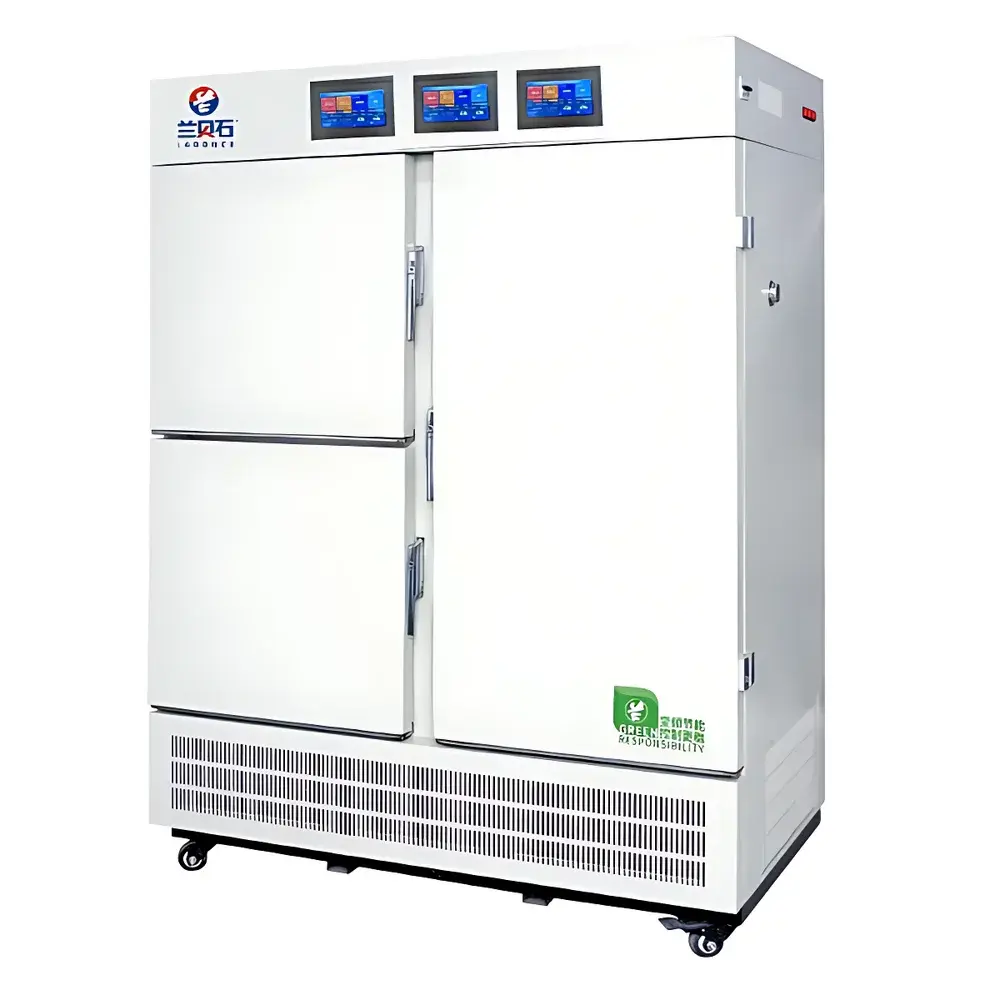
Labonce Labonce-930GS-FC Three-Chamber Drug Stability Testing Chamber
| Brand | Labonce |
|---|---|
| Origin | Beijing, China |
| Manufacturer Type | Direct Manufacturer |
| Product Origin | Domestic (China) |
| Model | Labonce-930GS-FC |
| Pricing | Available Upon Request |
| Temperature Range | 15–65 °C |
| Humidity Range | 20–95 %RH |
| Total Chamber Volume | 220 L (A+B) + 480 L (C) = 700 L |
| Internal Dimensions (W×D×H) | A/B Chamber: 600×700×520 mm |
| C Chamber | 600×700×1140 mm |
| External Dimensions (W×D×H) | 1570×1060×1960 mm |
| Power Consumption | 4.0 kW |
| Temperature Uniformity | ±0.5 °C (fluctuation), ±1.0 °C (deviation, dark condition) |
| Humidity Uniformity | ±2 %RH (fluctuation), ±3 %RH (deviation, dark condition) |
| Ambient Operating Temperature | +5 to +35 °C |
| Power Supply | AC 220 V ±10%, 50 Hz |
| Standard Shelves | 6 (A), 6 (B), 8 (C) |
| Compliance | ICH Q1A–Q1E, Chinese Pharmacopoeia 2020 Edition, GMP/GLP-ready architecture |
Overview
The Labonce Labonce-930GS-FC Three-Chamber Drug Stability Testing Chamber is an engineered environmental simulation system designed specifically for long-term, accelerated, and intermediate stability studies of pharmaceutical products in compliance with ICH Q1 series guidelines and the Chinese Pharmacopoeia (2020 Edition). Unlike single- or dual-chamber systems, the 930GS-FC integrates three physically isolated chambers—labeled A, B, and C—each independently programmable for temperature and relative humidity. Chamber C is configured as a high-capacity storage chamber (480 L), while Chambers A and B (220 L each) support parallel testing under distinct stress conditions—enabling concurrent ICH Zone IVa (30 °C/65 %RH), Zone III (30 °C/75 %RH), and accelerated (40 °C/75 %RH) protocols without cross-contamination or parameter interference. The system employs Couette-flow-based air circulation, double-wall vacuum-insulated construction, and precision dew-point humidity control to ensure spatial uniformity and temporal reproducibility across all test zones.
Key Features
- Triple independent chamber architecture: A (220 L), B (220 L), and C (480 L), each with dedicated PID-controlled refrigeration, humidification, and dehumidification circuits.
- High-efficiency variable-frequency hermetic compressors (imported), reducing energy consumption by >50% versus fixed-speed equivalents and minimizing thermal shock during setpoint transitions.
- Electrochemical capacitive humidity sensors (imported, factory-calibrated), delivering ±1.5 %RH accuracy over 0–100 %RH range with <0.05 %RH/year drift—no field recalibration required.
- 7-inch full-color programmable touchscreen controller with real-time display of compressor output ratio, dew-point temperature, and humidity saturation status.
- Three-tier user access control (Operator, Supervisor, Administrator) with role-based permissions, mandatory password authentication, and encrypted local credential storage.
- Audit trail functionality compliant with FDA 21 CFR Part 11 Annex 11 requirements: time-stamped records of all parameter changes, alarm events, door openings, and user logins—exportable via USB to immutable .csv or .pdf formats.
- Dual-door design: inner tempered glass door (for non-intrusive visual inspection) and outer solid insulated door—minimizing internal environment perturbation (<0.3 °C/2 %RH deviation within 30 s of brief opening).
- Robust safety architecture: independent overtemperature cutoff (mechanical backup), low-water-level detection, dry-run prevention for humidifiers, high-pressure refrigerant shutdown, and phase-failure protection.
Sample Compatibility & Compliance
The Labonce-930GS-FC accommodates standard ISO 8573-compliant sample trays, vial racks (2 mL–100 mL), blister packs, and primary packaging configurations. Its interior chamber surfaces are fabricated from electropolished AISI 304 stainless steel (Ra ≤ 0.4 µm), eliminating particulate shedding and enabling validated cleaning procedures per USP . The insulation core utilizes closed-cell polyurethane foam (density ≥ 40 kg/m³, thermal conductivity ≤ 0.018 W/m·K), certified per GB/T 29416–2012 for low VOC emission. System validation documentation supports IQ/OQ/PQ execution aligned with ASTM E2500-13 and EU Annex 15. All operational parameters meet or exceed the performance criteria specified in ICH Q5C (stability protocol design), Q5D (analytical method validation linkage), and the Chinese GMP Annex on Stability Testing (2022).
Software & Data Management
The embedded controller firmware includes built-in data logging at user-defined intervals (1 min to 24 h), storing ≥12 months of continuous environmental history (temperature, RH, alarm flags, compressor duty cycle) in non-volatile memory. Optional Ethernet/Wi-Fi connectivity enables remote monitoring via Labonce’s web-based StabilityLink™ platform (v3.2), supporting TLS 1.2 encryption, SSO integration, and automated report generation (PDF/Excel) per WHO TRS 992 Annex 9. Electronic records include digital signatures, revision history, and tamper-evident hash verification. The system supports 21 CFR Part 11-compliant electronic signatures when paired with external PKI infrastructure and maintains full traceability for GLP audits.
Applications
- ICH-guided long-term stability studies (25 °C/60 %RH, 30 °C/65 %RH) for registration dossiers (CTD Module 3).
- Accelerated stability assessment (40 °C/75 %RH) to predict shelf life per ICH Q1E evaluation models.
- Photostability pre-screening (when integrated with optional ICH Q1B-compliant light banks in Chamber A).
- Benchmarking of container-closure integrity under cyclic humidity stress (e.g., 25 °C ↔ 40 °C/75 %RH).
- Stability-indicating method development support through controlled degradation environment generation.
- GMP-compliant storage of reference standards and retained samples per USP and EU GDP Chapter 9.
FAQ
Does the Labonce-930GS-FC support ICH Q1B photostability testing?
Yes—Chamber A can be retrofitted with UV-A/visible spectrum LED arrays (320–400 nm, irradiance 1.2 mW/cm²) and calibrated radiometers to meet ICH Q1B Option 2 requirements.
What validation documentation is provided with shipment?
Factory-issued IQ/OQ protocols, calibration certificates for temperature/RH sensors (NIST-traceable), and a Certificate of Conformance per ISO 9001:2015 are included.
Can the system operate continuously for 12+ months without maintenance?
Yes—the variable-frequency refrigeration system and self-diagnostic controller enable unattended operation up to 18 months between scheduled service, contingent on ambient conditions meeting specification (+5 to +35 °C).
Is remote alarm notification supported via SMS or email?
Yes—via optional GSM module or SMTP relay; configurable thresholds for temperature deviation (>±1.5 °C), humidity excursion (>±5 %RH), power failure, and door-open duration (>60 s).
How is data integrity ensured during power loss?
All critical parameters are written to redundant flash memory with battery-backed real-time clock; unsaved logs auto-resume upon recovery with timestamp continuity verified via SHA-256 checksums.
Related Products




