
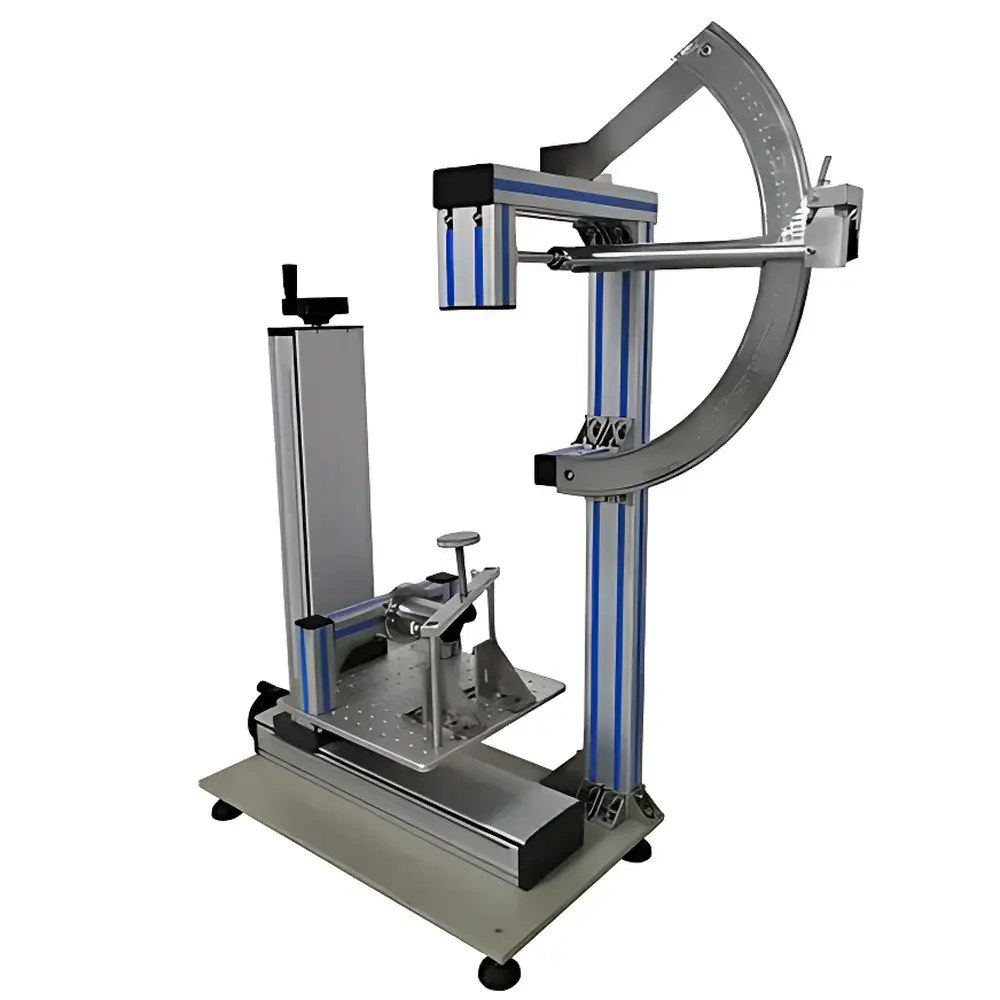
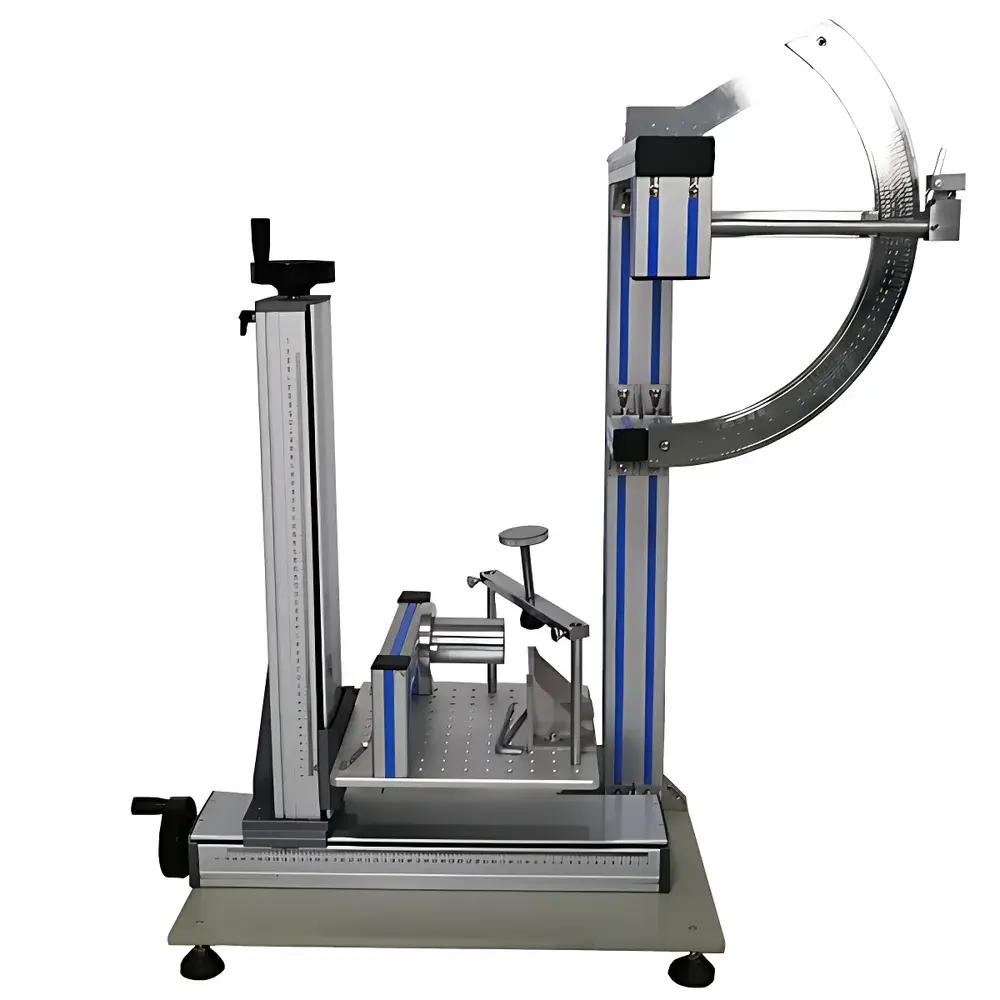
JB Ceramic Cantilever Impact Tester
| Origin | Hunan, China |
|---|---|
| Manufacturer Type | Distributor |
| Origin Category | Domestic |
| Model | JB |
| Price Range | USD 1,400–2,800 |
| Instrument Type | Pendulum Impact Tester |
| Impact Energy | 2.156 J |
| Impact Velocity | Adjustable |
| Pendulum Torque (Impact Constant) | 120 N·mm |
| Load Cell Range | 100 N |
| Maximum Lifting Height | 120 mm |
| Scale Division Value | 0.028 J |
| Pendulum Raise Angle | 120° |
| Distance from Pendulum Pivot to Impact Point | 300 mm |
| Vertical Travel of Test Table | 120 mm |
| Longitudinal Travel of Test Table | 210 mm |
| Sample Dimensions | Flat plates 6–10.5 inches in diameter |
| Net Weight | 50 kg |
| Overall Dimensions | 890 × 370 × 925 mm |
Overview
The JB Ceramic Cantilever Impact Tester is a precision-engineered pendulum-type impact testing system specifically designed for mechanical integrity evaluation of domestic ceramic tableware—flatware (plates, saucers), hollowware (bowls, mugs), and other glazed or unglazed porcelain and stoneware products. It operates on the principle of gravitational potential energy conversion: a calibrated pendulum is raised to a defined angular position (120°), released, and strikes the specimen at a controlled velocity. The energy absorbed during fracture initiation or complete fragmentation is quantified via mechanical dial reading (0.028 J resolution) or optional digital load cell integration (100 N range), enabling compliance with standardized assessment protocols for ceramic brittleness and impact resistance.
Key Features
- Fixed-pivot pendulum mechanism with precisely calibrated torque constant (120 N·mm) and nominal impact energy of 2.156 J—aligned with common industry reference values for small-format ceramic impact testing.
- Adjustable impact velocity achieved through variable pendulum release angle (standardized at 120°) and optimized moment arm (300 mm from pivot to impact point), ensuring repeatable kinetic input across test configurations.
- Motorized or manual vertical adjustment of the test table (120 mm travel) and longitudinal positioning (210 mm travel) to accommodate diverse specimen geometries—including flat plates (6–10.5 inch diameter), bowls, and cups (≥80 mm aperture, ≤100 mm height).
- Robust cast-iron base and rigid cantilever support structure minimize vibration transmission and ensure high reproducibility in energy absorption measurements.
- Compliance-ready mechanical dial scale with 0.028 J division value provides traceable, analog readout suitable for routine QC environments where digital instrumentation is not mandated.
- Designed for operation without external power supply (pendulum-driven), enhancing reliability and reducing maintenance complexity in production lab settings.
Sample Compatibility & Compliance
The JB tester accommodates both glazed and unglazed ceramic specimens per ISO 10545-5 (Ceramic tiles — Part 5: Determination of resistance to thermal shock) and GB/T 3810.5 (Chinese national standard for ceramic tile impact resistance), though its geometry-specific application aligns most closely with ASTM C1161 (Standard Test Method for Flexural Strength of Advanced Ceramics at Ambient Temperature) in terms of energy-based failure threshold characterization. While not a direct substitute for Charpy or Izod configurations, its cantilever-mounted impact point enables targeted loading at geometrically critical locations: center impact for crack-initiation energy measurement and edge impact for rim fracture resistance evaluation. All test fixtures and specimen supports are non-compliant with ISO/IEC 17025 calibration traceability by default; however, periodic verification using certified reference masses and angular encoders is recommended for GLP-aligned quality control laboratories.
Software & Data Management
The base JB model operates as a standalone mechanical instrument with analog dial readout and requires manual data recording. Optional digital upgrade kits include a 100 N capacity load cell with ±0.5% full-scale accuracy and USB-connected signal conditioning module, enabling real-time force-time curve acquisition and energy integral calculation via included Windows-compatible software. Data export supports CSV and PDF formats; audit trail functionality, electronic signatures, and 21 CFR Part 11 compliance are available only with validated third-party LIMS integration—not natively embedded. Calibration certificates (traceable to NIM or CNAS-accredited labs) must be obtained separately and renewed annually for regulated environments.
Applications
- Determination of first-crack energy (Einit) in flat ceramic plates subjected to central impact per ISO 10545-4 derived methodology.
- Quantification of total fragmentation energy (Efrag) for bowl and cup rims under lateral edge impact, supporting design validation for drop resistance.
- Batch-to-batch consistency monitoring in ceramic manufacturing QA workflows, especially for vitrified tableware lines producing dinner sets for export markets (EU, North America, Japan).
- Pre-screening of glaze adhesion strength and body–glaze thermal expansion mismatch effects through comparative impact energy thresholds.
- Supporting R&D investigations into microstructural toughening mechanisms (e.g., zirconia phase transformation, pore distribution effects) via controlled low-energy impact response mapping.
FAQ
Is this instrument compliant with ISO 148 or ASTM E23?
No—the JB tester is not configured for standardized Charpy or Izod specimen geometries and lacks the anvil geometry, striker radius, and energy calibration traceability required by ISO 148-1 or ASTM E23. It serves a specialized niche in ceramic tableware evaluation.
Can it test specimens thicker than 10 cm?
No—maximum specimen height is strictly limited to 100 mm due to pendulum clearance and table travel constraints.
What calibration documentation is provided?
A factory-issued mechanical verification report (non-accredited) is included; accredited calibration certificates require separate arrangement with a CNAS-recognized metrology lab.
Is operator training included with purchase?
Basic setup and safety procedure documentation is supplied; on-site technical training is available as a billable service upon request.
Does the instrument meet CE or UKCA marking requirements?
It does not carry CE or UKCA marking, as it falls outside the scope of EU Machinery Directive 2006/42/EC for dedicated impact testers and is intended for industrial laboratory use under supervised conditions.



