
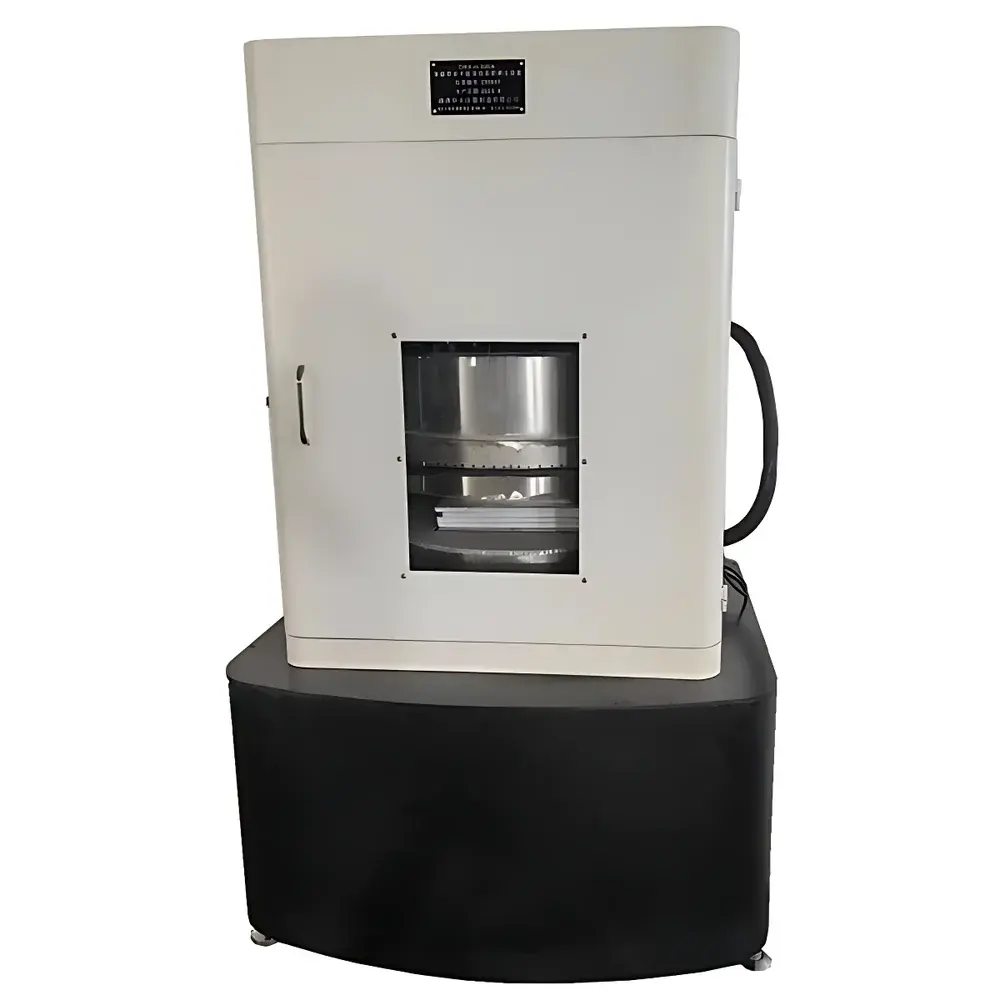
ZHENHUAFENXI DRH-300 Dual-Specimen Guarded Hot Plate Thermal Conductivity Analyzer
| Brand | ZHENHUAFENXI |
|---|---|
| Origin | Hunan, China |
| Model | DRH-300 |
| Measurement Principle | Guarded Hot Plate Method (ASTM C177, ISO 8302) |
| Test Environment | Ambient Temperature (18–25 °C, 20–80% RH) |
| Dimensions (L×W×H) | 1100 × 900 × 1300 mm |
| Thermal Conductivity Range | 0.001–2.2 W/(m·K) |
| Accuracy | ±3% |
| Repeatability | ±1% |
| Temperature Control Precision | ±0.1 °C (Hot Plate & Cold Plate) |
| Sample Thickness | 5–50 mm |
| Sample Size Options | 200 × 200 mm or 300 × 300 mm |
| Power Supply | AC 220 V ±5%, 3.0 kW |
| Software | Windows-based Automated Thermal Analysis Suite (English & Chinese UI) |
Overview
The ZHENHUAFENXI DRH-300 Dual-Specimen Guarded Hot Plate Thermal Conductivity Analyzer is engineered for high-accuracy, steady-state thermal conductivity measurement of low-to-moderate conductivity solid materials under ambient laboratory conditions. It operates on the guarded hot plate principle—defined in ASTM C177 and ISO 8302—as a primary standard method for absolute thermal property determination. Unlike transient techniques (e.g., laser flash), this instrument establishes a stable, one-dimensional heat flux across two identical specimens symmetrically mounted on either side of a centrally heated metering plate, with guard rings actively temperature-controlled to eliminate lateral heat loss. This dual-specimen configuration enhances measurement robustness by canceling out asymmetrical thermal drift and improving signal-to-noise ratio. The system is calibrated traceably via internal self-calibration routines for both heating power and mean specimen temperature, ensuring long-term stability and metrological integrity without external reference standards for routine operation.
Key Features
- Dual-specimen guarded hot plate architecture with independently controlled hot plate, cold plate, and annular guard ring—minimizing edge losses and enabling true steady-state heat flow.
- Fuzzy PID-based active temperature tracking: synchronizes guard ring temperature with the hot plate in real time (±0.1 °C control precision), eliminating parasitic conduction errors.
- Integrated temperature compensation algorithms for specimen thickness variation and average cross-sectional temperature—critical for compliant testing of non-uniform or anisotropic insulation boards.
- Automated thermal resistance and conductivity calculation per ISO 8302 Annex A, including corrections for contact resistance estimation and interfacial thermal resistance modeling.
- Modular sample fixture system supporting standardized 200 × 200 mm and 300 × 300 mm specimen formats, with adjustable compression load control (0–50 kPa) to maintain consistent interfacial contact pressure across rigid and semi-rigid materials.
- High-stability platinum RTD sensors (Class A, IEC 60751) embedded in all thermal surfaces—ensuring ±0.1 °C temperature resolution and repeatability over extended measurement cycles (up to 48 h).
Sample Compatibility & Compliance
The DRH-300 is validated for thermal characterization of construction-grade insulating materials—including mineral wool, expanded polystyrene (EPS), extruded polystyrene (XPS), polyisocyanurate (PIR), aerogel composites, glass fiber batts, and cellular concrete—as well as homogeneous solids such as float glass, ceramic tiles, and polymer sheets. Specimens must meet planarity tolerance (<0.5 mm deviation over 300 mm) and hardness requirements suitable for compressive loading without permanent deformation. The instrument satisfies functional requirements of ASTM C177, ISO 8302, GB/T 10294 (Chinese national standard), and JIS A 1412-1. Its design supports GLP-compliant workflows: full audit trail logging, user access levels, electronic signature capability, and data immutability features in the software suite—aligning with FDA 21 CFR Part 11 expectations for regulated quality control laboratories.
Software & Data Management
The included Windows-based Thermal Analysis Suite (v4.2+) provides fully automated test sequencing, real-time thermal gradient visualization, and ISO/ASTM-compliant reporting. It supports dual-language interfaces (English and Simplified Chinese), configurable report templates (PDF, Excel, XML), and metadata tagging for sample ID, operator, calibration date, and environmental conditions. All raw sensor readings—including 16-channel thermocouple/RTD inputs, power supply voltage/current, and PID loop diagnostics—are timestamped at 1 Hz and archived in HDF5 format for third-party analysis. Software validation documentation (IQ/OQ protocols) and source code checksums are supplied for GxP environments. Data export conforms to ASTM E1447 and ISO/IEC 17025 traceability frameworks.
Applications
- Quality assurance of building insulation products prior to CE marking or CCC certification.
- R&D evaluation of novel aerogel, vacuum insulation panels (VIPs), and phase-change material (PCM)-integrated composites.
- Thermal performance verification of fire-rated assemblies per EN 1364-1 and UL 263.
- Comparative analysis of aged vs. virgin insulation materials in durability studies (thermal aging at 70 °C for 90 days).
- Validation of computational fluid dynamics (CFD) and finite element method (FEM) thermal models used in building energy simulation (e.g., EnergyPlus, TRNSYS).
- Supporting LEED v4.1 Material Disclosure requirements through certified thermal property datasets.
FAQ
What standards does the DRH-300 comply with for thermal conductivity testing?
ASTM C177, ISO 8302, GB/T 10294, and JIS A 1412-1. Full compliance documentation—including uncertainty budget analysis per GUM (JCGM 100) and inter-laboratory comparison reports—is provided with shipment.
Can the system measure specimens thinner than 5 mm or thicker than 50 mm?
No. The mechanical fixture and thermal guard geometry are optimized for 5–50 mm thicknesses. Thinner samples induce excessive contact resistance uncertainty; thicker samples exceed the maximum allowable thermal resistance for stable steady-state convergence within practical test durations.
Is external water circulation required for cold plate temperature control?
Yes. A dedicated recirculating chiller or恒温水槽 (thermostatic bath) with ±0.1 °C stability and ≥10 L/min flow rate is mandatory for cold plate operation below ambient temperature or for high-precision sub-ambient differential measurements.
Does the software support 21 CFR Part 11 compliance for pharmaceutical or medical device applications?
The software includes role-based authentication, electronic signatures, and immutable audit trails—meeting core technical requirements of 21 CFR Part 11. Full validation packages (including risk assessment and test scripts) are available upon request for regulated users.
What maintenance is required to sustain measurement accuracy over time?
Annual calibration of all RTD sensors and power transducers against NIST-traceable references is recommended. Mechanical alignment of the hot/cold plates and guard ring concentricity should be verified biannually using optical leveling tools per manufacturer’s service manual.
Related Products



