
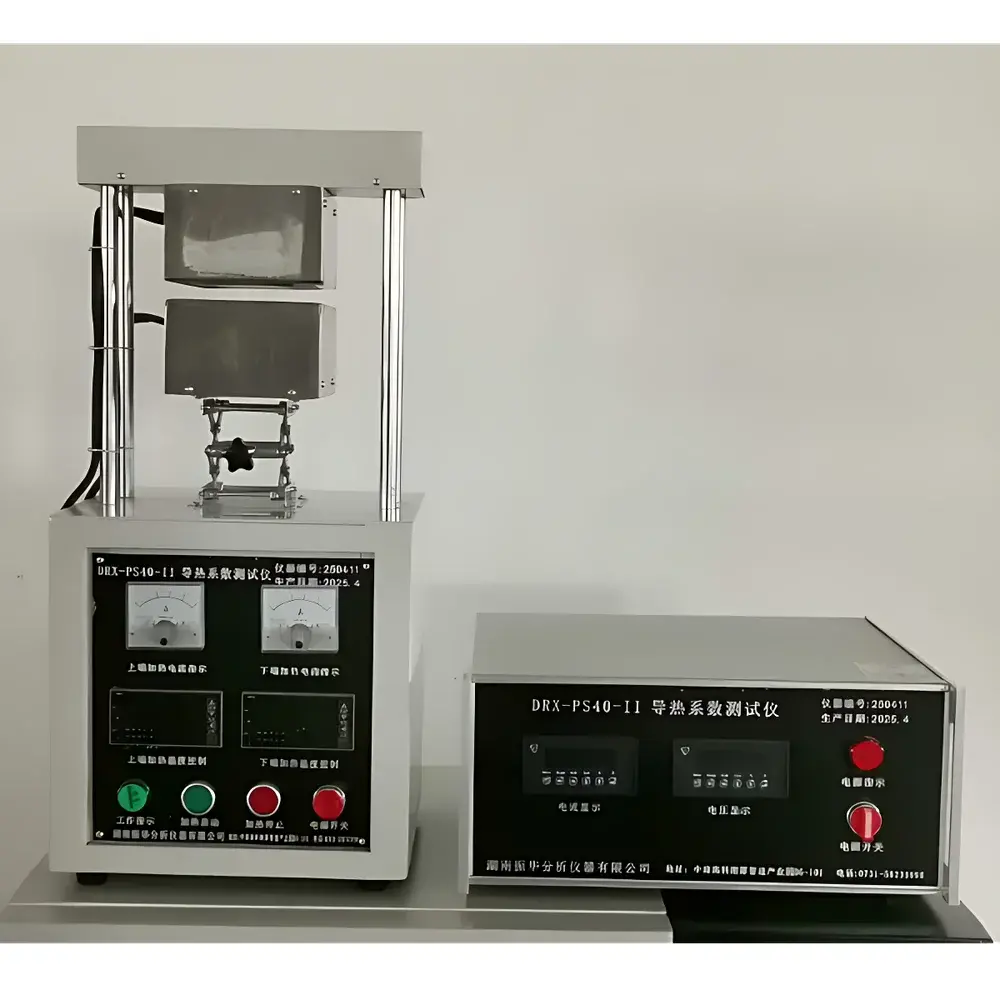
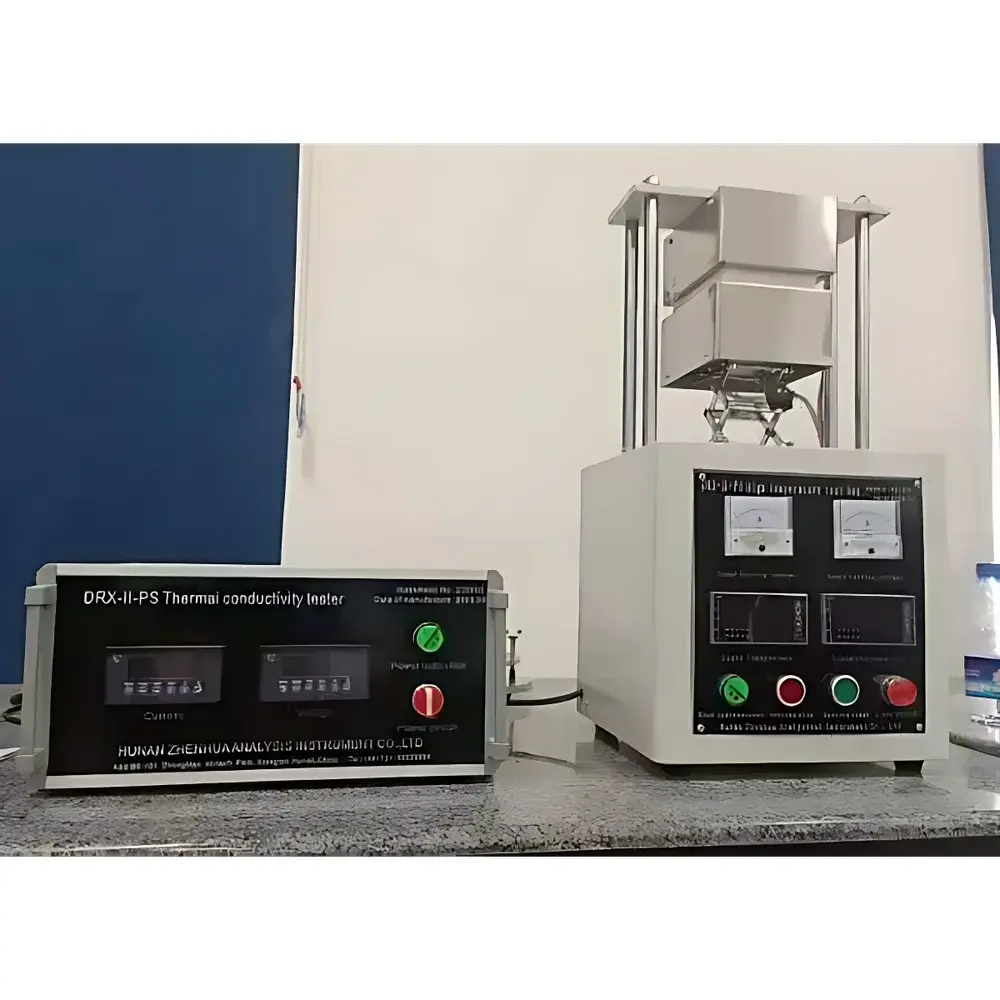
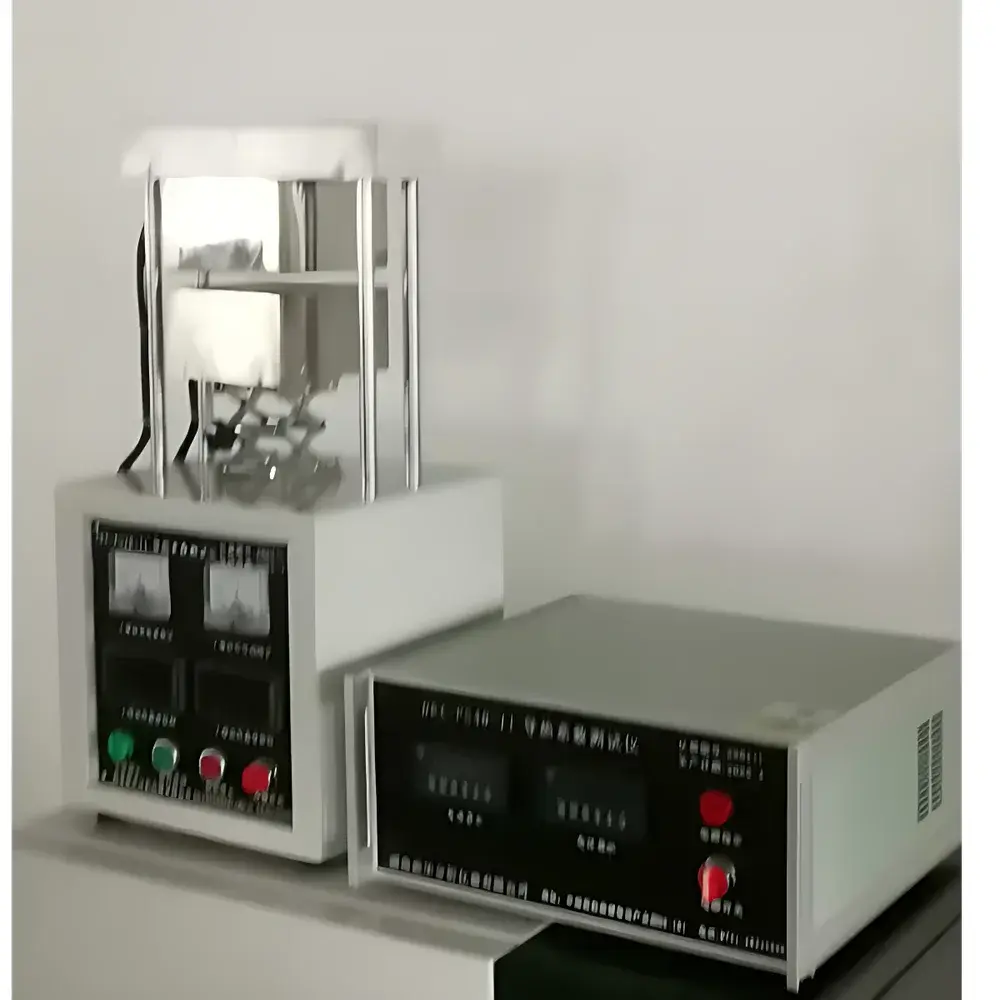
ZHENHUAFENXI DRX-II-PS Transient Plane Source (TPS) Thermal Conductivity Analyzer
| Brand | ZHENHUAFENXI |
|---|---|
| Origin | Hunan, China |
| Manufacturer Type | Authorized Distributor |
| Country of Origin | China |
| Model | DRX-II-PS |
| Instrument Principle | Transient Plane Source (TPS) Method |
| Sample Throughput | Single-sample mode |
| Test Environment | Ambient pressure |
| Dimensions (L×W×H) | 750 × 400 × 600 mm |
| Accuracy | ±3% |
| Thermal Conductivity Range | 0.005–500 W/m·K |
| Repeatability | ±3% |
| Temperature Range Options | Room temperature to 200 °C / 600 °C / 1000 °C (user-selectable configuration) |
| Measurement Duration | 1–160 s |
| Sample Thickness | 0.1–5 mm |
| Power Supply | AC 220 V, ≤500 W |
| Interface | RS232/USB for PC communication |
| Software | Integrated TPS analysis suite with automated reporting and ASTM/ISO-compliant data export |
Overview
The ZHENHUAFENXI DRX-II-PS Transient Plane Source (TPS) Thermal Conductivity Analyzer is a precision instrument engineered for rapid, contact-based measurement of thermal conductivity (λ), thermal diffusivity (α), and volumetric heat capacity (ρcp) across a broad spectrum of solid, semi-solid, and layered materials. Based on the well-established transient plane source method—standardized in ISO 22007-2 and ASTM D5470—the system employs a symmetric, double-sided nickel spiral sensor embedded in a thin Kapton film. During operation, the sensor acts simultaneously as both a resistive heater and a resistance thermometer. A short-duration constant-power pulse induces a controlled temperature rise; the resulting time-dependent voltage response is recorded with microsecond resolution and inverted via analytical solution of the heat diffusion equation in cylindrical coordinates. This first-principles approach eliminates reliance on steady-state assumptions or empirical calibration curves, delivering intrinsic material property values independent of interfacial contact resistance—a critical limitation of guarded-hot-plate or comparative cut-bar methods.
Key Features
- True transient measurement with acquisition window adjustable from 1 to 160 seconds, enabling optimization for low- and high-conductivity regimes
- Integrated dual-range temperature control module supporting user-selectable upper limits of 200 °C, 600 °C, or 1000 °C—calibrated per IEC 60584-2 using Pt100 or Type K thermocouples
- No requirement for metallized coatings, vacuum chambers, or geometrically constrained sample geometries; accommodates irregular surfaces with minimal planarity (Ra < 5 µm)
- Modular sensor configurations available: standard (bulk), thin-film, anisotropic, single-sided, and specific modules for coatings, powders, and composites
- Automated thickness compensation algorithm for samples 0.1–5 mm thick, validated against reference materials traceable to NIST SRM 1470
- Robust mechanical architecture with vibration-damped optical table base and EMI-shielded electronics enclosure
Sample Compatibility & Compliance
The DRX-II-PS accepts heterogeneous specimens including metals, ceramics, polymers, graphite foams, carbon fiber laminates, thermal interface materials (TIMs), PCB substrates, battery electrode coatings, and mineral insulation boards. It complies with ISO 22007-2 (Plastics — Determination of thermal conductivity and thermal diffusivity — Part 2: Transient plane source (hot disc) method), ASTM D5470 (Standard Test Method for Thermal Transmission Properties of Thermally Conductive Electrical Insulation Materials), and GB/T 32064–2015 (Chinese national standard for TPS-based thermal property testing). Data integrity meets GLP requirements through audit-trail-enabled software logging, electronic signatures, and 21 CFR Part 11–compliant user access controls when configured with optional validation package.
Software & Data Management
The proprietary TPS Analysis Suite v4.x runs on Windows 10/11 and supports real-time visualization of raw voltage vs. time traces, automatic baseline correction, multi-parameter curve fitting (including radial heat loss compensation), and uncertainty propagation per GUM (JCGM 100:2008). Export formats include CSV, XML, PDF reports with embedded metadata (operator ID, timestamp, environmental conditions, calibration certificate IDs), and direct integration with LIMS via OPC UA. All measurement sessions are time-stamped, digitally signed, and stored with SHA-256 hash verification to ensure forensic data integrity.
Applications
- Quality control of thermal interface materials (e.g., silicone greases, phase-change pads, graphite sheets) in electronics cooling applications
- R&D characterization of anisotropic composites used in aerospace structural panels and EV battery modules
- Validation of thermal models for additive-manufactured metal parts subject to localized heating
- Regulatory submission support for medical device thermal management systems under ISO 10993-12
- High-temperature screening of refractory ceramics and nuclear-grade graphites per ASTM C714
- Process development of thin-film photovoltaic absorbers and thermoelectric oxide layers
FAQ
What standards does the DRX-II-PS comply with for thermal conductivity measurement?
It adheres to ISO 22007-2, ASTM D5470, and GB/T 32064–2015, with optional documentation packages supporting ISO/IEC 17025 accreditation.
Can the instrument measure anisotropic materials such as unidirectional carbon fiber laminates?
Yes—using the dedicated anisotropic module, it quantifies in-plane (λ∥) and through-thickness (λ⊥) conductivity with orthogonal sensor orientation and directional heat flow modeling.
Is calibration traceable to national metrology institutes?
All factory calibrations use NIST-traceable reference materials (e.g., Pyroceram 9606, Inconel 600, Spectralon) and are documented in accordance with ISO/IEC 17025 Clause 6.6.
Does the system support automated batch testing for production environments?
When paired with optional robotic sample handling and PLC-triggered start/stop logic, it achieves unattended operation with full digital record retention per 21 CFR Part 11 Annex 11.
How is contact resistance mitigated during measurement?
The TPS method intrinsically decouples interfacial thermal resistance from bulk conduction by analyzing the early-time thermal response (<100 ms), where heat penetration remains confined within the sensor’s near-field region—eliminating the need for thermal grease or pressure optimization.



