
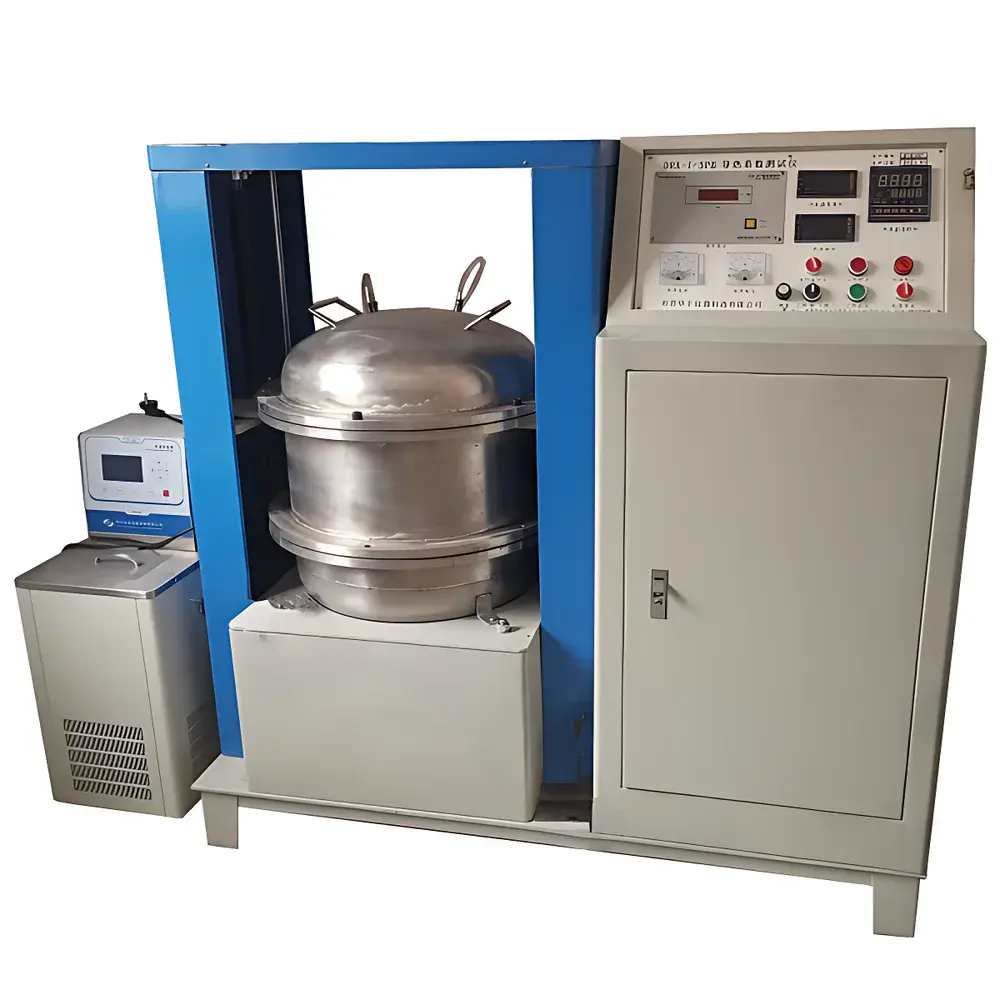
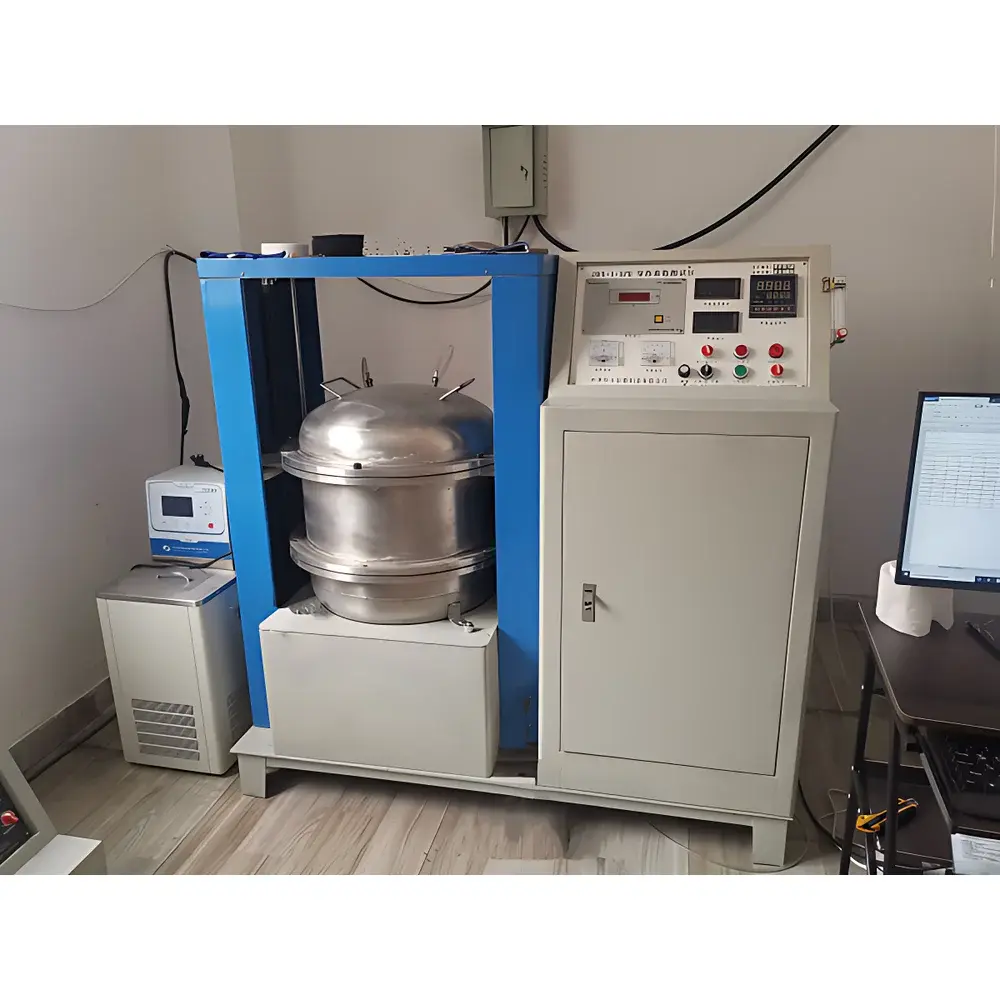
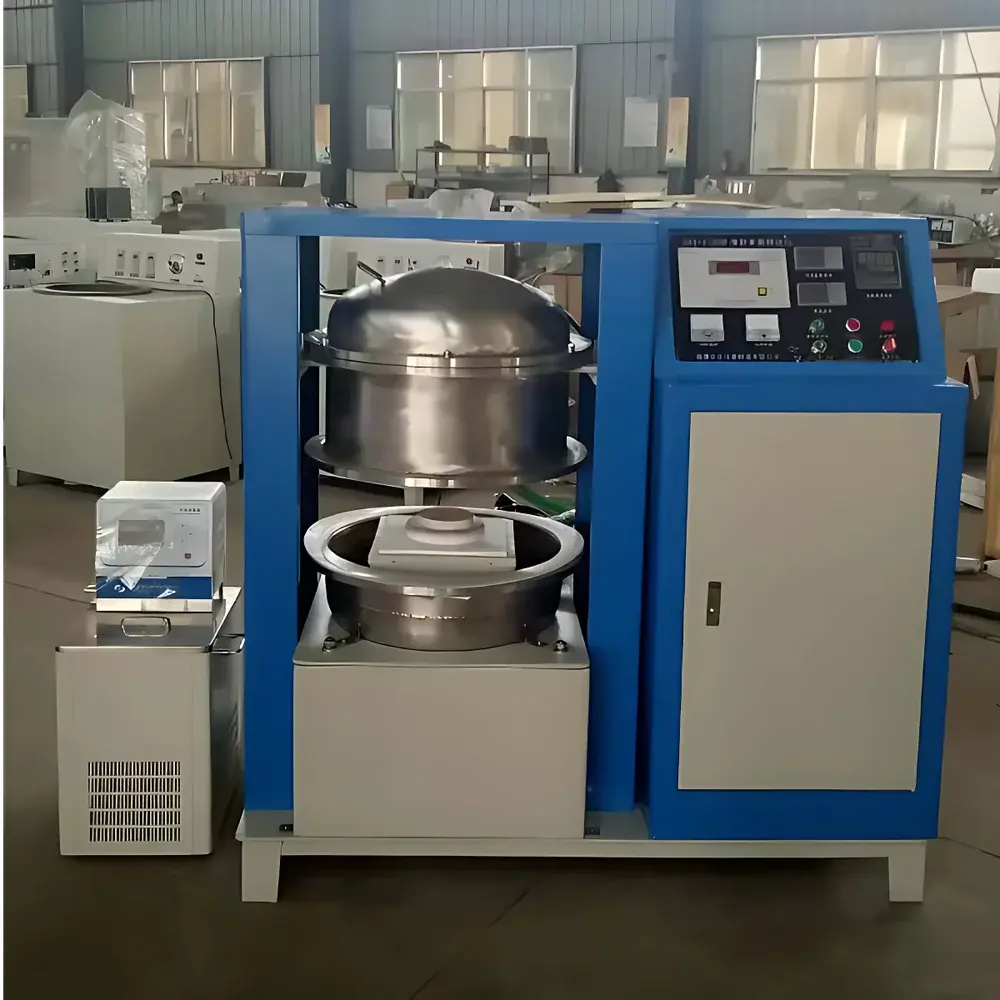
ZHENHUAFENXI DRX-II-SPB High-Temperature Thermal Conductivity Analyzer for Carbon Felt
| Brand | ZHENHUAFENXI |
|---|---|
| Model | DRX-II-SPB |
| Principle | Heat Flow Meter Method (HFMM) |
| Temperature Range | 600–1600 °C |
| Thermal Conductivity Range | 0.001–5 W/(m·K) |
| Accuracy | ±3% |
| Repeatability | ±3% |
| Sample Form | Solid disk (φ119 mm × 35–45 mm) |
| Atmosphere Control | Inert gas (N₂, Ar) or vacuum (≤1000 Pa) |
| Pressure Control | 0–0.1 MPa |
| Heating Element | Molybdenum rod |
| Cooling | External recirculating chiller |
| Sensor | Imported U.S. heat flux transducer |
| Compliance | GB/T 10295, GB/T 17911.8-2002, YB/T 4130-2005 |
| Dimensions (L×W×H) | 1300×800×1450 mm |
| Power Supply | 220 V, 50 Hz |
Overview
The ZHENHUAFENXI DRX-II-SPB High-Temperature Thermal Conductivity Analyzer is an engineered solution for precise measurement of thermal conductivity in low-conductivity refractory and carbon-based solids under extreme thermal conditions. It operates on the standardized heat flow meter method (HFMM), compliant with ASTM C518, ISO 8301, and Chinese national standards GB/T 10295, GB/T 17911.8-2002, and YB/T 4130-2005. Designed specifically for materials such as carbon fiber insulation felts, graphite felts, ceramic fiber composites, and high-purity carbon refractories, the system delivers traceable, reproducible data across a continuous operational range from 600 °C to 1600 °C. The instrument employs dual-plate geometry with guarded hot and cold surfaces, ensuring one-dimensional steady-state heat transfer through the sample. A molybdenum heating element provides stable, uniform furnace temperature profiles, while active water-cooled outer casing maintains thermal isolation and operator safety. The core measurement relies on calibrated, imported U.S.-sourced heat flux sensors mounted at the cold-side interface—enabling direct quantification of heat flux density with minimal calibration drift over extended thermal cycling.
Key Features
- High-temperature capability up to 1600 °C using robust molybdenum rod heating elements with integrated thermal shielding
- Precision-controlled test atmosphere: programmable inert gas purging (N₂, Ar) or vacuum operation down to ≤1000 Pa via integrated vacuum pump interface
- Adjustable axial sample compression (0–0.1 MPa) to ensure consistent interfacial contact and minimize contact resistance artifacts
- Dual-sensor architecture: primary heat flux transducer (U.S.-imported) + redundant thermocouple array (Type S, ±0.5 °C accuracy) for cross-validated temperature gradient monitoring
- Active cooling system: external recirculating chiller maintains cold-plate stability at ambient reference conditions (±0.1 °C) during prolonged high-temperature runs
- Modular hardware design supporting GLP-compliant installation: separate control cabinet, data acquisition unit, and dedicated cooling station for thermal decoupling and service accessibility
- Compliance-ready firmware architecture supporting audit trails, user access levels, and electronic signature protocols aligned with FDA 21 CFR Part 11 requirements
Sample Compatibility & Compliance
The DRX-II-SPB accepts solid cylindrical specimens measuring φ119 mm × 35–45 mm—optimized for industry-standard carbon insulation felts, sintered graphite blocks, silicon carbide composites, and alumina-silica fiber boards. Sample mounting utilizes non-reactive ceramic fixtures and pressure-controlled loading to preserve microstructural integrity without deformation-induced error. All thermal interfaces are coated with high-temperature boron nitride paste to minimize interfacial resistance variability. The system meets metrological traceability requirements per ISO/IEC 17025 when operated within defined environmental limits (ambient humidity <80% RH, stable 220 V/50 Hz supply, floor-mounted vibration isolation). Full compliance documentation—including calibration certificates for heat flux sensors, thermocouples, and pressure transducers—is provided with each shipment. Test reports generated by the software include full metadata: atmospheric composition, vacuum level, applied load, thermal gradient history, and raw sensor outputs—enabling third-party verification per ISO 17025 clause 7.8.2.
Software & Data Management
The included Windows-based analysis suite supports both fully automated and semi-manual test execution modes. During automation, the software orchestrates furnace ramping, atmosphere conditioning, pressure application, data logging (10 Hz sampling), and real-time convergence validation against user-defined stability thresholds (e.g., ΔT < 0.2 °C/10 min). All acquired parameters—including heat flux, mean sample temperature, surface ΔT, and calculated k-value—are stored in structured SQLite databases with embedded timestamps, operator IDs, and instrument configuration snapshots. Export options include CSV, PDF (with embedded digital signatures), and XML formats compatible with LIMS integration. Audit trail functionality records every parameter change, report generation event, and user login/logout with immutable timestamps—meeting GLP/GMP documentation standards. Optional API access enables integration with enterprise MES or QMS platforms via RESTful endpoints.
Applications
- Quality control of carbon fiber insulation felts used in single-crystal silicon growth furnaces (Czochralski process)
- R&D evaluation of next-generation refractory composites for aerospace thermal protection systems (TPS)
- Thermal property certification of graphite components in molten salt nuclear reactor designs
- Validation of thermal barrier coatings on carbon-carbon brake discs under simulated re-entry conditions
- Comparative analysis of oxidation-resistant surface treatments on ceramic fiber modules for industrial kiln linings
- Supporting ASTM E1530 and ISO 22007-2 round-robin interlaboratory studies on high-temperature insulators
FAQ
What sample preparation is required prior to testing?
Samples must be machined to exact dimensions (φ119 mm × 35–45 mm), with parallel, flat faces ground to Ra ≤ 0.8 µm. Surface contamination (oils, oxides, dust) must be removed via ultrasonic cleaning in acetone followed by drying under inert gas purge.
Can the system operate under dynamic gas flow conditions?
Yes—the gas inlet/outlet ports support continuous purge mode with mass flow controllers (optional add-on); standard configuration supports static atmosphere or vacuum hold only.
Is the molybdenum heating element field-replaceable?
Yes—modular furnace assembly allows full element replacement without recalibration; spare parts kit includes alignment jigs and torque-spec fasteners.
Does the software support multi-sample batch processing?
Yes—queue-based workflow manager permits unattended sequential testing of up to 12 samples with automatic report generation and pass/fail flagging against user-defined k-value tolerances.
What maintenance intervals are recommended for long-term accuracy?
Heat flux sensor recalibration every 12 months; thermocouple verification before each high-temperature campaign; vacuum pump oil change every 500 operating hours; chiller fluid exchange biannually.



