
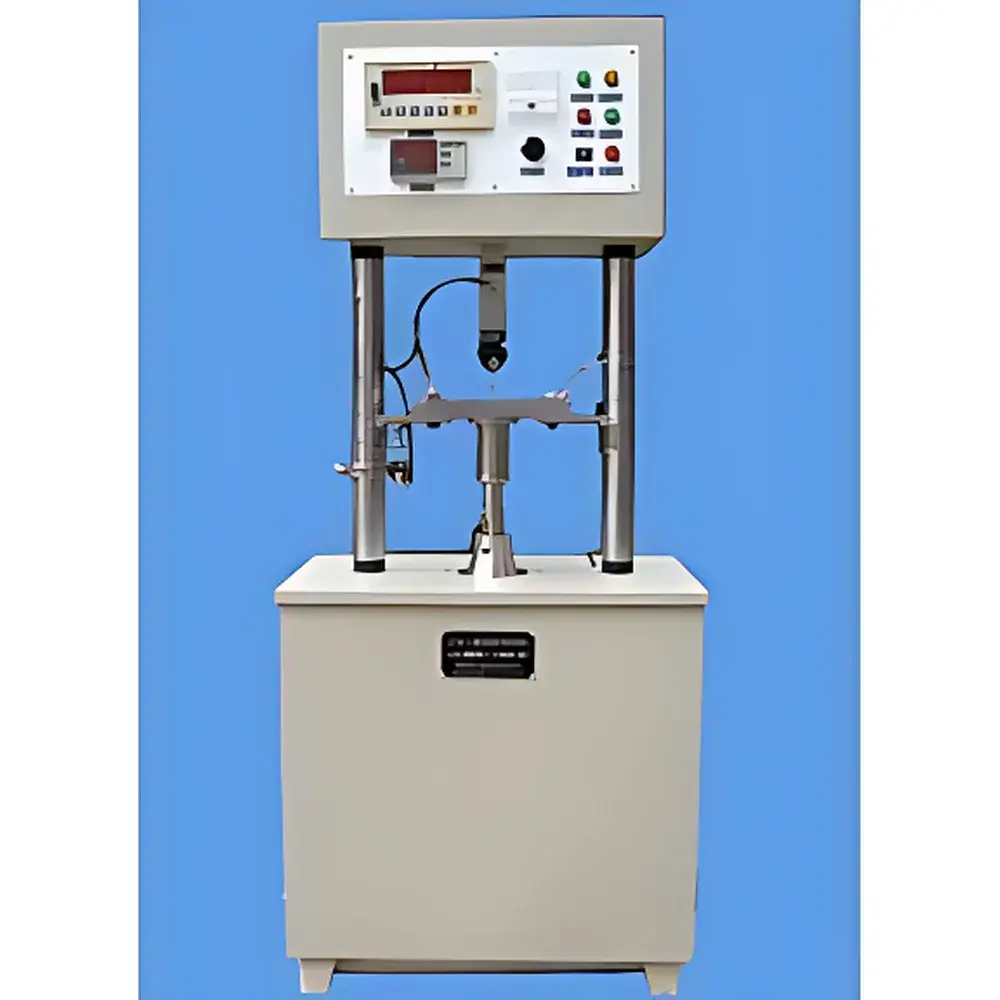
Static Elastic Modulus Tester GTM Series
| Origin | Hunan, China |
|---|---|
| Manufacturer Type | Authorized Distributor |
| Origin Category | Domestic (China) |
| Model | GTM-1 / GTM-2 |
| Load Capacity Options | 0–5 kN, 0–10 kN, 0–20 kN, 0–50 kN |
| Measurement Accuracy (Load) | ±0.15% FS |
| Deflection Range | ±5 mm |
| Deflection Accuracy | ±0.5% FS |
| Crosshead Speed | 0–1 mm/min (adjustable) |
| Temperature Capability | GTM-1 — Ambient only |
| Sample Dimension Tolerance per GB/T 1182 & GB/T 1031 | Parallelism ≤0.02 mm, Perpendicularity ≤0.02 mm, Surface Roughness Rz ≤1.60 µm |
| Compliance Standards | GB 10700–2006, GB/T 6569, GB/T 1182, GB/T 1031 |
Overview
The Static Elastic Modulus Tester GTM Series is a precision mechanical testing system engineered for the deterministic measurement of Young’s modulus (E), shear modulus (G), and Poisson’s ratio (ν) in solid materials via static three-point or four-point bending methods. Based on Hooke’s law and Euler–Bernoulli beam theory, the instrument applies controlled quasi-static loads to standardized rectangular or cylindrical specimens while simultaneously acquiring high-resolution displacement data at the mid-span. The resulting linear region of the stress–strain or load–deflection curve is used to compute elastic modulus with traceable metrological rigor. Designed specifically for brittle and quasi-brittle materials—including engineering ceramics, structural glass, graphite, polymer matrix composites, and metallic alloys—the GTM series meets the stringent geometric and procedural requirements defined in GB 10700–2006 and aligns with internationally recognized test frameworks such as ASTM C1161 (flexural strength of advanced ceramics) and ISO 14704 (fine ceramics – determination of flexural strength). Its static loading architecture eliminates dynamic inertial artifacts, ensuring high reproducibility for quality control, material certification, and R&D validation in both industrial and academic laboratories.
Key Features
- Modular load frame architecture supporting multiple capacity configurations: 5 kN, 10 kN, 20 kN, and 50 kN—each calibrated to ISO 7500-1 Class 0.5 accuracy.
- Dual-mode operation: Three-point bending (for general-purpose modulus evaluation) and four-point bending (to eliminate shear contribution and isolate pure bending strain).
- High-stability temperature chamber integration (GTM-2 model only): Capable of sustained operation from ambient to 1000 °C with ±1 °C thermal uniformity across the specimen zone, enabling high-temperature elastic property mapping per ISO 20502.
- Sub-micron resolution deflection measurement via calibrated linear variable differential transformer (LVDT) or non-contact optical encoder, compliant with GB/T 6569 displacement acquisition protocols.
- Programmable crosshead speed control (0–1 mm/min) with closed-loop feedback, ensuring consistent strain rate application within the linear elastic regime.
- Specimen alignment fixtures with precision-ground support rollers and adjustable loading nose—designed to enforce strict adherence to GB/T 1182 parallelism (≤0.02 mm) and GB/T 1031 surface finish (Rz ≤1.60 µm) tolerances.
Sample Compatibility & Compliance
The GTM Series accommodates specimens fabricated per GB 10700–2006 dimensional specifications: minimum 5 specimens per test batch, rectangular cross-sections with width/thickness measured to ±0.01 mm, and span length verified to ±0.01 mm. Compatible material classes include monolithic oxides (Al₂O₃, ZrO₂), non-oxide ceramics (SiC, Si₃N₄), vitreous silicates, carbon-based refractories, fiber-reinforced thermosets, and wrought or sintered metals. All mechanical test procedures satisfy national metrological verification requirements under JJG 139–2014 (tensile/compression testing machines) and support audit readiness for GLP and ISO/IEC 17025-accredited laboratories. Test reports generated are structured to meet traceability mandates of CNAS-CL01 and may be extended to support FDA 21 CFR Part 11-compliant electronic records when paired with validated software modules.
Software & Data Management
The GTM system integrates with optional PC-based control and analysis software compliant with Windows OS (64-bit). The interface enables real-time visualization of load–deflection curves, automatic identification of the linear elastic segment (slope calculation via least-squares regression), and direct computation of E-modulus using standard beam equations. Raw data export is supported in CSV and XLSX formats; metadata fields include operator ID, calibration certificate number, environmental conditions (temperature/humidity), and specimen geometry logs. Audit trail functionality records all parameter modifications, test starts/stops, and result approvals—meeting documentation requirements for GMP environments and internal quality audits. Optional API access allows integration into LIMS platforms via TCP/IP or RS-232 protocols.
Applications
- Quality assurance of ceramic substrates and insulators in electronics manufacturing.
- Thermo-mechanical characterization of nuclear-grade graphite under elevated temperature conditions (GTM-2).
- Validation of sintering process consistency in powder metallurgy and additive manufacturing feedstock qualification.
- Interlaboratory round-robin studies for elastic property benchmarking across ISO/TC 206 (fine ceramics) working groups.
- Educational use in materials science curricula for hands-on instruction in elasticity theory, fracture mechanics, and standard test method execution.
- Supporting failure analysis investigations where modulus degradation correlates with microstructural evolution (e.g., oxidation-induced embrittlement).
FAQ
What standards does the GTM Series comply with?
The system implements test methodologies aligned with GB 10700–2006, GB/T 6569, GB/T 1182, and GB/T 1031. It is also compatible with ASTM C1161, ISO 14704, and ISO 20502 for international reporting.
Can the GTM-1 operate at elevated temperatures?
No—GTM-1 is rated for ambient-temperature testing only. Elevated-temperature capability (up to 1000 °C) requires the GTM-2 configuration with integrated furnace and thermal shielding.
Is computer interface included as standard equipment?
A basic RS-232 or USB interface is provided for data logging; full PC control and analysis software is available as an optional module with configurable validation packages.
What is the minimum specimen count required per test batch?
Per GB 10700–2006, a minimum of five specimens must be tested to establish statistical confidence in reported modulus values.
How is measurement traceability ensured?
Each GTM unit ships with a factory calibration certificate traceable to NIM (National Institute of Metrology, China), and load cells are certified to ISO 376 Class 0.5; periodic recalibration follows JJG 139–2014 guidelines.



