
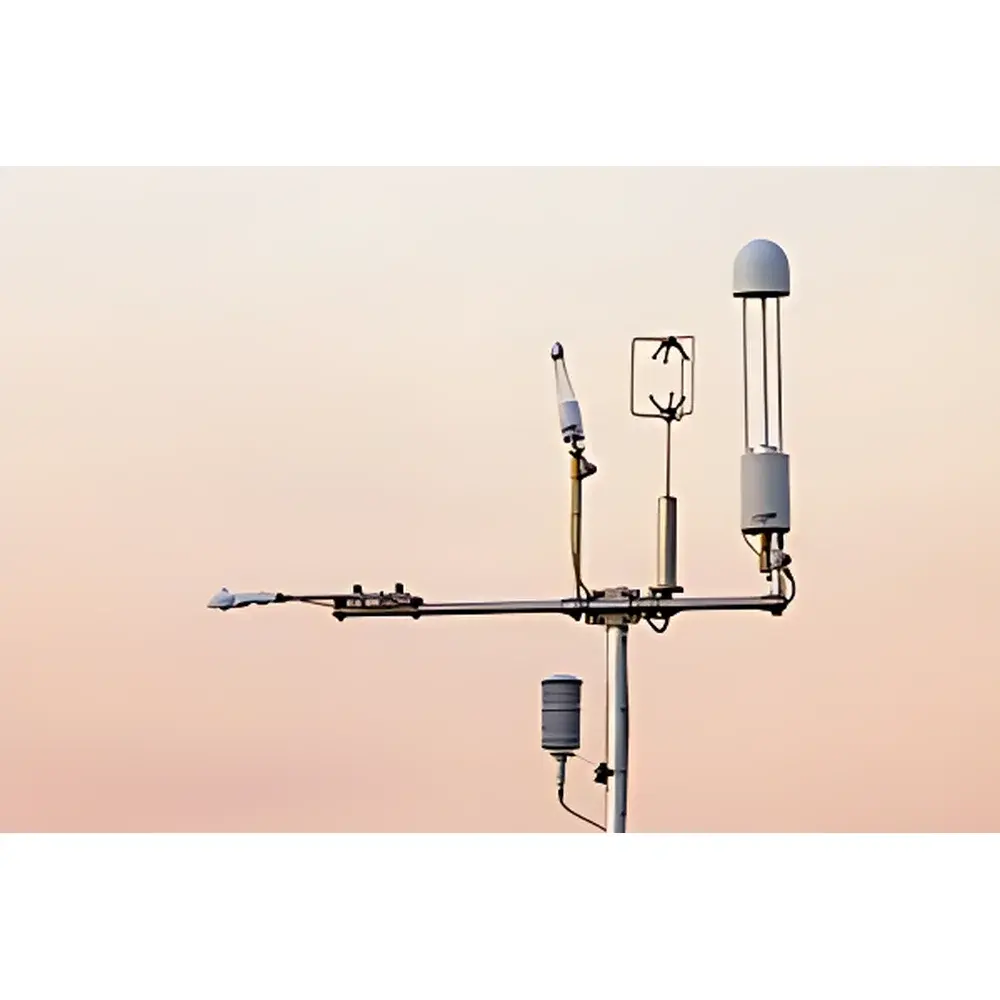
LI-COR GHG Eddy Covariance Flux Measurement System
| Brand | LI-COR |
|---|---|
| Origin | USA |
| Model | GHG-RS2 (with SmartFlux® and LI-7500DS/LI-7700) |
| Instrument Type | Eddy Covariance Flux System for Greenhouse Gases |
| Power Consumption | <12 W (system-wide, solar-compatible) |
| Data Output Frequency | Up to 40 Hz |
| Compliance | ASTM D6348, ISO 14064-3, US EPA GHG Reporting Program (Subpart H), FLUXNET Best Practices |
Overview
The LI-COR GHG Eddy Covariance Flux Measurement System is a field-deployable, scientifically validated platform engineered for high-temporal-resolution quantification of turbulent exchange fluxes of carbon dioxide (CO2), water vapor (H2O), methane (CH4), and sensible/latent heat across ecosystem-atmosphere interfaces. It operates on the eddy covariance principle—a micrometeorological method that computes vertical fluxes by cross-covariancing high-frequency (≥10 Hz) fluctuations in scalar gas concentrations (measured via infrared absorption spectroscopy) with simultaneous three-dimensional wind velocity components (measured via ultrasonic anemometry). Designed for long-term unattended operation in remote or off-grid environments—including tundra, forest canopies, agricultural fields, and wetlands—the system integrates open-path and closed-path analyzers, robust ultrasonic anemometers, biometeorological sensors, and embedded real-time processing architecture to deliver traceable, audit-ready flux data compliant with FLUXNET standards and IPCC Tier 3 reporting requirements.
Key Features
- Integrated SmartFlux® module running EddyPro® firmware onboard—enables real-time flux computation (CO2, H2O, CH4, energy) directly at the measurement site without post-hoc transfer of raw data
- LI-7500DS Open-Path CO2/H2O Analyzer: Digital signal processing architecture, 4 W nominal power draw, temperature-stabilized optical path, and automatic zero/span verification—optimized for low-maintenance deployment over multi-year campaigns
- LI-7700 Open-Path CH4 Analyzer: 40 Hz output, mirror-based auto-cleaning triggered by signal attenuation, pump-free design eliminating inlet lag and pressure-induced phase errors critical for high-frequency covariance accuracy
- Gill WindMaster Pro or uSonic-3 ClassA MP 3D Ultrasonic Anemometer: Precision wind vector measurement with built-in tilt compensation (optional), IP66-rated housing, and calibrated sonic path geometry meeting WMO Guide to Instruments and Methods of Observation (CIMO) specifications
- Biomet Environmental Sensor Suite: Synchronized acquisition of air temperature, relative humidity, photosynthetically active radiation (PAR), net radiation, soil heat flux, and volumetric water content—time-aligned to eddy covariance data streams for gap-filling and footprint-weighted interpretation
- Industrial-grade USB storage with GHG-format binary logging: Self-documenting data files containing instrument metadata, GPS coordinates, sensor calibration history, and full-resolution time series—structured for direct ingestion into EddyPro® and Tovi™ software
Sample Compatibility & Compliance
The system is validated for continuous, in situ monitoring of greenhouse gas exchange from terrestrial and aquatic ecosystems under diverse climatic regimes—from arctic permafrost sites to tropical rainforests. Its open-path configuration avoids sampling artifacts associated with tubing delays, adsorption/desorption, and condensation common in closed-path systems. All core analyzers comply with ISO/IEC 17025-accredited calibration protocols and are traceable to NIST-standard reference gases. Data processing workflows conform to FLUXNET QA/QC Level 1–4 standards and support GLP-compliant audit trails when deployed with EddyPro® Advanced Mode and FluxSuite® cloud logging. The GHG-RS2 configuration meets US EPA Subpart H requirements for facility-level methane monitoring and satisfies ISO 14064-3 criteria for uncertainty quantification in carbon accounting applications.
Software & Data Management
- EddyPro® (Local & Field Edition): Open-source, MATLAB-based software providing both Express (automated) and Advanced (customizable) processing modes—supports coordinate rotation, spectral correction, Webb-Pearman-Leuning (WPL) density corrections, and uncertainty propagation per IUPAC guidelines
- FluxSuite® Cloud Platform: Secure, role-based web interface enabling remote station health monitoring, real-time flux visualization, automated alerting (e.g., signal dropout, power loss, calibration drift), and synchronized multi-site dashboarding—fully compatible with 4G/LTE and Iridium satellite backhaul
- Tovi™ Post-Processing Suite: Graphical desktop application for advanced QA/QC flagging, flux partitioning (e.g., RECO/NEE separation), footprint modeling (using Kljun et al. 2015 algorithm), spatial interpolation, and publication-ready figure generation—imports EddyPro® output without requiring scripting expertise
Applications
This system serves as the de facto standard in ecosystem-scale carbon cycle research, supporting studies in carbon sequestration potential of reforestation projects, methane emissions from rice paddies and peatlands, drought-induced stomatal limitation effects on evapotranspiration, and urban-rural boundary layer exchange dynamics. It is widely deployed in AmeriFlux, Europe’s ICOS network, AsiaFlux, and the global FLUXNET-2015 synthesis dataset. Regulatory applications include verification of carbon offset projects under Verra’s VM0042 methodology, compliance monitoring for landfill gas capture systems, and baseline characterization for nature-based climate solutions under Article 5 of the Paris Agreement.
FAQ
What distinguishes LI-COR’s GHG-RS2 from generic eddy covariance setups?
The GHG-RS2 integrates hardware synchronization, factory-calibrated co-location geometry, and embedded SmartFlux® processing—eliminating inter-device timing offsets and alignment uncertainties inherent in third-party component assemblies.
Can the system operate without grid power?
Yes. Total system power draw remains below 12 W under typical conditions, enabling reliable operation using a 60 W solar panel + 100 Ah deep-cycle battery configuration with >30 days autonomy during winter solstice conditions at 50°N latitude.
Is raw data accessible for custom processing?
All high-frequency time series (anemometer voltages, IR absorption signals, thermistor outputs) are logged in open binary format with documented byte structure—fully compatible with Python (eddyproc), R (REddyProc), and MATLAB custom pipelines.
How is data integrity ensured during transmission?
FluxSuite® implements TLS 1.2 encryption, SHA-256 file hashing, and write-once-read-many (WORM) archival policies on AWS S3 storage—meeting FDA 21 CFR Part 11 requirements for electronic records in regulated environmental monitoring.
Does LI-COR provide technical support for flux processing methodology?
Yes. LI-COR offers annual workshops on eddy covariance theory, EddyPro® configuration, and FLUXNET-compliant reporting—delivered by PhD-level flux scientists with >15 years of field experience across six continents.
Related Products







