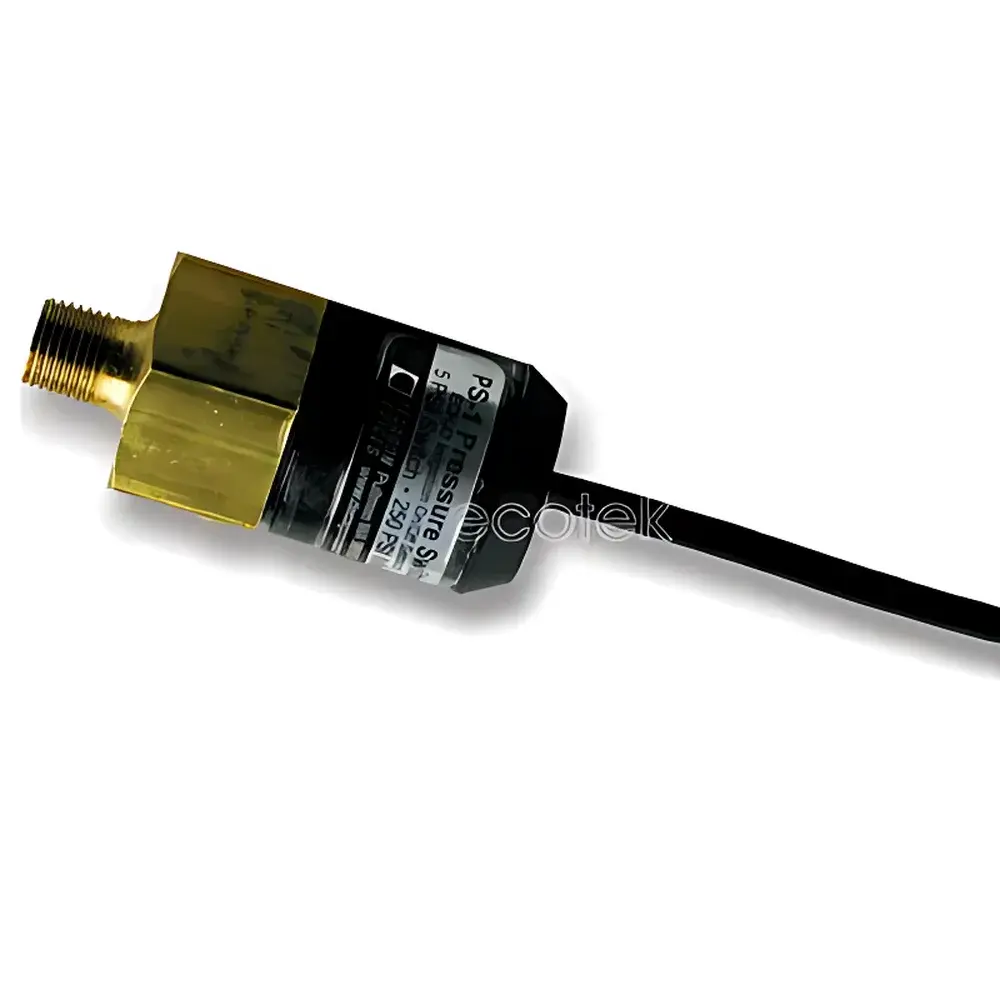
PS-1 Irrigation Status Sensor
| Brand | METER |
|---|---|
| Origin | USA |
| Model | PS-1 |
| Setpoint | 5 psi (±1.0 psi) |
| Max Operating Pressure | 250 psi |
| Burst Pressure | 750 psi |
| Thread Interface | 1/8" NPT male brass |
| Enclosure Rating | NEMA 4 & 13 |
| Diaphragm Material | Buna-N (Nitrile Rubber) |
| Cable | 5 m, 3.5 mm stereo jack |
| Compatible Loggers | ZL6, EM50, EM60 series |
Overview
The PS-1 Irrigation Status Sensor is an industrial-grade pressure-actuated switch designed to objectively detect and log the operational state of irrigation systems in real time. Engineered by METER Group (formerly Decagon Devices), this sensor operates on a reliable mechanical pressure threshold principle: it registers an “ON” state when system line pressure reaches or exceeds 5 psi (±1.0 psi), corresponding to the typical minimum activation pressure of solenoid valves and drip emitters in agricultural and landscape irrigation networks. Unlike binary flow meters or current-sensing relays, the PS-1 directly monitors hydraulic pressure—providing unambiguous, physically grounded confirmation that water is being delivered under pressure. Its output is a TTL-level digital signal (open-collector) that integrates natively with METER’s ZL6, EM50, and EM60 data loggers, enabling synchronized timestamped logging alongside soil moisture, temperature, and EC measurements. This co-located, multi-parameter dataset forms the empirical foundation for irrigation performance auditing, scheduling optimization, and water-use efficiency reporting.
Key Features
- Pressure-triggered binary detection calibrated at 5 psi ±1.0 psi—optimized for low-pressure drip and micro-irrigation systems
- Robust brass 1/8″ NPT male thread interface ensures leak-tight installation directly into PVC, polyethylene, or metal irrigation lines
- NEMA 4 & 13-rated enclosure provides protection against dust, hose-directed water, and oil-laden atmospheres—suitable for outdoor deployment in humid, dusty, or chemically exposed environments
- Buna-N (nitrile rubber) diaphragm offers excellent resistance to aliphatic hydrocarbons, vegetable oils, and common irrigation water constituents including chlorine residuals up to 5 ppm
- 5-meter shielded cable with 3.5 mm stereo plug enables plug-and-play connectivity to METER’s ecosystem without external power supplies or signal conditioning
- Rated for continuous operation at up to 250 psi and certified burst pressure of 750 psi—exceeding ASME B31.4 pipeline safety margins for agricultural distribution systems
Sample Compatibility & Compliance
The PS-1 is compatible with pressurized irrigation infrastructure operating within standard agricultural pressure ranges (0–250 psi). It is validated for use with potable water, reclaimed water (per EPA Guidelines for Water Reuse), and nutrient solutions containing ≤1000 ppm total dissolved solids (TDS). The sensor complies with IEC 60529 for ingress protection (IP65 equivalent per NEMA 4), and its electrical interface meets UL 508 industrial control equipment requirements. While not intrinsically safe, it is suitable for Class I, Division 2 hazardous locations when installed per NEC Article 501. The Buna-N diaphragm conforms to FDA 21 CFR §177.2600 for indirect food-contact applications—supporting use in orchard, vineyard, and nursery settings where irrigation water contacts edible crops.
Software & Data Management
Data from the PS-1 is logged as a discrete Boolean channel (0 = OFF, 1 = ON) within METER’s cloud-connected ZL6 and EM-series logger firmware. Time-stamped status transitions are automatically aligned with concurrent soil volumetric water content (VWC), soil temperature, and electrical conductivity (EC) readings—enabling cross-parameter correlation in METER’s cloud platform, ZENTRA Cloud. Users can generate custom reports showing cumulative irrigation duration per zone, lag time between valve actuation and soil wetting front advancement, and statistical analysis of irrigation event frequency versus precipitation or evapotranspiration (ETo) thresholds. Audit trails include full metadata (logger ID, firmware version, GPS location, and sensor calibration history), satisfying GLP-compliant recordkeeping requirements under ISO/IEC 17025 and USDA NRCS EQIP documentation standards.
Applications
- Validation of automated irrigation controller outputs against actual hydraulic delivery—identifying valve failures, clogged emitters, or pressure loss due to pipe scaling
- Quantifying irrigation efficiency metrics such as Distribution Uniformity (DU) and Application Efficiency (AE) when paired with spatially distributed soil moisture sensors
- Supporting deficit irrigation protocols in viticulture and tree nut production by correlating irrigation timing with root-zone water depletion curves
- Long-term monitoring of irrigation system performance degradation across seasons—detecting gradual pressure decay indicative of pump wear or filter fouling
- Integration into university extension irrigation training modules and USDA-ARS field trials requiring objective, timestamped irrigation event logs
FAQ
How does the PS-1 differ from a flow meter?
The PS-1 detects pressure presence—not flow rate. It confirms whether water is being actively delivered under pressure, avoiding false positives from static head or trapped air that may register as flow in turbine-based meters.
Can the PS-1 be used with non-METER loggers?
Yes—its open-collector digital output is compatible with any data logger accepting 3–15 V DC sinking input; however, the 3.5 mm stereo jack requires custom adapter wiring for non-METER systems.
Is recalibration required over time?
No scheduled recalibration is specified; the mechanical pressure switch design exhibits long-term hysteresis stability <0.5% FS/year under continuous 25°C ambient conditions, per METER’s ISO 17025-accredited test reports.
What is the maximum recommended cable run beyond the standard 5 m?
For signal integrity, total loop resistance should remain below 1 kΩ; extending beyond 15 m requires twisted-pair shielded cable and local pull-up resistor configuration per EM50 hardware manual Section 4.3.
Does the PS-1 support Modbus or SDI-12 communication?
No—it is a dedicated binary status sensor with analog-compatible voltage output only; protocol-based communication requires integration via METER’s ZL6 gateway or third-party PLC interfacing.