
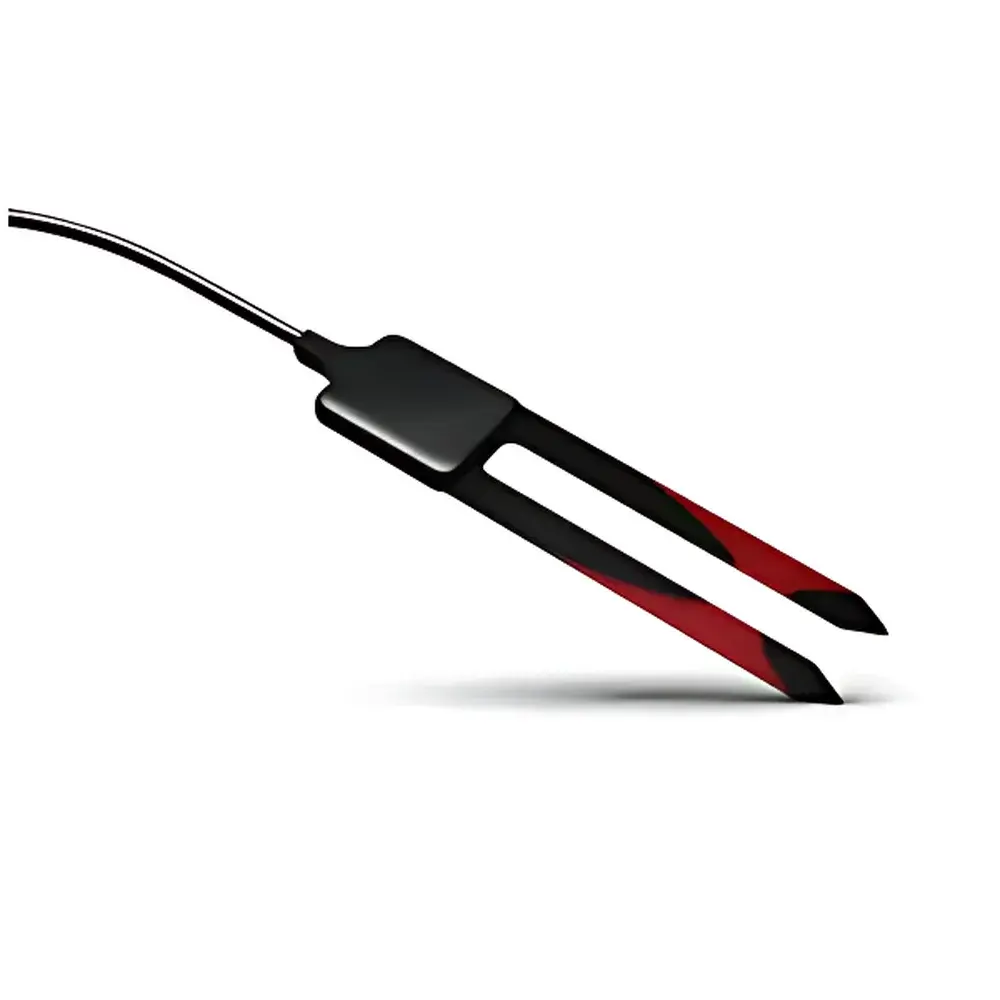
METER 10HS Volumetric Water Content Sensor
| Brand | METER |
|---|---|
| Origin | USA |
| Model | 10HS |
| Sensor Type | Capacitive (Frequency Domain) |
| Operating Voltage | 3–15 VDC |
| Output Signal | 300–1250 mV (ratiometric, voltage-independent) |
| Measurement Volume | 1320 cm³ |
| Probe Length | 10 cm |
| Dimensions | 16.0 × 3.3 × 0.8 cm |
| Standard Cable Length | 5 m (custom up to 40 m) |
| Connector | 3.5 mm stereo jack or tinned 3-wire lead |
| Operating Temperature | –40 to +50 °C |
| Resolution | 0.0008 m³/m³ (0.08% VWC) in mineral soils (0–50% VWC) |
| Accuracy (mineral soils, standard calibration) | ±0.03 m³/m³ or ±3% VWC (EC < 10 dS/m) |
| Accuracy (soil-specific calibration) | ±0.02 m³/m³ or ±2% VWC |
| Dielectric Range | εₐ = 1–80 |
| Measurement Time | 10 ms |
| Compliance | ISO 9001:2015, CE (2014/30/EU, 2011/65/EU), EN 61326-1:2013, EN 50581:2012 |
Overview
The METER 10HS Volumetric Water Content (VWC) Sensor is a high-stability, frequency-domain capacitive sensor engineered for precise, long-term monitoring of soil moisture in mineral soils and non-soil media. Operating at a fixed 70 MHz oscillation frequency—identical to the widely deployed EC-5 sensor—the 10HS leverages mature dielectric spectroscopy principles to measure the apparent dielectric permittivity (εa) of the surrounding medium, which correlates directly with volumetric water content via established empirical or site-specific calibrations. Its robust design eliminates the need for sensor-specific voltage compensation: an integrated voltage regulator ensures stable excitation across a broad 3–15 VDC supply range, while maintaining output linearity and eliminating recalibration when interfacing with diverse data loggers. With a total sensing volume of 1320 cm³—significantly larger than comparable compact probes—the 10HS delivers enhanced spatial representativeness, reducing point-measurement bias in heterogeneous field conditions.
Key Features
- Wide excitation voltage tolerance (3–15 VDC) with on-board voltage regulation—no firmware or coefficient adjustment required when switching power sources or loggers
- Large effective measurement volume (1320 cm³) improves statistical representativeness in structured or layered soils
- Voltage-independent analog output (300–1250 mV) referenced to supply voltage—ensures signal integrity across variable battery or solar-powered deployments
- Fast 10 ms measurement cycle enables high-frequency sampling for transient hydrological studies or irrigation control feedback loops
- Compact, rugged probe geometry (16.0 × 3.3 × 0.8 cm; 10 cm active length) facilitates installation in augered holes, access tubes, or embedded matrices without significant soil disturbance
- CE-marked and compliant with EN 61326-1:2013 (EMC for laboratory and industrial use) and EN 50581:2012 (RoHS conformity assessment)
Sample Compatibility & Compliance
The 10HS is optimized for mineral soils (sand, loam, clay) with bulk electrical conductivity ≤10 dS/m. Under standard factory calibration (based on the Topp equation and verified against gravimetric standards), it achieves ±0.03 m³/m³ (±3% VWC) accuracy across the 0–50% VWC range. For organic-rich, saline, or highly variable substrates—including potting mixes, compost, or volcanic ash—site-specific calibration using parallel gravimetric or neutron probe validation is recommended to achieve ±0.02 m³/m³ (±2% VWC) performance. The sensor meets ISO 9001:2015 manufacturing quality requirements and carries CE marking under EU directives 2014/30/EU (EMC) and 2011/65/EU (RoHS). While not intrinsically certified for hazardous locations, its low-power operation (12–15 mA @ 3–15 VDC) and non-invasive measurement principle support deployment in USDA NRCS, USGS, and FAO-aligned environmental monitoring networks requiring traceable, auditable data acquisition.
Software & Data Management
The 10HS outputs a ratiometric analog voltage signal compatible with any data logger supporting single-ended voltage measurement and ≥12-bit resolution—including METER’s ZL6, EM50, and EM60 series, Campbell Scientific CR1000X/CR6, Onset HOBO UX120, and Decagon legacy platforms. No proprietary software is required for basic acquisition; however, METER’s cloud-based ZENTRA Cloud platform provides automated calibration application, time-series visualization, QA/QC flagging (e.g., temperature-compensated drift detection), and export to CSV/NetCDF formats compliant with FAIR (Findable, Accessible, Interoperable, Reusable) data principles. All raw εa and derived VWC values retain full metadata (timestamp, logger ID, probe serial, supply voltage, temperature), satisfying GLP-aligned audit trails per ISO/IEC 17025:2017 Annex A.2 for environmental testing laboratories.
Applications
- Long-term agro-hydrological monitoring in precision irrigation scheduling and deficit irrigation trials
- Soil moisture profiling in vadose zone studies, including infiltration experiments and evapotranspiration partitioning
- Calibration and validation of satellite-based soil moisture products (e.g., SMAP, Sentinel-1)
- Green infrastructure performance assessment—bioswales, rain gardens, and permeable pavements
- Ecological research on plant-water relations, root-zone dynamics, and drought stress thresholds
- Environmental compliance monitoring for landfill cover systems and containment barriers
FAQ
Does the 10HS require recalibration when used with different data loggers?
No. Its internal voltage regulator and ratiometric output architecture ensure consistent performance across all compatible loggers—no coefficient modification is necessary.
Can the 10HS be used in saline or organic soils?
Yes—but standard calibration accuracy degrades above 10 dS/m EC or in high-OM (>20%) soils. Site-specific calibration using local soil samples is strongly advised to maintain ±0.02 m³/m³ accuracy.
What is the maximum cable length supported without signal degradation?
Factory-tested and guaranteed up to 40 m with standard shielded twisted-pair cabling. Beyond 20 m, we recommend verifying noise immunity in situ using a calibrated reference logger.
Is temperature compensation built into the sensor?
The 10HS does not include an integrated temperature sensor. However, its dielectric response exhibits minimal thermal hysteresis (<0.001 m³/m³/°C) within –40 to +50 °C, and external temperature data can be applied post-acquisition for advanced correction models.
How does the 10HS differ from the EC-5 sensor?
While both operate at 70 MHz, the 10HS features a larger sensing volume (1320 cm³ vs. 210 cm³), extended voltage range (3–15 VDC vs. 5–15 VDC), and improved low-VWC resolution—making it better suited for coarse-textured or low-moisture soils where spatial averaging enhances reliability.







