
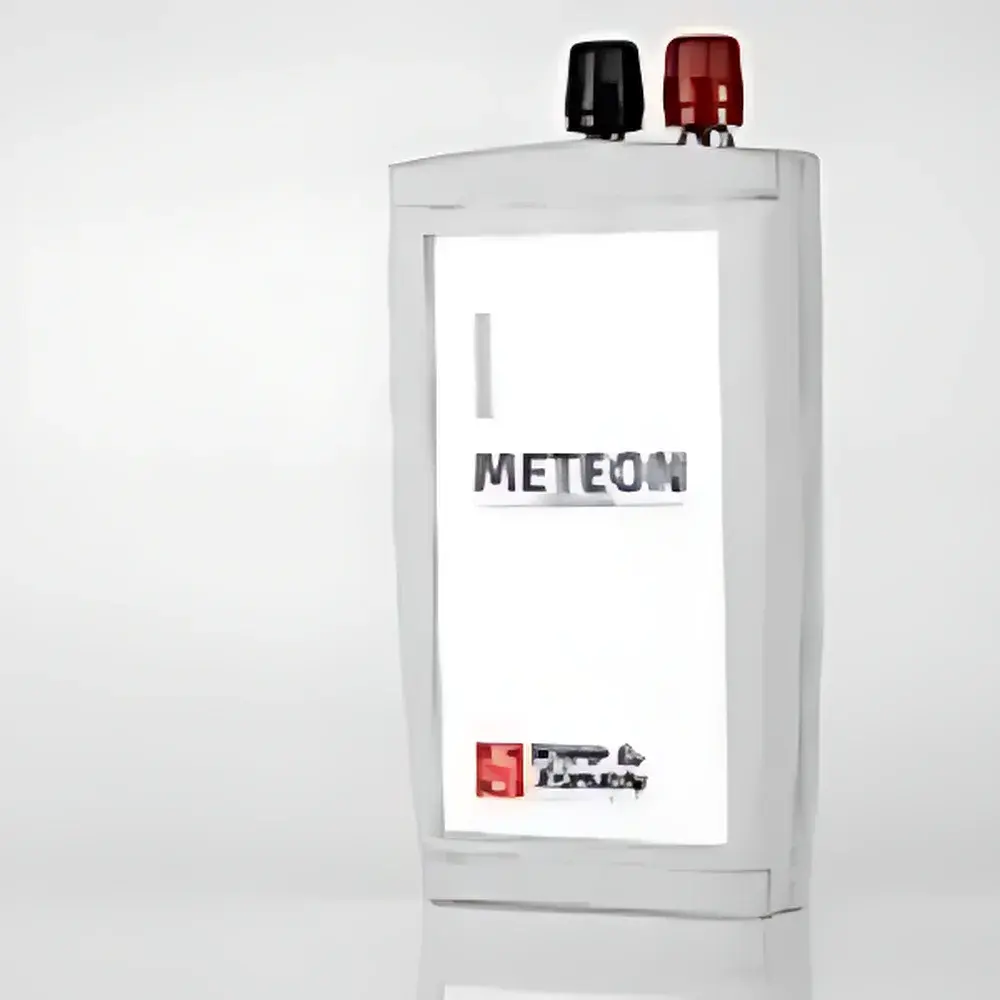
Kipp & Zonen METEON 2.0 Portable Solar Radiation Data Logger
| Brand | Kipp & Zonen |
|---|---|
| Origin | Netherlands |
| Model | METEON 2.0 |
| Storage Capacity | 3500 samples |
| Input Channels | 5 smart + 1 analog radiation sensors + 1 PV panel temperature sensor + 1 S0 kWh pulse input |
| Power Supply | Internal AA batteries (6) |
| Environmental Rating | Weather-resistant for outdoor deployment |
| Communication | USB, Bluetooth (METEON 2.0) |
| Compatibility | Modbus RTU, analog voltage/current (4–20 mA, 0–1 V, 0–5 V, 0–10 V) |
| Mounting Accessories | CVF4 ventilator, CMF1/CMF4 mounts, CMB1 universal mast bracket, CLF4 leveling fixture, AMPBOX signal conditioner, CM121B/C shading ring, anti-glare hood kit |
Overview
The Kipp & Zonen METEON 2.0 is a compact, handheld solar radiation data logger engineered for precision photovoltaic (PV) performance monitoring and solar resource assessment. Unlike general-purpose loggers, it is purpose-built to interface natively with Kipp & Zonen’s intelligent pyranometers (e.g., SMP series), thermopile-based irradiance sensors (CMP series), and complementary environmental sensors—including Mencke & Tegtmeyer PV module temperature probes and kWh energy meters via S0 pulse counting. Its measurement architecture adheres to the principles of thermoelectric detection and calibrated analog-to-digital conversion, ensuring traceability to WRR (World Radiometric Reference) through sensor-level calibration certificates. Designed for field-deployable reliability, the METEON 2.0 operates independently of external power infrastructure, drawing from six internal AA batteries—enabling multi-week autonomous operation under typical solar monitoring duty cycles. The device supports real-time display of irradiance (W/m²), integrated dose (kWh/m²), temperature, and energy yield metrics, with all data timestamped to UTC and stored in non-volatile memory.
Key Features
- Simultaneous acquisition from up to five smart radiation sensors (Modbus RTU) and one analog input—supporting both voltage (0–10 V) and current (4–20 mA) signal types.
- Dedicated S0 pulse input for kWh meter integration, enabling direct correlation between incident solar irradiance and AC energy output.
- Integrated PV panel temperature sensing via Mencke & Tegtmeyer-compatible 10 kΩ NTC or PT1000 inputs—critical for performance ratio (PR) and temperature-corrected yield analysis.
- Ruggedized IP65-rated enclosure with rubberized grip and sunlight-readable LCD—designed for operation across –20 °C to +60 °C ambient conditions.
- Onboard data storage capacity of 3,500 timestamped records; expandable via periodic USB or Bluetooth export to PC or mobile devices.
- Configurable logging intervals (1 sec to 24 hrs), arithmetic channel calculation (e.g., GHI − DHI = DNI), and alarm-triggered event logging.
Sample Compatibility & Compliance
The METEON 2.0 is validated for use with ISO 9060:2018 Class A and Class B pyranometers, including Kipp & Zonen CMP21, CMP22, SMP10, and SMP11 models. It fully supports the digital Modbus RTU protocol implemented in Kipp & Zonen’s Smart Sensor line, preserving factory calibration coefficients and spectral correction factors within each reading. When deployed with CVF4 ventilation units or CM121B/C shading rings, the system meets IEC 61724-1:2021 requirements for PV system monitoring accuracy. All accessories—including CMB1 mast brackets, CMF4 mounting kits, and CLF4 leveling fixtures—are mechanically designed to maintain sensor alignment within ±0.2° of horizontal, satisfying ASTM E892 and ISO 9060 angular response specifications. No proprietary firmware or cloud dependency is required for regulatory compliance; raw binary or CSV exports support GLP-aligned audit trails.
Software & Data Management
Data retrieval and configuration are managed via Kipp & Zonen’s free LOGVIEW software (Windows/macOS), which provides time-synchronized multi-channel visualization, linear regression diagnostics, and automated report generation in PDF or Excel formats. The METEON 2.0 stores metadata—including sensor serial numbers, calibration dates, and installation geometry—in each data file header, enabling full chain-of-custody documentation. For remote deployments, the companion LOGBOX SE variant extends functionality with embedded GSM/GPRS telemetry, configurable SMS alerts, and FTP/HTTP(S) push to secure enterprise servers. Both devices support user-defined data validation rules (e.g., irradiance >0 W/m² during daylight hours) and generate checksum-verified logs compliant with ISO/IEC 17025 documentation standards.
Applications
- Utility-scale PV plant performance verification per IEC 61724-1 Tier B monitoring protocols.
- Research-grade solar resource mapping for site feasibility studies and bankable energy yield assessments.
- Calibration validation of reference cells and secondary standard pyranometers in field laboratories.
- Long-term degradation analysis using co-located GHI, DHI, and module temperature data streams.
- Educational solar meteorology stations requiring portable, self-contained instrumentation with minimal setup overhead.
FAQ
Does the METEON 2.0 require external power for continuous operation?
No—it operates autonomously on six AA alkaline or lithium batteries, delivering up to eight weeks of logging at 1-minute intervals under typical conditions.
Can it log data from third-party pyranometers with analog outputs?
Yes, provided they output standard 0–1 V, 0–5 V, 0–10 V, or 4–20 mA signals; calibration coefficients must be manually entered into LOGVIEW.
Is Modbus communication encrypted or authenticated?
Modbus RTU over RS-485 is unencrypted by design; however, physical layer security and local network isolation are recommended for sensitive installations.
How is sensor tilt angle accounted for in irradiance calculations?
Tilt geometry is configured during setup in LOGVIEW; the device applies no real-time correction but stores tilt metadata for post-processing with transposition models (e.g., Perez, Hay-Davies).
Are firmware updates field-installable?
Yes—via USB or Bluetooth using LOGVIEW; update packages include version-controlled release notes and SHA-256 integrity hashes.
Related Products







