
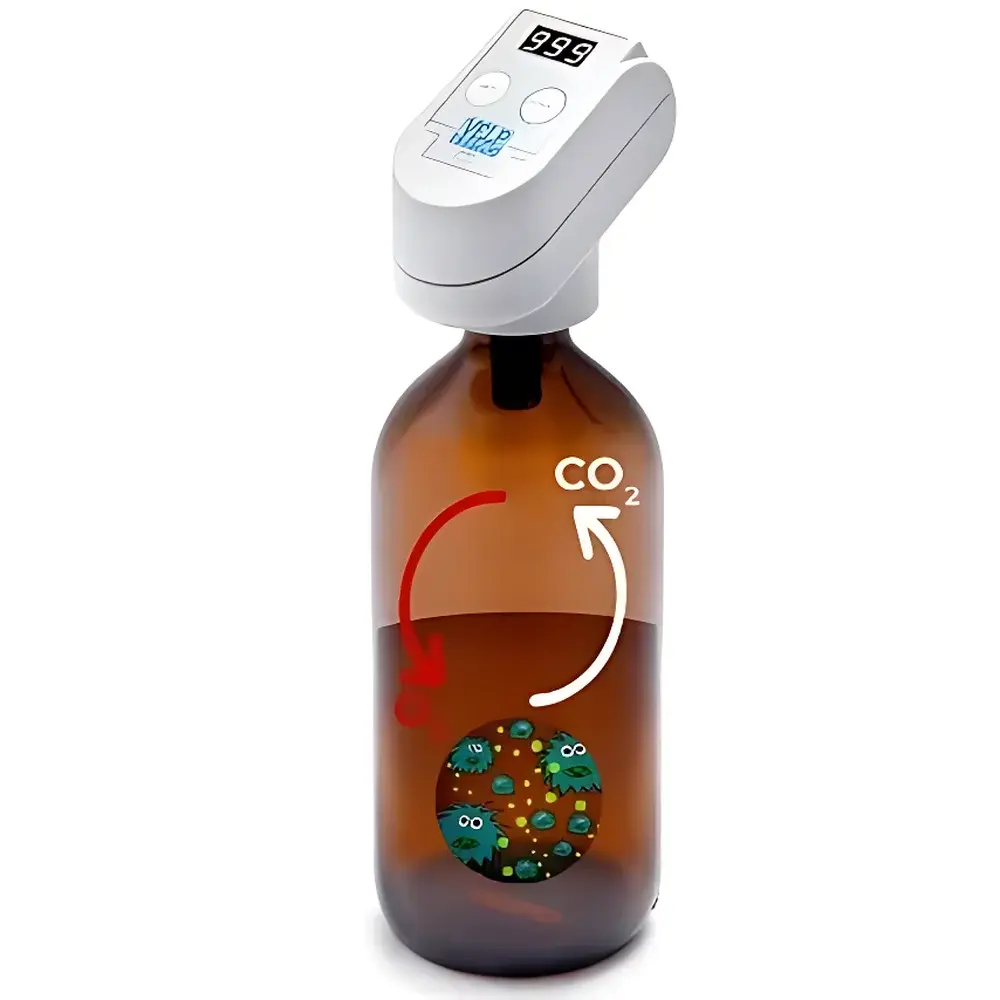
VELP BODAuto 5000 Pressure-Difference Based Automated BOD Analyzer
| Brand | VELP |
|---|---|
| Origin | Italy |
| Model | BODAuto 5000 |
| Principle | Pressure-difference (manometric) method |
| Measurement Range | 90–999 mg/L (extendable to 4000 mg/L via dilution) |
| Detection Limit | 90 mg/L |
| Accuracy | ±1 mg/L |
| Single-sample Analysis Time | 1 min |
| Repeatability | ±1% RSD |
| Sample Volume | 500 mL |
| Sensor Display | 3-digit LED, direct mg/L readout |
| Data Logging | Automatic BOD value storage every 24 h (up to 5 values) |
| Sensor Housing Material | High-performance polymer |
| Sensor Power | 2 × CR2430 lithium batteries (6 V total) |
| Ingress Protection | IP54 (IEC/EN 60529) |
| Safety Compliance | IEC/EN 61010-1 |
| Standards Conformance | ISO 5815-1:2019, Standard Method 5210D |
| Dimensions (Sensor) | 55 × 71 × 73 mm |
| Weight (Sensor) | 0.08 kg |
| Dimensions (Analyzer Unit) | 75 × 230 × 75 mm |
| Weight (Analyzer Unit) | 0.4 kg |
| Optional Configurations | 6-position and 10-position magnetic stirring systems (FOC 200E incubator compatible) |
| Accessories | Calibration kit (A00000135), Control test tablets (A00000136, 8 pcs/box) |
Overview
The VELP BODAuto 5000 is a fully automated, pressure-difference based biochemical oxygen demand (BOD) analyzer engineered for precise, unattended determination of BOD5, BOD6, and BOD10 in wastewater, surface water, and effluent samples. Operating on the manometric principle defined in ISO 5815-1:2019 and Standard Method 5210D, the system quantifies oxygen consumption by aerobic microorganisms during biodegradation of organic matter under controlled incubation conditions. A sealed 500 mL amber glass bottle houses the sample and nutrient medium; microbial respiration consumes dissolved oxygen and generates CO2, which is immediately absorbed by potassium hydroxide (KOH) placed in the neck reservoir. This absorption creates a measurable pressure drop proportional to oxygen depletion—captured in real time by a high-stability, mercury-free pressure transducer integrated directly into the sensor head. The instrument computes and displays BOD concentration directly in mg/L without manual calculation or calibration curve interpolation.
Key Features
- Direct mg/L readout via 3-digit LED display—no post-processing required
- Integrated pressure sensor mounted directly on the reaction vessel for minimal dead volume and maximal signal fidelity
- Automated data logging: stores five BOD values at 24-hour intervals, enabling full BOD5 kinetic profiling with timestamped records
- Uninterrupted operation up to 10 days—designed for walk-away monitoring in compliance with GLP and routine environmental lab workflows
- IP54-rated sensor housing ensures dust resistance and protection against low-pressure water jets—suitable for humid incubator environments
- Magnetic stirring integration (optional BOD-6 or BOD-10 systems) maintains homogeneous suspension of biomass and prevents boundary-layer oxygen limitation
- Compatible with VELP FOC 200E incubators: up to four 6-position systems fit per unit, optimizing space and temperature uniformity across multi-sample runs
- Onboard validation using certified control test tablets (A00000136) enables daily system performance verification and sensor drift correction per QA/QC protocols
Sample Compatibility & Compliance
The BODAuto 5000 accepts standard 500 mL BOD bottles and accommodates undiluted samples within the 90–999 mg/L range; higher-concentration samples (up to 4000 mg/L) are supported through standardized dilution per ISO 5815-1. The system complies with internationally recognized regulatory frameworks for environmental testing, including ISO 5815-1:2019 (Water quality — Determination of biochemical oxygen demand after n days — Part 1: BOD5 using dilution and seeding) and Standard Method 5210D (Manometric BOD). Its design supports traceable, auditable workflows aligned with EPA-recommended practices and laboratory accreditation requirements (e.g., ISO/IEC 17025). All hardware—including KOH absorbent holders, PTFE-sealed caps, and inert polymer sensor housings—is chemically resistant and non-leaching, eliminating interference from device materials.
Software & Data Management
While the BODAuto 5000 operates as a standalone instrument with embedded firmware, its data architecture supports seamless integration into LIMS and electronic lab notebook (ELN) ecosystems. Logged BOD values are retained in non-volatile memory and retrievable via front-panel interface at any time. For laboratories requiring enhanced traceability, optional USB export modules (not included) enable CSV-formatted output compliant with FDA 21 CFR Part 11 requirements when paired with validated software. Audit trails—including sensor initialization time, incubation start/end timestamps, and control tablet verification logs—are maintained internally. Battery-powered operation (CR2430 ×2) ensures uninterrupted measurement continuity during power fluctuations common in shared incubator circuits.
Applications
- Routine BOD5 analysis in municipal wastewater treatment plants for process control and discharge compliance reporting
- Environmental monitoring of river, lake, and estuarine waters under national water framework directives
- Industrial effluent characterization in food processing, pharmaceutical, and pulp & paper sectors
- Research-grade biodegradability screening of novel surfactants, polymers, and agrochemical formulations
- Educational laboratories requiring robust, low-maintenance instrumentation for undergraduate water quality curricula
- Third-party testing labs performing accredited environmental analyses under ISO/IEC 17025 scope
FAQ
How does the pressure-difference method differ from dilution-thiosulfate (Winkler) or optical DO-based BOD systems?
The manometric method measures cumulative oxygen uptake via sealed-bottle pressure decay, eliminating reliance on dissolved oxygen probes subject to membrane fouling or calibration drift. It provides inherent compensation for CO2 accumulation and delivers higher reproducibility in heterogeneous or particulate-laden samples.
Can the BODAuto 5000 be used for BOD20 or extended incubation periods?
Yes—the instrument supports user-defined incubation durations beyond 5 days; however, BOD5 remains the regulatory benchmark. Extended runs require periodic sensor verification using control tablets to ensure long-term pressure transducer stability.
Is the system compatible with existing VELP incubators other than FOC 200E?
The BOD-6 and BOD-10 configurations are mechanically and thermally optimized for FOC 200E; compatibility with other models (e.g., FOC 100, FOC 300) requires dimensional verification and may necessitate custom mounting brackets.
What maintenance is required for the pressure sensor?
No routine calibration is needed. Annual verification using the A00000135 calibration kit and daily validation with A00000136 control tablets fulfill preventive maintenance requirements per ISO/IEC 17025 Clause 6.4.
Does the analyzer meet GLP or GMP documentation standards?
The device supports GLP-compliant operation through timestamped, tamper-evident internal logging. Full GMP alignment (e.g., 21 CFR Part 11) requires integration with validated third-party data acquisition software and procedural controls for electronic signatures and audit trail review.
Related Products







