
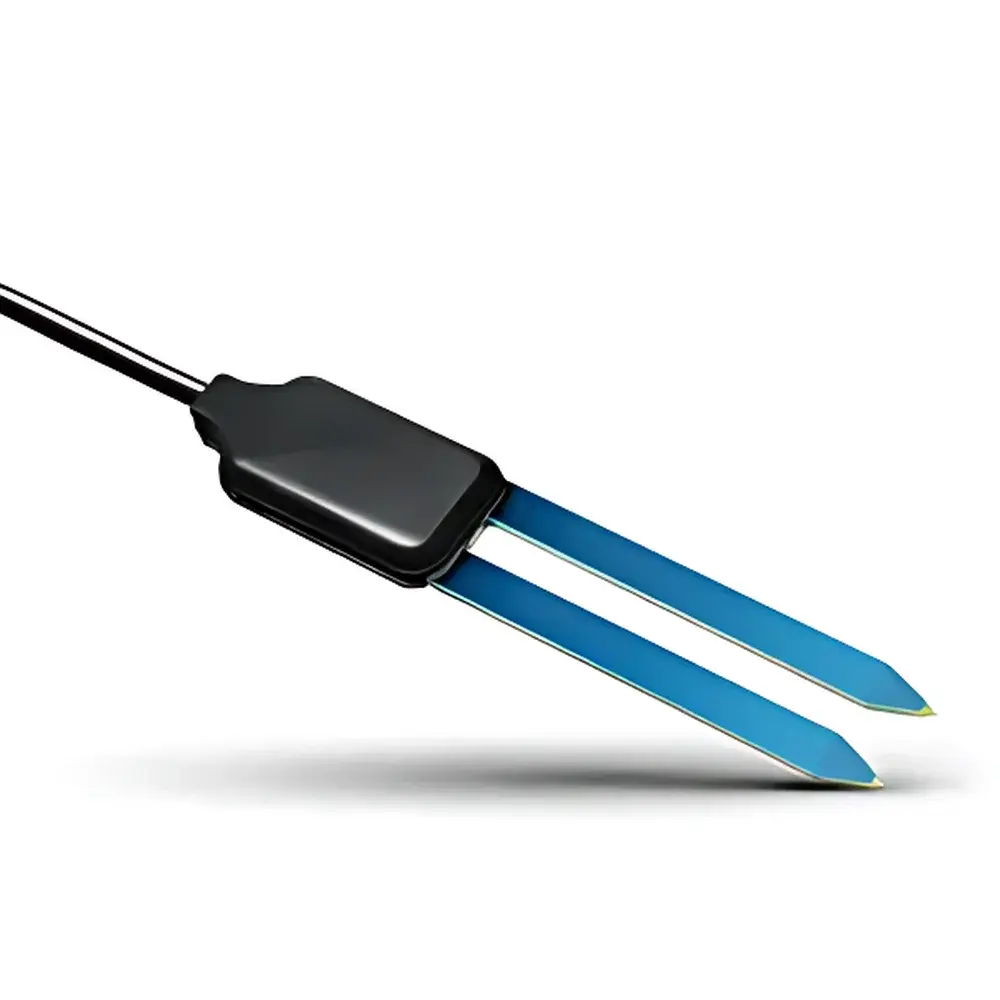
METER EC-5 Compact Soil Moisture Sensor
| Brand | METER |
|---|---|
| Origin | USA |
| Manufacturer | METER Group, Inc. (formerly Decagon Devices) |
| Model | EC-5 |
| Measurement Principle | High-Frequency Capacitance (5 MHz) |
| Volumetric Water Content (VWC) Range | 0–100% |
| Accuracy (Mineral Soils, EC < 8 dS/m) | ±3% VWC (±2% with soil-specific calibration) |
| Resolution | 0.1% VWC (mineral soils), 0.25% VWC (growing media) |
| Measurement Time | 10 ms |
| Excitation Voltage | 2.5–3.6 V DC @ 10 mA |
| Output Signal | 10–50% of excitation voltage (250–1,250 mV at 2.5 V excitation) |
| Operating Temperature | −40 to +60 °C |
| Probe Length | 5 cm |
| Dimensions | 8.9 × 1.8 × 0.7 cm |
| Cable Length | Standard 5 m (customizable up to 40 m) |
| Connector | 3.5 mm stereo jack or 3-conductor tinned lead wires |
| Compatibility | METER ZL6, EM50/EM60 data loggers |
| Compliance | ISO 9001:2015, ISO/IEC 17050:2010 (CE Mark), EU Directive 2014/30/EU (EMC), 2011/65/EU (RoHS), EN 61326-1:2013, EN 50581:2012 |
Overview
The METER EC-5 Compact Soil Moisture Sensor is an engineered solution for high-fidelity, in-situ measurement of volumetric water content (VWC) in soils and growth media. Utilizing a stable 5 MHz high-frequency capacitance principle, the EC-5 minimizes dielectric interference from soluble salts (electrical conductivity, EC) and particle-size distribution—key sources of error in low-frequency capacitance and time-domain reflectometry (TDR) sensors. This design enables robust performance across diverse soil textures—from coarse sands to fine clays—and in saline or organic-rich substrates commonly encountered in horticulture, agronomy, and ecological research. Its compact form factor (8.9 × 1.8 × 0.7 cm) and short 5 cm probe length allow deployment in confined spaces, including root zones of containerized plants, shallow soil profiles, and growth media such as peat, coir, and hydroponic aggregates. The sensor operates over an extended temperature range (−40 to +60 °C), supporting year-round field use in temperate and arid climates.
Key Features
- High-frequency (5 MHz) capacitance sensing architecture engineered for reduced sensitivity to bulk electrical conductivity and soil texture effects
- Factory-calibrated for mineral soils; supports user-specific calibration for improved accuracy (±2% VWC) in target media
- Rapid 10 ms measurement cycle—enables high-temporal-resolution monitoring in dynamic irrigation or drought-stress studies
- Low-power operation: 2.5–3.6 V DC excitation at 10 mA, compatible with solar-powered and battery-operated data acquisition systems
- Modular interface options: standardized 3.5 mm stereo jack or bare 3-conductor tinned leads for flexible integration into existing environmental monitoring networks
- Robust mechanical construction with epoxy-sealed electronics and stainless-steel probe electrodes for long-term stability in saturated or freeze-thaw conditions
Sample Compatibility & Compliance
The EC-5 is validated for direct insertion into undisturbed mineral soils (sand, loam, clay), structured growing media (e.g., bark, perlite, rockwool), and organic substrates (peat-based mixes). Its measurement reliability under variable salinity (EC < 8 dS/m) meets requirements for irrigation scheduling in saline agriculture and greenhouse production. All units are manufactured under ISO 9001:2015 quality management systems and conform to European regulatory frameworks: CE marking per EU Directive 2014/30/EU (Electromagnetic Compatibility), 2011/65/EU (RoHS), and harmonized standards EN 61326-1:2013 (electrical equipment for measurement) and EN 50581:2012 (assessment of hazardous substances). Documentation supports GLP-compliant field trials and ISO 11277-based soil physics validation protocols.
Software & Data Management
The EC-5 outputs a linear analog voltage signal (250–1,250 mV at 2.5 V excitation), requiring no onboard digitization or firmware configuration. It integrates natively with METER’s ZL6 and EM50/EM60 series data loggers, which provide automated temperature compensation, on-device calibration storage, and SD-card logging compliant with FAO-recommended metadata schemas. When used with third-party dataloggers (e.g., Campbell Scientific CR1000X, Onset HOBO U30), the sensor requires a 12-bit or higher analog-to-digital converter and configurable excitation control. Raw voltage outputs can be converted to VWC using published polynomial calibrations (e.g., Hilhorst model) or site-specific regressions derived via gravimetric validation. Exported CSV or NetCDF files support traceable analysis in MATLAB, R, or Python-based workflows aligned with FAIR data principles.
Applications
- Precision irrigation control in open-field and protected cropping systems
- Root-zone moisture monitoring for phenotyping platforms and controlled-environment plant science
- Soil hydraulic property characterization in lysimeter and mesocosm experiments
- Long-term edaphic monitoring in ecological restoration and climate change observatories
- Calibration reference for satellite-based soil moisture products (e.g., SMAP, Sentinel-1)
- Validation of numerical models (HYDRUS, STICS) simulating water flux in unsaturated zones
FAQ
Does the EC-5 require temperature compensation?
Yes—while the sensor includes internal temperature sensing, accurate VWC conversion requires simultaneous temperature measurement and application of temperature-corrected dielectric mixing models. METER loggers perform this automatically; third-party systems must implement correction algorithms per manufacturer guidelines.
Can the EC-5 be used in frozen soil?
The sensor remains physically intact at −40 °C, but liquid water detection ceases below 0 °C due to phase transition. It is not designed for ice-content quantification; interpretation of readings in sub-zero conditions requires complementary thermal or neutron probe data.
Is factory calibration sufficient for all soil types?
Factory calibration targets mineral soils with low organic matter (<5%) and EC < 2 dS/m. For peat, compost, or high-salinity soils, empirical calibration using gravimetric sampling is strongly recommended to achieve ±2% VWC accuracy.
What is the maximum cable length without signal degradation?
Signal integrity is maintained up to 40 m with shielded twisted-pair cabling and proper grounding. Beyond 20 m, users should verify signal-to-noise ratio (SNR > 60 dB) and consider active voltage buffering if operating in electrically noisy environments.
How does the EC-5 compare to TDR or FDR sensors in terms of spatial resolution?
With a 5 cm probe length and ~3 cm effective sensing radius, the EC-5 provides localized point measurements ideal for high-density sensor arrays. Its resolution is comparable to 10 cm TDR waveguides but offers faster response and lower power draw than full-spectrum FDR instruments.
Related Products







