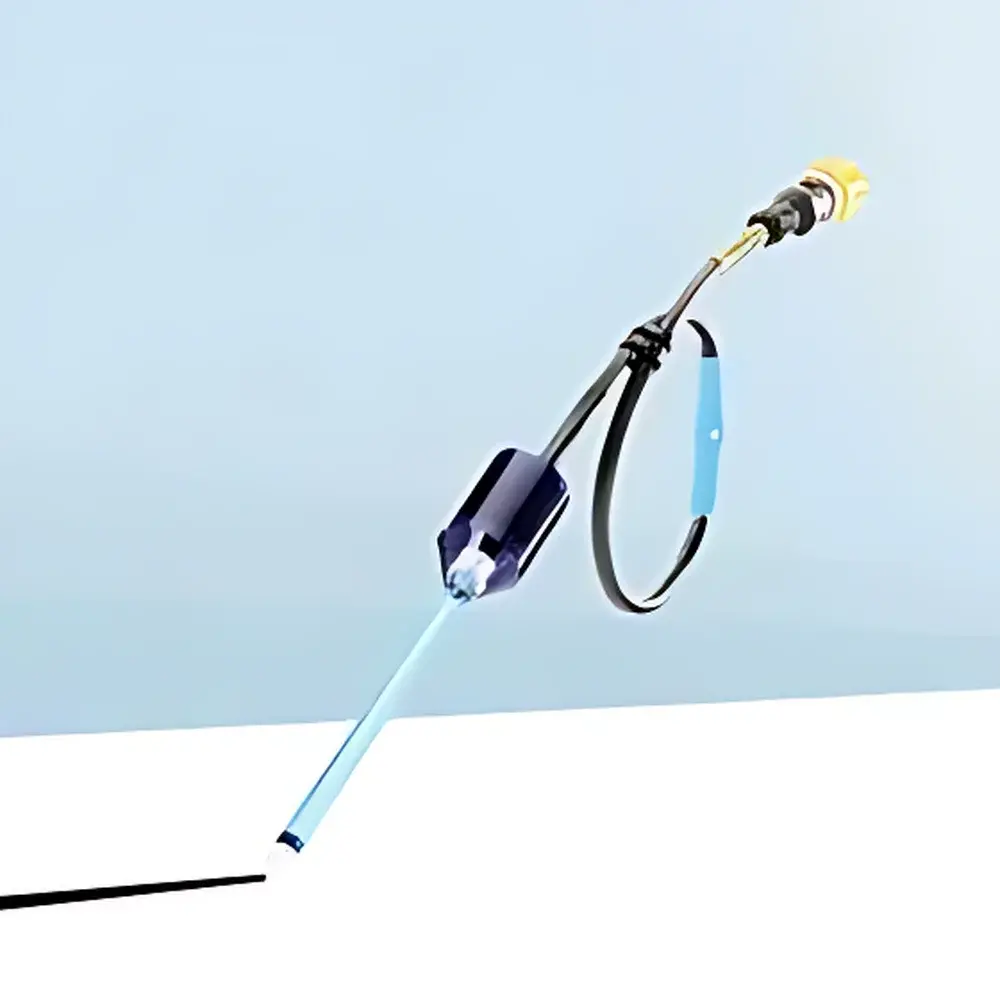
METER T5 Laboratory Soil Water Potential Sensor
| Brand | METER |
|---|---|
| Origin | USA |
| Manufacturer Type | Authorized Distributor |
| Origin Category | Imported |
| Model | T5 |
| Product Category | Pressure-Based Tensiometer |
| Measurement Principle | Ceramic Cup Equilibrium with Integrated Piezoresistive Pressure Transducer |
| Operating Range | +100 to −85 kPa (≈ pF 2.9) |
| Accuracy | ±0.5 kPa |
| Resolution | 0.1 kPa |
| Typical Drift | <0.5% per annum |
| Temperature Compensation | Yes, 0.5% FS over 25 K |
| Excitation Voltage | 10.6 VDC (5–15 VDC stable) |
| Output Signal | Ratiometric mV/V (−100 ±3 mV at +100 kPa |
| Sensor Body Diameter | 5 mm |
| Sensor Head Diameter | 20 mm |
| Sensing Area | 0.5 cm² |
| Total Length | 4 cm + custom shaft length (standard 70 mm) |
| Cable Length | Standard 5 m (customizable) |
| Power Consumption | ~1.3 mA @ 10.6 VDC |
| Bridge Configuration | Asymmetric Wheatstone Bridge |
| Sensing Element | Silicon Piezoresistive Pressure Sensor |
| Max Overpressure Tolerance | ±300 kPa |
| Material | Acrylic Shaft, Porous Ceramic Cup |
| Compatibility | Campbell Scientific dataloggers, InField 7 systems |
Overview
The METER T5 Laboratory Soil Water Potential Sensor is a precision-engineered tensiometric instrument designed specifically for controlled laboratory environments where high spatial resolution, minimal soil disturbance, and rapid response dynamics are critical. It operates on the fundamental physical principle of hydrostatic equilibrium: water potential in the surrounding soil matrix equilibrates across a porous ceramic cup (typically 0.5 cm² surface area), inducing proportional pressure changes within a hermetically sealed internal chamber. These changes are detected by a calibrated silicon piezoresistive pressure transducer configured in an asymmetric Wheatstone bridge architecture. The resulting analog output signal—ratiometric to excitation voltage—is linearly correlated to soil water potential over a defined range of +100 kPa (saturated conditions) to −85 kPa (near permanent wilting point, approx. pF 2.9). Unlike volumetric water content sensors, the T5 measures *energy status*, enabling direct interpretation of plant-available water, hydraulic conductivity estimation, and boundary condition definition in unsaturated flow modeling.
Key Features
- Ultra-compact sensing head (0.5 cm² contact area) minimizes mechanical and hydraulic disruption during insertion into undisturbed or repacked soil columns.
- Sub-5 mm shaft diameter (5 mm standard) enables high-density spatial profiling in confined experimental setups, including microcosms, rhizoboxes, and layered soil columns.
- Direction-agnostic installation: functional in vertical, horizontal, or inverted orientation due to self-contained hydraulic isolation and gravity-independent transduction mechanism.
- Modular design supports customizable shaft and ceramic cup lengths (standard 70 mm; extended options available) to accommodate diverse sample geometries and depth-specific requirements.
- Integrated temperature compensation ensures stable calibration across typical lab thermal ranges (±0.5% full scale over 25 K), mitigating drift-induced artifacts in long-term experiments.
- Low-power operation (~1.3 mA @ 10.6 VDC) facilitates compatibility with battery-powered or low-noise data acquisition systems without compromising signal integrity.
Sample Compatibility & Compliance
The T5 is validated for use with mineral soils, structured clays, sandy loams, and organic amendments where ceramic–soil contact resistance remains within operational limits. Its small footprint allows integration into ASTM D5856-compliant soil column studies and ISO 11277-based texture–water retention characterization workflows. The sensor meets general requirements for GLP-compliant instrumentation: traceable calibration documentation, documented long-term stability (<0.5% annual drift), and reproducible output under repeatable equilibration protocols. While not intrinsically certified to FDA 21 CFR Part 11, its analog output architecture supports audit-trail-capable data logging when paired with compliant Campbell Scientific CR-series or METER EM50G dataloggers.
Software & Data Management
The T5 delivers a passive analog voltage output (mV/V ratio referenced to 10.6 V excitation), requiring external signal conditioning only for high-precision applications. It integrates natively with Campbell Scientific’s LoggerNet and PC400 software suites via standard differential analog input channels. When deployed with METER’s ProCheck handheld reader or InField 7 field monitoring platform, real-time diagnostics—including zero-point verification, bridge balance assessment, and ceramic saturation status—are accessible. Raw mV readings are converted to kPa using factory-provided linear coefficients (slope = −1.0 mV/kPa, offset ≤ ±3 mV), supporting transparent post-processing in MATLAB, Python (NumPy/Pandas), or R environments. All calibration certificates include NIST-traceable reference points at ≥3 independent potentials (e.g., 0, −33, −100 kPa).
Applications
- High-resolution water potential profiling in soil column experiments investigating preferential flow, hysteresis, or solute transport.
- In situ validation of HYDRUS-1D or STANMOD model boundary conditions under controlled matric potential gradients.
- Root zone water stress quantification in pot-based phenotyping trials, especially where volumetric sensors lack energy-state specificity.
- Calibration and verification of dielectric-based water content sensors (e.g., EC-5, GS3) across the entire pF curve.
- Long-term equilibration studies of swelling clays, biochar-amended substrates, or engineered growth media where pore-size distribution governs retention behavior.
FAQ
What is the recommended method for ceramic cup saturation prior to deployment?
Saturate the cup overnight in deionized water under vacuum (≤25 kPa) followed by 24-hour atmospheric equilibration. Avoid boiling, which may alter pore structure.
Can the T5 be used in saline soils?
Yes, but prolonged exposure to EC >4 dS/m may accelerate ceramic fouling; periodic cleaning with dilute HCl (0.1 M) and re-saturation is advised.
How is zero-point drift monitored during extended experiments?
Perform periodic in-situ zero checks by temporarily immersing the ceramic cup in saturated water (0 kPa reference) and recording deviation from nominal 0 mV output.
Is cable length extension supported without signal degradation?
Shielded twisted-pair cabling up to 50 m maintains signal fidelity; beyond this, a signal conditioner (e.g., METER AM100) is recommended to mitigate noise and impedance mismatch.
Does the T5 require temperature correction during data processing?
No—the built-in temperature compensation circuitry corrects for thermal effects across the operating range; raw mV values may be directly converted to kPa using the supplied calibration equation.