
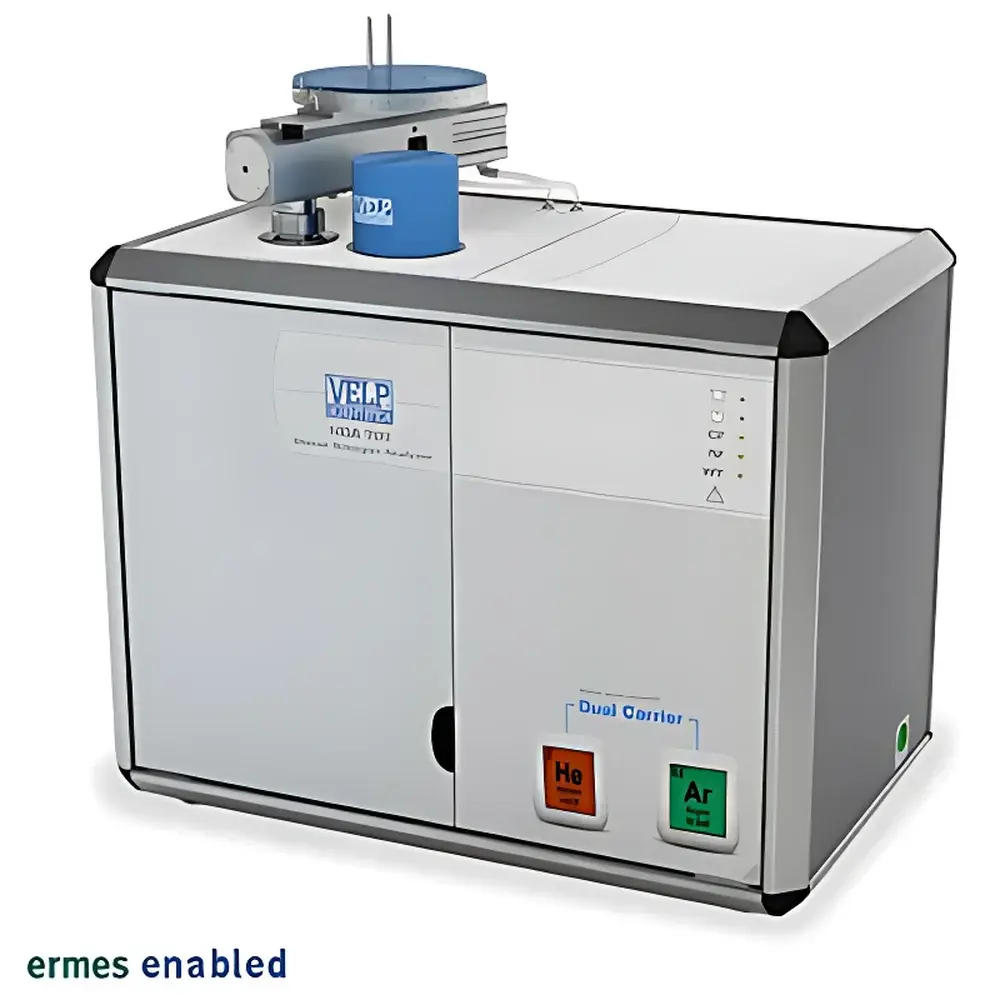
VELP CN 802 Carbon-Nitrogen Elemental Analyzer
| Brand | VELP |
|---|---|
| Origin | Italy |
| Model | CN 802 |
| Analysis Method | High-Temperature Combustion (1030 °C) |
| Detection Principle | TCD for N, NDIR for C |
| Analysis Time | 3–4 min per sample |
| Sample Weight | Up to 1 g |
| Detection Limits | 0.001 mg N (He), 0.01 mg N (Ar), 0.01 mg C |
| Repeatability (RSD) | ≤0.5% (100 mg EDTA standard) |
| Recovery | >99.5% |
| Carrier Gas | Helium or Argon (99.999% purity, 2 bar) |
| Oxygen Purity | 99.999%, 2 bar |
| Power | 1400 W, 230 V / 50–60 Hz |
| Dimensions (W×H×D) | 655×510×410 mm (655×690×410 mm with autosampler) |
| Weight | 54 kg |
| Compliance | AOAC, AOCS, AACC, ISO, EN, CEN, EPA, IFFO |
| Connectivity | USB, RS232, Wi-Fi/Ethernet to VELP Ermes Cloud Platform |
| Software | CN802 Control & Analysis Suite with GLP-compliant audit trail, real-time graphing, automated C/N ratio calculation, and report generation |
Overview
The VELP CN 802 Carbon-Nitrogen Elemental Analyzer is a high-precision, combustion-based instrument engineered for the simultaneous quantitative determination of total carbon (TC), total nitrogen (TN), organic carbon (TOC after acidification), inorganic carbon (TIC), and the critical C/N ratio in heterogeneous organic matrices. It operates on the principle of high-temperature catalytic combustion (1030 °C) in an oxygen-rich environment, followed by selective gas-phase detection: nitrogen is quantified via a high-stability thermal conductivity detector (TCD) employing LoGas™ technology—eliminating the need for reference gas—while carbon dioxide is measured using a calibrated non-dispersive infrared (NDIR) detector with integrated near-infrared (IR) sensing. The system incorporates a dual-stage dehydration architecture: physical water removal via DriStep™ (WT1), followed by chemical drying (WT2), with an intermediate reduction furnace (RF) ensuring complete conversion of nitrogen oxides to molecular nitrogen. This robust analytical pathway delivers trace-level sensitivity, high reproducibility, and full compliance with methodological requirements across agricultural, environmental, food, and feed testing laboratories.
Key Features
- Ultra-rapid analysis cycle: 3–4 minutes per sample, enabling high-throughput routine operation without compromise on accuracy.
- Dual independent detection channels: TCD for nitrogen (detection limit: 0.001 mg N with He; 0.01 mg N with Ar) and NDIR for carbon (detection limit: 0.01 mg C), each optimized for linear dynamic range (ppm to 150 mg C; ppm to 200 mg N).
- Modular autosampler support: Configurable with up to four 30-position sample trays for unattended 24/7 operation—ideal for batch processing of soils, sediments, digestates, feedstuffs, and wastewater solids.
- Robust combustion architecture: Platinum-catalyzed quartz combustion tube operating at 1030 °C, coupled with oxygen purity control (≥99.999%) and carrier gas regulation (He/Ar at 2 bar), ensuring complete oxidation and minimal memory effects.
- VELP Ermes Cloud integration: Real-time remote monitoring, instrument status alerts, method synchronization, and secure data backup via encrypted Wi-Fi or Ethernet connection—fully auditable under GLP/GMP frameworks.
- Self-regenerating CO2 scrubber and maintenance-free LoGas™ TCD extend operational uptime and reduce consumable dependency.
Sample Compatibility & Compliance
The CN 802 is validated for solid and homogenized samples including agricultural soils, composts, activated sludge, filter residues, animal feeds, cereals, starches, and food products. Its combustion protocol meets the performance criteria defined in AOAC Official Methods 993.13 and 2001.11, AOCS Ba 4e-93, ISO 13878:1998, EN 15936:2012, CEN/TS 15397:2007, EPA Method 440.1, and IFFO Standard 1005. All hardware and software components adhere to IEC 61000-6-3 (EMC) and IEC 61010-1 (safety). The system supports 21 CFR Part 11-compliant electronic signatures and full audit-trail logging within the CN802 software—enabling traceability from raw signal to final report for regulatory submissions.
Software & Data Management
The CN802 Control & Analysis Software provides an intuitive, icon-driven interface designed for routine laboratory personnel—no specialized informatics training required. It features real-time chromatogram visualization, automatic peak integration, dynamic baseline correction, and built-in calibration curve management (linear, quadratic, or multi-point). All C/N calculations—including mass-normalized ratios, percentage composition, and stoichiometric conversions—are performed automatically. Reports are exportable in PDF, CSV, or XML formats, with configurable templates aligned to internal SOPs or external accreditation requirements (e.g., ISO/IEC 17025). Data integrity is enforced through role-based access control, time-stamped modification logs, and immutable archive storage synchronized with the Ermes Cloud platform.
Applications
- Agricultural science: Quantifying soil organic carbon sequestration potential and nitrogen mineralization rates for fertility modeling.
- Environmental monitoring: Assessing carbon/nitrogen balance in wastewater treatment residuals, landfill leachates, and sediment cores per EPA and ISO protocols.
- Feed & food quality control: Verifying crude protein equivalence (N × 6.25), detecting adulteration, and validating nutritional labeling claims.
- Research laboratories: Supporting biogeochemical cycling studies, compost maturity evaluation (germination index correlation), and biochar characterization.
- Regulatory compliance labs: Generating auditable data packages for certification under EU Fertilising Products Regulation (EU) 2019/1009 and USDA Organic standards.
FAQ
What carrier gases are compatible with the CN 802, and how do they affect detection limits?
Helium and argon are both supported. Helium enables lower nitrogen detection limits (0.001 mg N) due to its superior thermal conductivity contrast with N2; argon yields slightly higher limits (0.01 mg N) but offers cost and supply advantages in certain regions.
Is acidification required to measure TOC, and how is it implemented?
Yes—TOC determination requires pre-acidification of the sample to remove inorganic carbon (TIC) as CO2. The CN 802 does not perform in situ acidification; samples must be treated offline per ISO 8245 or US EPA 415.1 prior to loading.
Does the system support GLP-compliant data archiving and electronic signatures?
Yes—the CN802 software includes full 21 CFR Part 11 functionality: user authentication, audit trails, electronic signatures, and tamper-evident data storage, all synchronized with the Ermes Cloud platform.
Can the autosampler handle powdered, granular, and pelletized samples without manual intervention?
Yes—samples must be homogenized and loaded into standard ceramic or quartz crucibles (supplied). The autosampler accommodates variable particle sizes typical of soils, feeds, and digested biomass, provided bulk density remains consistent across the batch.
What maintenance intervals are recommended for optimal long-term performance?
Daily: Check O2 and carrier gas pressures; weekly: inspect DriStep™ desiccant and CO2 scrubber saturation; quarterly: clean combustion tube and replace RF catalyst; annually: full system calibration verification and TCD/NDIR sensor validation per ISO/IEC 17025.
Related Products




