
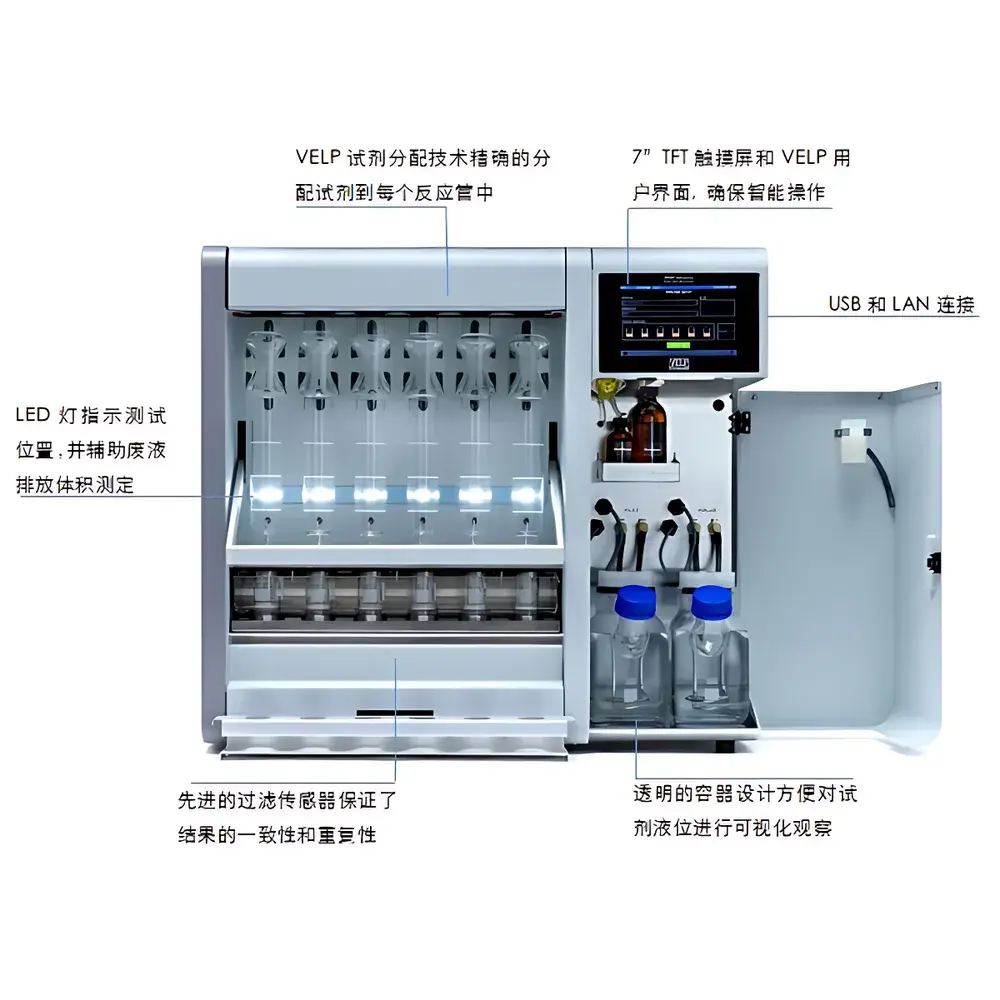
VELP FIWE ADVANCE Automated Fiber Analyzer
| Brand | VELP |
|---|---|
| Origin | Italy |
| Model | FIWE ADVANCE |
| Sample Capacity | 6 positions |
| Throughput | up to 36 samples/day (Crude Fiber/Wende method), up to 60 samples/day (NDF/ADF/ADL) |
| Sample Mass | 0.5–3 g |
| Measurement Range | 0.1–100% fiber content |
| Repeatability | ±1% (at 5–30% fiber level) |
| Display | 7" color touchscreen |
| Reagent Delivery | Fully automated, pre-heated, precision dosing |
| Digestion Waste Handling | Integrated automatic collection |
| Safety | Closed-system reagent containment, no operator exposure to hot chemicals or fumes |
| Connectivity | LAN, USB (3×), Wi-Fi adapter optional |
| Power Supply | 230 V / 50–60 Hz |
| Power Consumption | 2100 W |
| Dimensions (W×D×H) | 735 × 420 × 666 mm |
| Weight | 57 kg |
| Water Consumption | 1.0 L/min |
| Method Library | 5 pre-installed standard methods (ISO, AOAC, GB) + 30 customizable methods |
| Barcode Scanner Support | Yes |
| Balance Integration | Yes |
| Cloud Platform Compatibility | Via LAN or USB Wi-Fi adapter |
Overview
The VELP FIWE ADVANCE Automated Fiber Analyzer is a fully integrated, benchtop instrument engineered for the precise, standardized determination of dietary fiber fractions—including Crude Fiber (CF), Neutral Detergent Fiber (NDF), Acid Detergent Fiber (ADF), and Acid Detergent Lignin (ADL)—in animal feed, forage, cereals, and botanical matrices. It implements the classical gravimetric digestion principle based on sequential detergent-based solubilization and filtration, aligned with internationally recognized reference methodologies: AOAC Official Methods 978.10, 962.09, 973.18; ISO 6865, ISO 5986, ISO 13906; and Chinese National Standards GB/T 6434, GB/T 20806, and GB/T 5515. Unlike semi-automated or manual systems, the FIWE ADVANCE performs all digestion, rinsing, drying, and ashing steps—within a single, sealed crucible—eliminating sample transfer errors and ensuring analytical integrity across the entire workflow.
Key Features
- Load&Go Operation: Full method initiation requires only two minutes of user interaction—sample loading, barcode scanning (optional), and method selection—after which the system executes unattended.
- Closed-Crucible Processing: All digestion residues remain in the same ceramic crucible from initial weighing through acid/base treatment, filtration, drying (105 °C), and ashing (550 °C), minimizing mass loss and cross-contamination risks.
- Automated Reagent Management: Integrated glass reservoirs house all required reagents (neutral detergent, acid detergent, sulfuric acid, acetone); the system preheats, dispenses, and recovers digestate automatically—no manual pipetting or open-vessel handling.
- Integrated Safety Architecture: Exhaust-controlled fume management, temperature-monitored heating blocks, pressure-relief digestion vessels, and LED position indicators ensure compliance with laboratory safety protocols (EN 61010-1).
- Precision Fluidics: VELP’s proprietary peristaltic dispensing system delivers reagents with ≤±0.5% volumetric accuracy per cycle, supporting reproducible NDF/ADF/ADL fractionation critical for nutritional labeling and feed formulation.
- Remote Monitoring & Scheduling: Ethernet and optional Wi-Fi connectivity enable remote status checks, method updates, and overnight batch scheduling via cloud-accessible dashboards compatible with LIMS environments.
Sample Compatibility & Compliance
The FIWE ADVANCE accommodates heterogeneous solid matrices typical in animal nutrition and agricultural research: hay, silage, distillers’ grains, soybean meal, grass clippings, and cereal by-products. Its 0.5–3 g sample mass range balances sensitivity and representativeness for low-fiber (e.g., concentrates) and high-fiber (e.g., straw) materials. All operational parameters—including digestion temperature profiles, hold times, rinse volumes, and drying/ashing setpoints—are configurable to meet method-specific requirements under AOAC, ISO, and GB frameworks. The system supports full audit trails (user ID, timestamp, method version, raw weight data) and is designed to operate within GLP-compliant laboratories requiring traceable, 21 CFR Part 11–ready data handling when paired with validated software extensions.
Software & Data Management
The embedded firmware features an intuitive 7-inch capacitive touchscreen interface with multilingual support (English, Spanish, French, German, Chinese). Preloaded methods include AOAC 973.18 (NDF), AOAC 962.09 (ADF), AOAC 978.10 (ADL), ISO 6865 (CF), and GB/T 6434 (CF). Users may create, save, and tag custom methods using adjustable digestion parameters (e.g., boiling duration, enzyme addition timing, acetone rinse count). Results are auto-calculated per AOAC equations, stored locally in encrypted SQLite databases, and exportable as CSV or PDF reports. USB ports support direct data transfer to external drives; LAN connectivity enables seamless integration with enterprise LIMS or ELN platforms. Optional cloud synchronization provides centralized method distribution and cross-site performance benchmarking.
Applications
- Quality control of ruminant feedstuffs in commercial feed mills and compound feed producers
- Nutritional profiling for dairy and beef ration formulation under NRC and INRA standards
- Research-grade fiber fractionation in academic and government agricultural institutes
- Regulatory compliance testing for EU Feed Hygiene Regulation (EC) No 183/2005 and FDA Title 21 feed labeling requirements
- Method validation and inter-laboratory comparison studies adhering to ISO/IEC 17025
- Stability assessment of forage preservation techniques (e.g., ensiling, wilting)
FAQ
Does the FIWE ADVANCE require external fume hoods?
No. Its integrated condensation and exhaust management system meets EN 14175-3 requirements for closed-digestion instruments and operates safely on standard lab benches.
Can it analyze samples according to both AOAC and ISO protocols simultaneously?
Yes. Each method is independently configurable; users may store and recall AOAC 973.18 and ISO 6865 as separate protocols with distinct heating ramps, reagent volumes, and rinse cycles.
Is calibration traceable to national standards?
Temperature sensors are factory-calibrated against NIST-traceable references; gravimetric verification is performed using certified reference materials (e.g., NIST SRM 1846) during installation qualification.
What maintenance is required for long-term reliability?
Routine tasks include monthly cleaning of the peristaltic pump tubing, quarterly inspection of crucible seating alignment, and annual verification of thermal block uniformity and reagent delivery accuracy.
How does it handle foam generation during neutral detergent digestion?
The system automatically injects a defined volume of antifoaming agent (e.g., silicone emulsion) at programmable intervals during NDF digestion, eliminating manual intervention and improving repeatability.





