
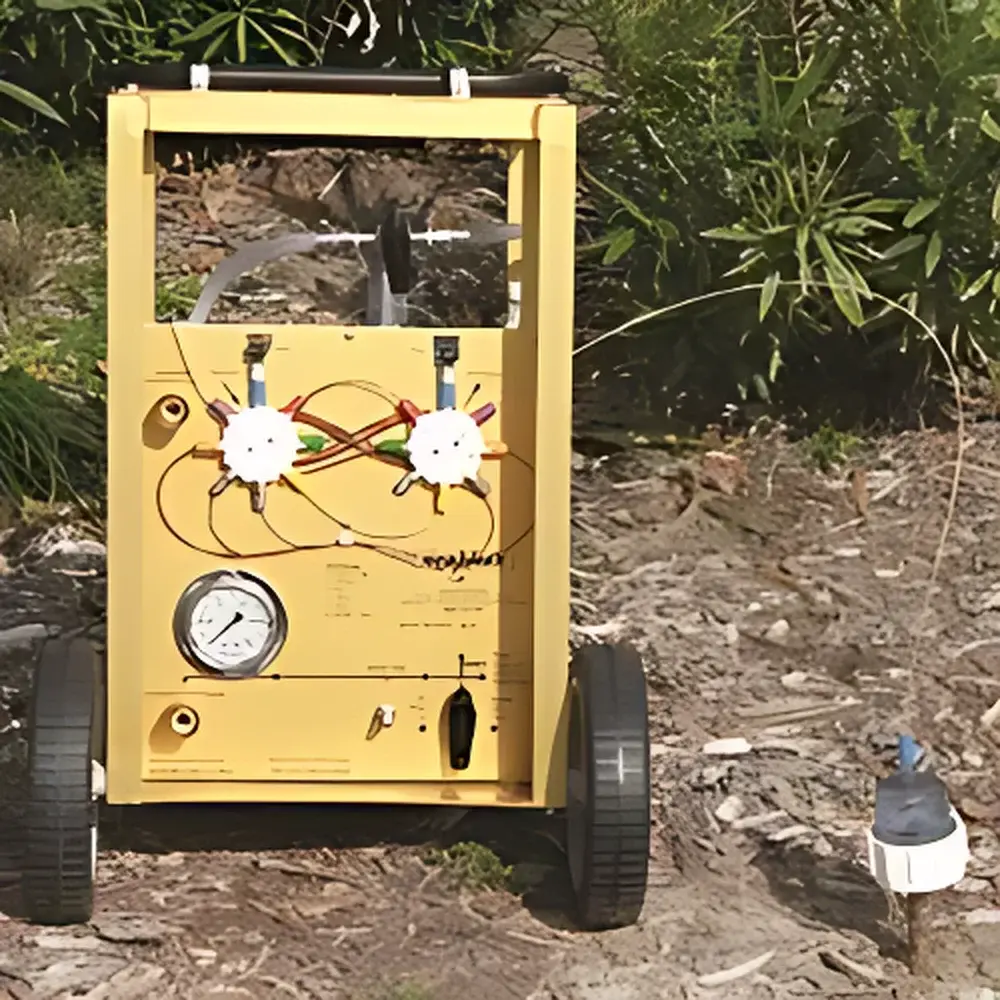
Dynamax HPFM-Gen3 High-Pressure Flow Meter for Plant Hydraulic Conductance Measurement
| Brand | Dynamax |
|---|---|
| Origin | USA |
| Model | HPFM-Gen3 |
| Pressure Range | 0–630 kPa |
| Flow Rate Range | 0.7–2500 g/h (6 full-scale ranges) |
| Hydraulic Conductance Range | 7.7×10⁻⁸ to 2.2×10⁻³ kg·s⁻¹·MPa⁻¹ |
| Sampling Interval | 1 reading per 2 s |
| A/D Resolution | 24-bit dual analog-to-digital conversion |
| Dimensions | 33 × 31 × 52 cm |
| Weight | 12 kg (excluding pressure vessel) |
| Deaerated Water Capacity | 8 L |
| Power & Interface | USB-powered, no external power supply required |
| Operating Systems | Windows XP, Vista, Windows 7 |
| Compliance | NIST-traceable calibration, GLP-compliant data acquisition architecture |
Overview
The Dynamax HPFM-Gen3 High-Pressure Flow Meter is a field-deployable, precision instrument engineered for quantitative measurement of plant hydraulic conductance (Kh) in excised or semi-intact plant segments—including roots, stems, petioles, and branches. It operates on the principle of controlled-pressure-driven flow, applying regulated positive pressure to a deaerated water reservoir to drive water through a prepared plant sample under steady-state or ramped-pressure conditions. By simultaneously measuring applied pressure (via integrated digital pressure transducer) and volumetric flow rate (via high-sensitivity differential pressure sensor across a calibrated laminar flow element), the system calculates hydraulic conductance according to Darcy’s law: Kh = F / ΔP, where F is flow rate (kg·s⁻¹) and ΔP is the pressure gradient (MPa). This methodology enables direct, reproducible quantification of xylem-level water transport efficiency—critical for studies in plant hydraulics, drought response physiology, root-soil interface dynamics, and functional trait analysis.
Key Features
- Third-generation platform with enhanced signal stability, expanded flow range (+50% upper limit vs. Gen2), and improved low-flow sensitivity down to 0.7 g/h
- NIST-traceable factory calibration with documented uncertainty budgets for both pressure and flow channels
- Integrated 24-bit dual-channel analog-to-digital conversion ensures high-resolution temporal capture of transient hydraulic responses
- Real-time regression and automated averaging algorithms embedded in firmware—no post-processing required for standard Kh output
- USB-native architecture: powered and communicated via single USB 2.0 connection; compatible with Windows XP, Vista, and Windows 7 without driver installation
- Modular design supports field upgrades—including backward-compatible firmware and hardware retrofit kits for legacy HPFM units
- No external power source required: all electronics, sensors, and data logging operate from bus-powered USB
Sample Compatibility & Compliance
The HPFM-Gen3 accommodates cylindrical plant samples with diameters from 1.0 to 55.0 mm, enabling analysis across herbaceous crops, woody seedlings, mature tree branches, and intact root systems. Sample mounting uses standardized quick-coupling interfaces with fluorinated ethylene propylene (FEP) tubing and stainless-steel compression fittings to minimize leakage and air intrusion. All wetted components are chemically inert and compatible with deaerated water containing algaecide (included). The system conforms to Good Laboratory Practice (GLP) requirements for traceable instrumentation: each unit ships with a calibration certificate referencing NIST Standard Reference Materials, timestamped firmware logs, and audit-ready metadata tagging (sample ID, operator, date/time, ambient T/RH if logged externally). While not FDA-regulated, its data structure and acquisition protocol align with 21 CFR Part 11 principles for electronic records integrity when used in academic or regulatory-supported agronomic research.
Software & Data Management
Dynamax-provided acquisition software (v4.2+) runs natively on Windows platforms and provides synchronized dual-channel time-series visualization (pressure vs. flow), real-time Kh calculation, and export to CSV or MATLAB-compatible MAT files. Data files include embedded headers with instrument serial number, calibration epoch, user-defined sample annotations, and automatic timestamping at 500-ms resolution. The software supports batch processing for multi-sample comparative analysis and integrates with third-party modeling environments (e.g., R ‘plantecophys’, Python ‘treex’) via documented API hooks. Audit trails record all parameter changes, manual overrides, and calibration events—enabling full traceability for peer-reviewed publication or grant reporting. No cloud dependency: all data reside locally unless explicitly exported.
Applications
- Quantifying species-specific xylem vulnerability curves (P50, P88) under controlled dehydration protocols
- Evaluating rootstock-scion hydraulic mismatch in grafted horticultural crops
- Assessing impacts of soil salinity, compaction, or mycorrhizal colonization on whole-root-system conductance
- Parameterizing mechanistic transpiration models (e.g., Penman-Monteith variants with dynamic Kh inputs)
- Validating non-invasive sap flow estimates (e.g., heat ratio method) against direct conductance measurements
- Screening breeding populations for drought-resilient hydraulic architecture traits
FAQ
Does the HPFM-Gen3 require external power or compressed gas cylinders?
No. It is fully USB bus-powered. The included 8-L pressure vessel is charged manually using the portable deaeration and pressurization kit; no high-pressure gas cylinders are needed for standard operation.
Can I measure intact plants or only excised segments?
The HPFM-Gen3 is designed for excised or cut-segment measurements. Intact plant measurements require complementary instrumentation (e.g., stem heat balance or thermal dissipation probes); however, HPFM-derived Kh values serve as essential boundary conditions for scaling those field-based estimates.
Is software included, and is it updatable?
Yes—full-featured acquisition and analysis software is provided on CD and downloadable from Dynamax’s secure support portal. Firmware and software updates are version-controlled and distributed with release notes covering validation status and compatibility matrices.
How is calibration maintained over time?
Each unit includes a factory calibration certificate valid for 12 months. Field recalibration is not user-serviceable; return-to-factory recalibration is recommended annually or after 500 operational hours, with NIST-traceable documentation issued upon completion.
What consumables are required for routine use?
Deaerated water (prepared using included vacuum degassing kit), algaecide (supplied), coupling lubricant, and 0.2-µm inline filters (reusable after autoclaving). FEP tubing and quick-connect couplings have typical service lives exceeding 200 measurement cycles under proper handling.



