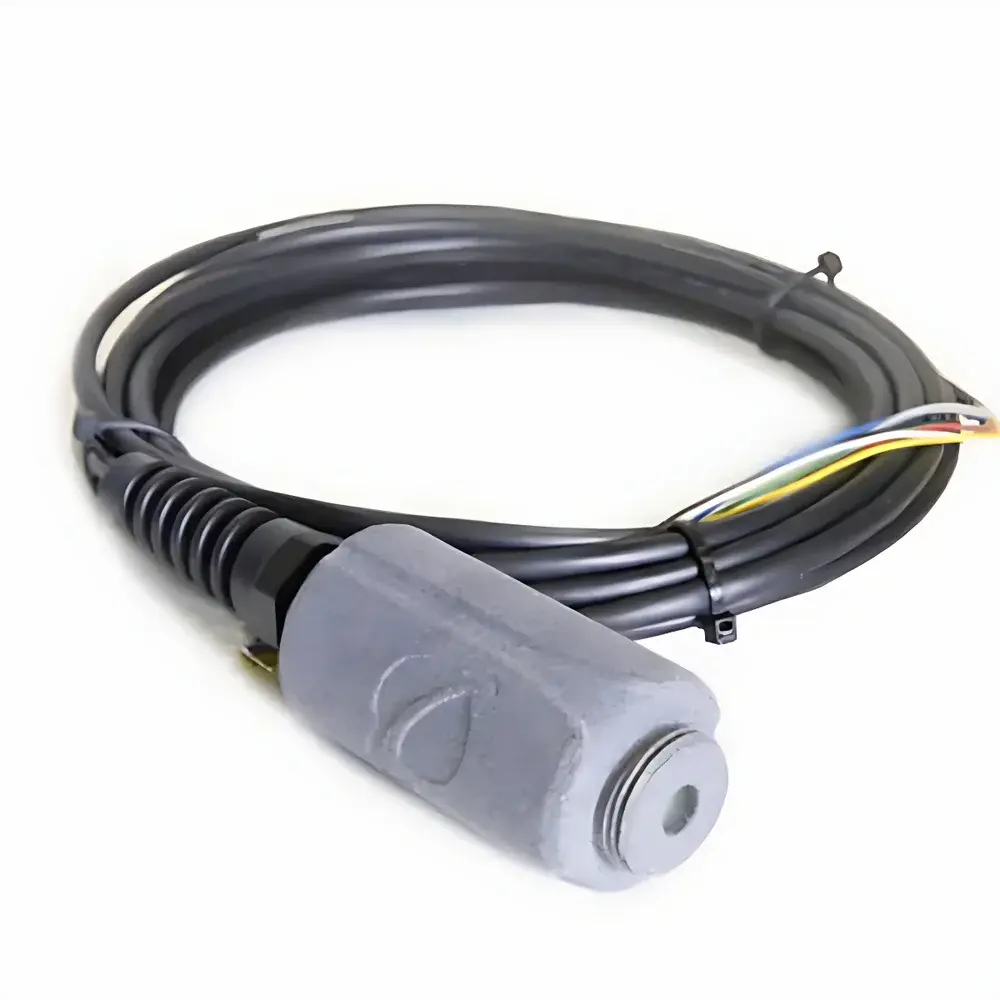
METER SO-431 Galvanic Oxygen Sensor
| Brand | METER |
|---|---|
| Origin | USA |
| Model | SO-431 |
| Measurement Principle | Galvanic (Electrochemical) |
| Output Signal | Analog mV (O₂ concentration proportional) |
| Range | 0–30% O₂ |
| Repeatability | < 0.1% (at 20.95% O₂) |
| Nonlinearity | < 1% |
| Long-term Drift | 5% per year (0.6 mV/year) |
| O₂ Consumption | 0.1 μmol/day (at 20.95% O₂, 23°C) |
| Response Time (t₉₀) | 15 s |
| Operating Temperature | –20 to +60 °C |
| Relative Humidity | 0–100% RH (non-condensing) |
| Pressure Range | 60–114 kPa |
| Excitation Voltage (Thermistor) | 2.5 V DC |
| Heater Supply | 12 V DC |
| Heater Power | 74 mW |
| Thermistor Current | ≤0.1 mA @ 70 °C |
| Quiescent Current | 0.6 mA |
| Active Measurement Current | 1.3 mA |
| Sensitivity | 10–15 mV at 20.95% O₂ (sea level, 101.3 kPa) |
| Zero Output | < 0.5 mV |
| Housing Material | Polypropylene |
| Diffusion Cavity | Integrated micro-chamber for gas equilibration |
| Cable Length | 5 m (extendable) |
| Dimensions | Ø32 mm × 68 mm |
| Weight | 175 g (incl. cable) |
| Compatible Data Loggers | METER EM60 Series, ZL6 Series, ZSC |
| Software Integration | ZENTRA Cloud platform with auto-recognition and remote data access |
Overview
The METER SO-431 Galvanic Oxygen Sensor is a field-deployable, self-powered electrochemical transducer engineered for continuous, in situ measurement of gaseous oxygen (O₂) concentration in porous media, sealed environments, and atmospheric boundary layers. Unlike optical or paramagnetic sensors, the SO-431 operates on the galvanic (fuel-cell) principle: molecular oxygen diffuses through a hydrophobic PTFE membrane into an internal electrolyte chamber, where it undergoes a spontaneous reduction reaction at the cathode, generating a current proportional to the partial pressure of O₂. This current is converted to a stable analog voltage output (mV), linearly correlated to O₂ concentration across its 0–30% range. The sensor’s zero-power operation—requiring no external polarization voltage—ensures low power demand and long-term stability in unattended deployments. Its design prioritizes robustness in chemically aggressive matrices, including acidic tailings, compost piles, and saturated soils, while maintaining metrological integrity under wide thermal and hygrometric gradients.
Key Features
- Galvanic cell architecture: Self-powered operation eliminates need for external bias; enables ultra-low power consumption (<1.3 mA during measurement).
- Integrated thermal compensation: Onboard thermistor (2.5 V DC excitation) provides real-time temperature data for automatic signal correction, critical for accurate O₂ quantification across –20 to +60 °C.
- Condensation mitigation system: Embedded resistive heater (12 V DC, 74 mW) prevents water condensation on the PTFE diffusion membrane—preserving response time and eliminating diffusion-path blockage in high-humidity or sub-zero environments.
- Diffusion-equilibration micro-cavity: Precision-machined internal chamber ensures rapid gas-phase equilibration and uniform O₂ flux, enabling reliable burial in soil, mine waste, or compost without mechanical shielding.
- Rugged polypropylene housing: Chemically inert, UV-stabilized construction resists corrosion from acidic leachates (pH < 3), organic acids, and oxidizing agents common in biogeochemical monitoring.
- Plug-and-play compatibility: Auto-recognized by METER ZL6, EM60, and ZSC data loggers; calibrated parameters stored in sensor firmware eliminate manual coefficient entry.
Sample Compatibility & Compliance
The SO-431 is validated for direct insertion into unsaturated and saturated porous media—including mineral soils, biochar-amended substrates, lignocellulosic compost, sulfidic tailings, and landfill cover systems. Its operational pressure range (60–114 kPa) supports deployment at elevations up to 4,000 m above sea level. While not certified to IEC 60079 for explosive atmospheres, the sensor complies with ASTM D5267 (Standard Guide for Soil Gas Monitoring) and ISO 17403:2017 (Soil quality — Determination of oxygen concentration in soil gas). Its analog output and metadata-rich firmware interface align with GLP-compliant data acquisition workflows, supporting audit-ready traceability when paired with ZENTRA Cloud’s 21 CFR Part 11–enabled logging and electronic signature capabilities.
Software & Data Management
The SO-431 integrates natively with METER’s ZENTRA Cloud platform via ZL6 or EM60 loggers. Upon connection, the sensor’s embedded calibration coefficients (including temperature-response polynomial and zero-offset) are automatically loaded—eliminating manual configuration. Raw mV signals are converted to %O₂ using real-time thermistor readings and barometric pressure inputs (if available). All data streams—O₂ concentration, temperature, heater status, and battery voltage—are timestamped, geotagged (when GPS-enabled), and encrypted in transit. Users configure alert thresholds (e.g., hypoxia onset <5% O₂), schedule automated report generation (PDF/CSV), and grant role-based access to collaborators. Audit logs record all parameter changes, user actions, and firmware updates—satisfying GMP documentation requirements for environmental monitoring programs.
Applications
- Long-term monitoring of O₂ depletion kinetics in aerobic bioremediation zones and constructed wetlands.
- Quantifying microbial respiration rates in soil incubations and sediment cores via closed-chamber O₂ drawdown.
- Tracking redox stratification in mine waste repositories and acid sulfate soil profiles.
- Validating aeration efficiency in industrial composting facilities and anaerobic digestion pre-treatment stages.
- Measuring O₂ gradients across root zones and rhizosphere interfaces in controlled-environment plant physiology studies.
- Environmental forensics: Detecting subsurface hydrocarbon biodegradation signatures through localized O₂ consumption anomalies.
FAQ
Does the SO-431 require periodic recalibration?
Field recalibration is not required under normal operating conditions. The sensor exhibits <5% annual drift (0.6 mV/year); users may perform a two-point verification (0% N₂ and ambient air) annually using METER’s calibration kit if regulatory protocols mandate it.
Can the SO-431 be used underwater or in liquid-phase environments?
No. The SO-431 measures only gaseous O₂. For aqueous dissolved oxygen, METER’s DO-200 series optical sensors are recommended.
Is cable extension supported beyond the standard 5 m?
Yes—shielded, twisted-pair extension cables up to 100 m are compatible without signal degradation, provided proper grounding and voltage drop compensation are implemented per METER’s installation guide.
How does barometric pressure affect accuracy?
O₂ partial pressure varies with total atmospheric pressure. For applications requiring absolute mole-fraction accuracy (e.g., flux calculations), users must input local barometric pressure either manually or via a connected METER ATMOS 41 station.
What maintenance is required for long-term deployments?
The PTFE membrane requires no cleaning or replacement under typical use. In highly particulate or biofouling-prone settings (e.g., compost windrows), optional stainless-steel mesh guards are available to protect the diffusion surface without impeding response time.