
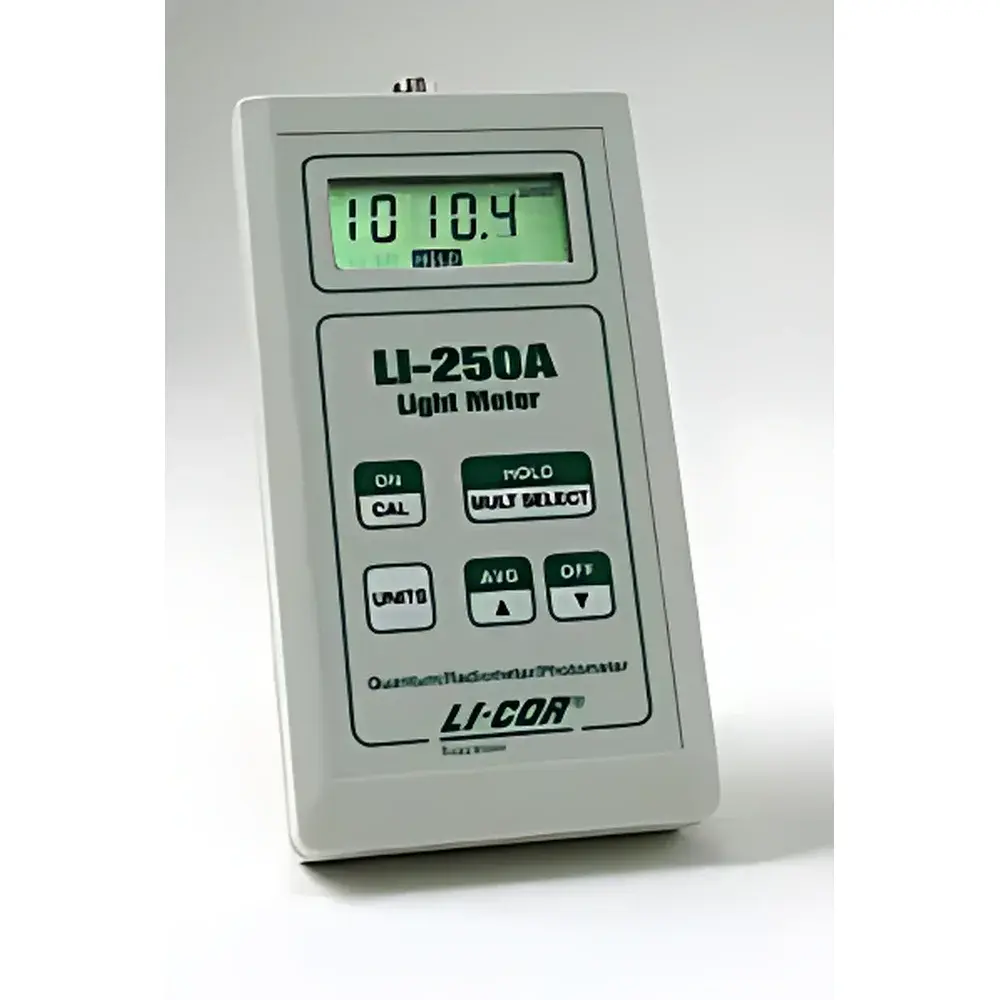
LI-COR LI-250A Illuminance and Quantum Light Meter
| Brand | LI-COR |
|---|---|
| Origin | USA |
| Model | LI-250A |
| Sensor Type | Silicon Photodiode |
| Accuracy (25 °C) | ±0.4% of full scale ±3 digits |
| Accuracy (0–55 °C) | ±0.6% of full scale ±3 digits |
| Range Selection | Auto-ranging across 3 scales |
| Linearity | ±0.05% |
| Display | Digital LCD, 0.5 s update in instantaneous mode |
| Power | One 9 V alkaline battery (150 h typical life) |
| Operating Environment | 0–55 °C, 0–95% RH (non-condensing) |
| Storage | −55–60 °C, 0–95% RH (non-condensing) |
| Dimensions | 14 × 7.7 × 3.8 cm |
| Weight | 0.26 kg |
| IP Rating | Rain- and dust-resistant (O-ring sealed enclosure) |
| Signal Averaging | 15 s moving average (~60 samples) |
| Input Interface | BNC connector for LI-COR radiation sensors |
| Calibration | User-entered sensor-specific calibration coefficient |
Overview
The LI-COR LI-250A Illuminance and Quantum Light Meter is a precision handheld instrument engineered for reliable, field-deployable measurement of photosynthetically active radiation (PAR), illuminance, and broadband irradiance. Designed exclusively for use with LI-COR’s family of calibrated radiation sensors—including quantum sensors (e.g., LI-190R, LI-191R), pyranometers (e.g., LI-200R), and photopic lux sensors—the LI-250A functions as a universal digital readout unit that converts analog voltage signals into scientifically meaningful units without signal degradation or external amplification. Its measurement principle relies on high-stability analog-to-digital conversion synchronized with sensor-specific calibration coefficients, ensuring traceable accuracy across environmental gradients. The instrument operates within the physiological and photometric domains critical to plant physiology, agronomy, architectural lighting design, greenhouse management, and ecological monitoring—where quantification of photon flux density (μmol·m⁻²·s⁻¹), illuminance (lux/klux), or radiant flux (W·m⁻²) must meet methodological rigor and repeatability requirements.
Key Features
- Direct digital readout for all LI-COR BNC-output radiation sensors—no external power supply or interface module required
- Auto-ranging across three decades per measurement unit, eliminating manual range selection errors
- Real-time display with 0.5-second update rate in instantaneous mode; optional 15-second moving average (≈60-sample integration) for stable field readings
- O-ring sealed enclosure rated for rain and dust resistance—suitable for extended outdoor deployment in variable climatic conditions
- Low-power architecture: single 9 V alkaline battery supports up to 150 hours of continuous operation under typical usage
- Temperature-compensated electronics with documented accuracy specifications across 0–55 °C operating range
- High linearity (±0.05%) ensures fidelity across full dynamic range, essential for comparative studies and long-term monitoring
- User-accessible calibration coefficient entry enables traceable recalibration when sensor certificates are updated
Sample Compatibility & Compliance
The LI-250A is validated for use only with LI-COR radiation sensors equipped with standard BNC analog outputs and documented factory calibration certificates. It does not support third-party or uncalibrated sensors. Each connected sensor requires entry of its unique calibration coefficient—a value traceable to NIST-calibrated reference standards and provided with every LI-COR sensor shipment. While the LI-250A itself is not CE-marked or FDA-registered, its application in environmental and agricultural research aligns with ISO 17025-accredited laboratory practices when paired with certified sensors. Data generated using this system are routinely cited in peer-reviewed publications compliant with FAO, USDA, and APS reporting guidelines. The instrument meets general electrical safety requirements per UL/EN 61010-1 for portable measurement devices used in non-hazardous environments.
Software & Data Management
The LI-250A operates as a standalone meter with no embedded data logging or PC connectivity. All measurements are displayed locally on its high-contrast LCD screen and may be manually recorded. For automated data acquisition, users integrate the LI-250A into larger measurement systems via its analog output (available on select configurations) or pair it with external dataloggers compatible with 0–2.5 V or 0–5 V sensor outputs. Although the device lacks native USB or Bluetooth interfaces, its deterministic analog behavior and stable output characteristics make it compatible with Campbell Scientific CR series, Onset HOBO, or LI-COR’s own LI-1500 Smart Sensor Interface when used in networked environmental monitoring stations. Audit trails and calibration history must be maintained externally per GLP-compliant documentation protocols.
Applications
- Photosynthetic photon flux density (PPFD) mapping in controlled-environment agriculture and vertical farms
- Validation of LED and HID lighting systems against CIE S 026/E:2018 photobiological safety and efficacy benchmarks
- Field validation of satellite-derived PAR products in ecosystem carbon modeling (e.g., MODIS, Sentinel-3)
- Greenhouse light uniformity assessments per ASABE S580.1 standards
- Architectural daylighting analysis supporting LEED v4.1 EQ Credit: Daylight compliance verification
- Long-term phenology studies requiring stable, low-drift radiometric baselines across seasonal temperature fluctuations
FAQ
Can the LI-250A be used with non-LI-COR sensors?
No. The LI-250A is designed exclusively for LI-COR sensors with standardized BNC output and known sensitivity characteristics. Using third-party sensors invalidates calibration traceability and voids accuracy specifications.
Does the LI-250A support data logging?
No. It provides real-time or averaged digital display only. External datalogging requires connection to a compatible analog-input logger.
Is the LI-250A suitable for underwater PAR measurements?
Not directly. While the enclosure is rain-resistant, it is not submersible. Underwater applications require waterproof sensor housings (e.g., LI-192SA with UW housing) and appropriate pressure-rated cabling.
How often should the calibration coefficient be updated?
Annually—or whenever the sensor is serviced, repaired, or re-certified by an ISO/IEC 17025-accredited laboratory. Users must manually enter the new coefficient via keypad.
What is the impact of temperature drift on measurement stability?
The instrument specifies ±0.6% of full scale ±3 digits over 0–55 °C. This accounts for both sensor thermal response and internal circuit compensation—no user correction is needed within this range.




