
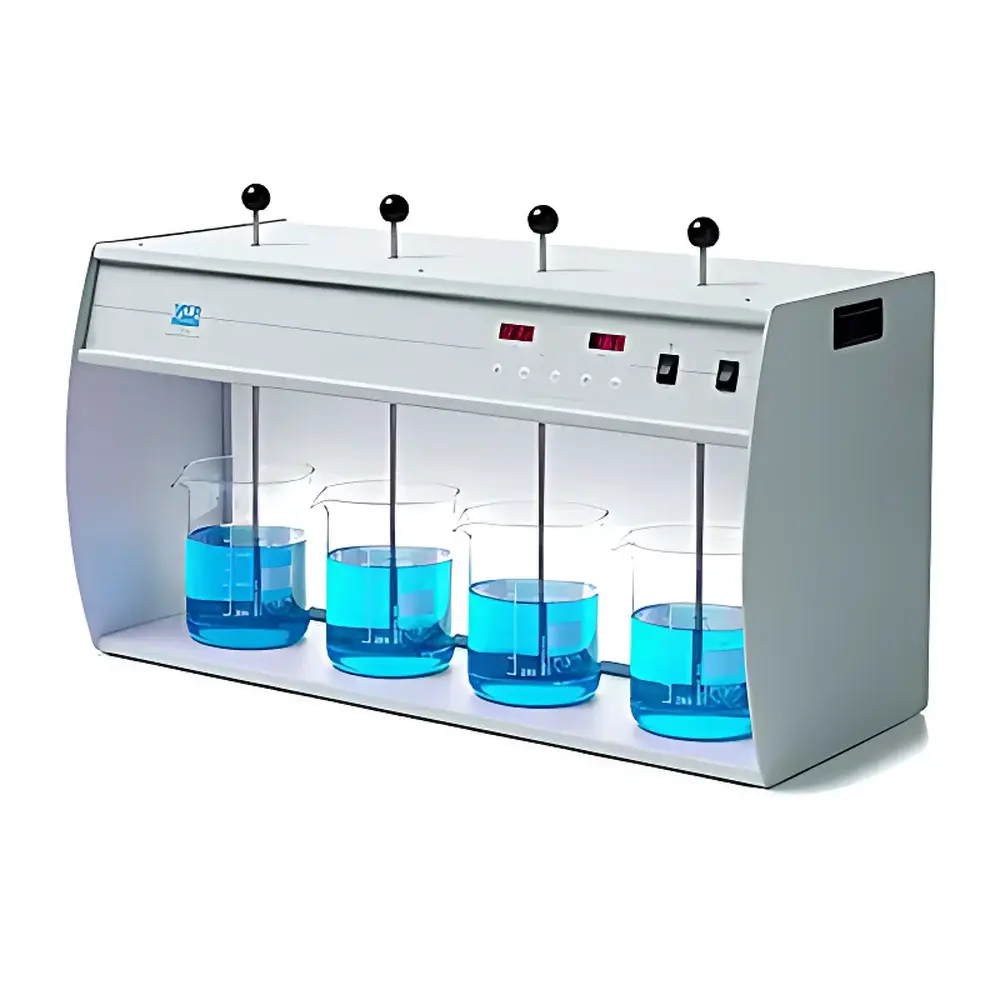
VELP JLT 4 and JLT 6 Multi-Position Stirring Stations
| Brand | VELP |
|---|---|
| Origin | Italy |
| Model | JLT 4 and JLT 6 |
| Instrument Type | Electric Multi-Position Stirrer |
| Speed Range | 10–300 rpm (1 rpm increment) |
| Temperature Control | Ambient only |
| Power Supply | 100–240 V, 50–60 Hz |
| Dimensions (W×H×D) | JLT 4 — 645×347×260 mm |
| Weight | JLT 4 — 13 kg |
| Power Consumption | JLT 4 — 11 W |
| Illuminated Display | Yes |
| Adjustable Stirring Rod Height | Yes, with self-locking chuck |
| Timer Range | 0–999 min or 0–99 h (continuous mode available) |
| Compliance | CE, RoHS, IEC 61010-1 |
Overview
The VELP JLT 4 and JLT 6 Multi-Position Stirring Stations are precision-engineered laboratory instruments designed for reproducible, synchronized stirring across multiple vessels in routine quality control, environmental analysis, water treatment studies, and coagulation-flocculation process optimization. Unlike single-position stirrers, these units integrate four (JLT 4) or six (JLT 6) independently mounted stirring stations on a rigid epoxy-coated metal chassis, enabling parallel sample processing under identical mechanical conditions. Each station employs a robust DC motor coupled to a precision gear train, delivering consistent torque output across the full 10–300 rpm range with 1 rpm resolution—critical for standardizing mixing intensity in jar test protocols per ASTM D2035, ISO 5815-1, and EPA Method 100.3. The absence of integrated heating eliminates thermal interference, ensuring that observed floc formation, settling behavior, or turbidity changes reflect solely hydrodynamic and chemical variables—not temperature artifacts.
Key Features
- High-speed reproducibility (< ±1 rpm deviation over extended operation), essential for inter-laboratory method transfer and regulatory validation.
- Ergonomically tilted control panel with backlit LCD display for clear parameter visibility under ambient lab lighting or low-light conditions.
- Self-locking adjustable chuck mechanism enabling precise vertical positioning of stainless-steel stirring rods (standard 10 mm diameter) without slippage during prolonged agitation.
- Programmable dual-range timer: 0–999 minutes or 0–99 hours, with continuous mode option for unattended long-term experiments.
- Universal power input (100–240 V, 50–60 Hz) ensures stable operation across global laboratory infrastructures without external transformers.
- Low-power consumption design (11 W for JLT 4; 19 W for JLT 6) supports energy-efficient 24/7 operation in shared core facilities.
Sample Compatibility & Compliance
The JLT series accommodates standard 1 L beakers (glass or polypropylene), conical sedimentation vessels (with or without volume graduations), and custom containers up to 150 mm height. Optional accessories—including calibrated conical glass jars (A00001003), corrosion-resistant plastic cones (A00001002), and dedicated cone holders (A00001004)—facilitate adherence to jar testing standards such as APHA Standard Methods 2000 (Section 2710B) and DIN EN ISO 11923. All units comply with IEC 61010-1 for electrical safety in laboratory environments and carry CE and RoHS markings, confirming conformity with EU health, safety, and environmental protection directives. No internal heating element ensures compatibility with thermally sensitive coagulants (e.g., polyaluminum chloride, ferric sulfate) where exothermic reactions must be isolated from mechanical agitation effects.
Software & Data Management
While the JLT 4 and JLT 6 operate via standalone hardware controls, their deterministic timing and speed calibration support integration into GLP-compliant workflows. Each unit maintains non-volatile parameter memory—retaining last-used rpm and timer settings after power cycling—to reduce operator-induced variability. For auditability, users may document operational parameters (speed, duration, vessel type, reagent batch) manually in laboratory notebooks or within LIMS platforms using standardized templates aligned with ISO/IEC 17025 requirements. Though no native digital interface is provided, the 1 rpm resolution and ±0.5% speed accuracy (verified at 100 rpm per factory calibration certificate) enable traceable data generation suitable for FDA 21 CFR Part 11–aligned recordkeeping when paired with controlled procedural documentation.
Applications
- Standardized jar testing for optimizing coagulant/flocculant dosing in wastewater and drinking water treatment plants.
- Comparative evaluation of polymer performance (anionic vs. cationic PAMs) under identical shear profiles.
- Sedimentation kinetics analysis using time-series turbidity or particle size measurements post-stirring.
- Method development and validation for ASTM D5257 (determination of suspended solids removal efficiency).
- Teaching laboratories conducting hands-on instruction in colloid chemistry, water chemistry, and unit process engineering.
FAQ
Can the JLT 4 or JLT 6 be used for heated stirring applications?
No—these models operate at ambient temperature only. For temperature-controlled multi-position stirring, consider the VELP FC4S or FC6S series, which integrate Peltier-based heating/cooling modules.
Are the stirring rods included with the instrument?
Yes—each unit ships with four (JLT 4) or six (JLT 6) stainless-steel stirring rods, 10 mm diameter, 300 mm length, compatible with standard 1 L vessels.
Is speed calibration traceable to national standards?
Each unit undergoes factory calibration against a NIST-traceable tachometer; calibration certificates are available upon request for IQ/OQ documentation.
What is the maximum vessel height supported?
The self-locking chuck allows vertical adjustment up to 150 mm above the base plate, accommodating tall-form cylinders and conical jars with adequate clearance for vortex-free mixing.
Do the JLT models meet GMP requirements for pharmaceutical water system validation?
While not classified as GMP-grade instrumentation per se, their mechanical consistency, parameter repeatability, and CE/IEC 61010-1 compliance make them suitable for supporting GMP-aligned water testing protocols when operated within validated SOPs.



