
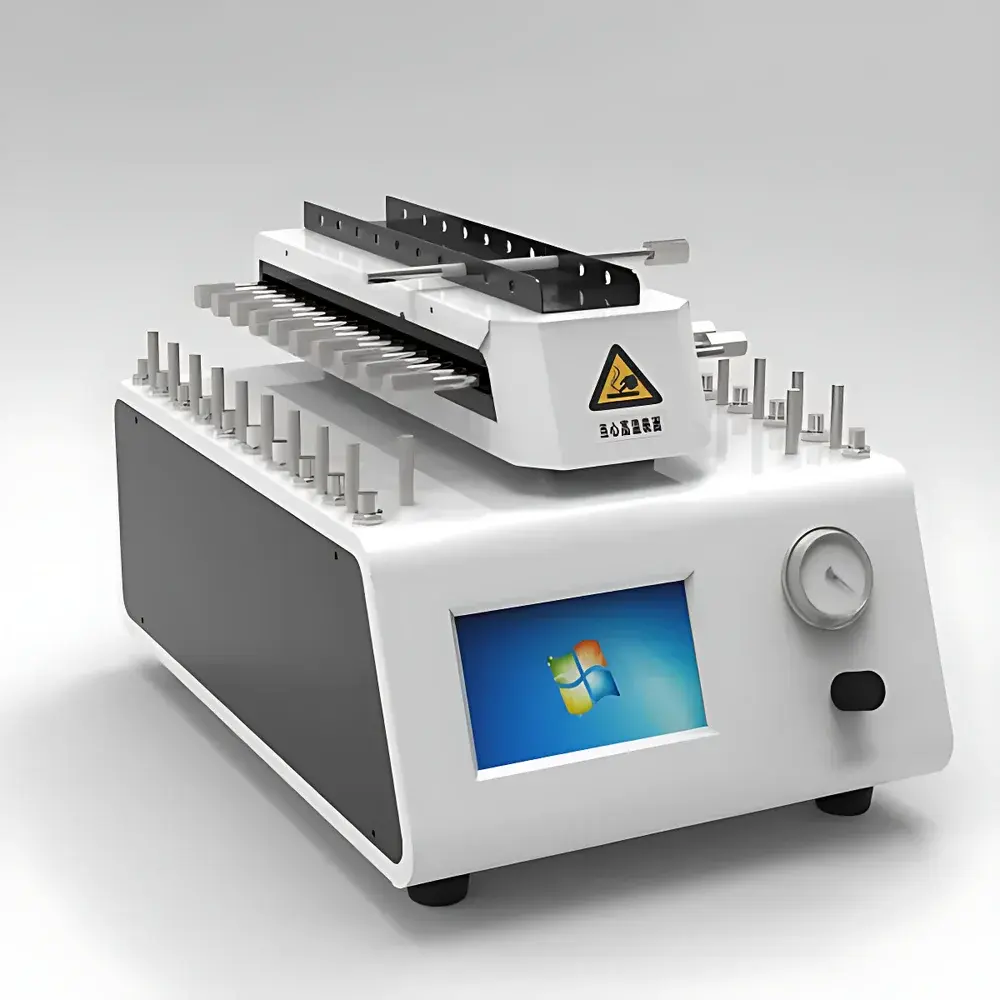
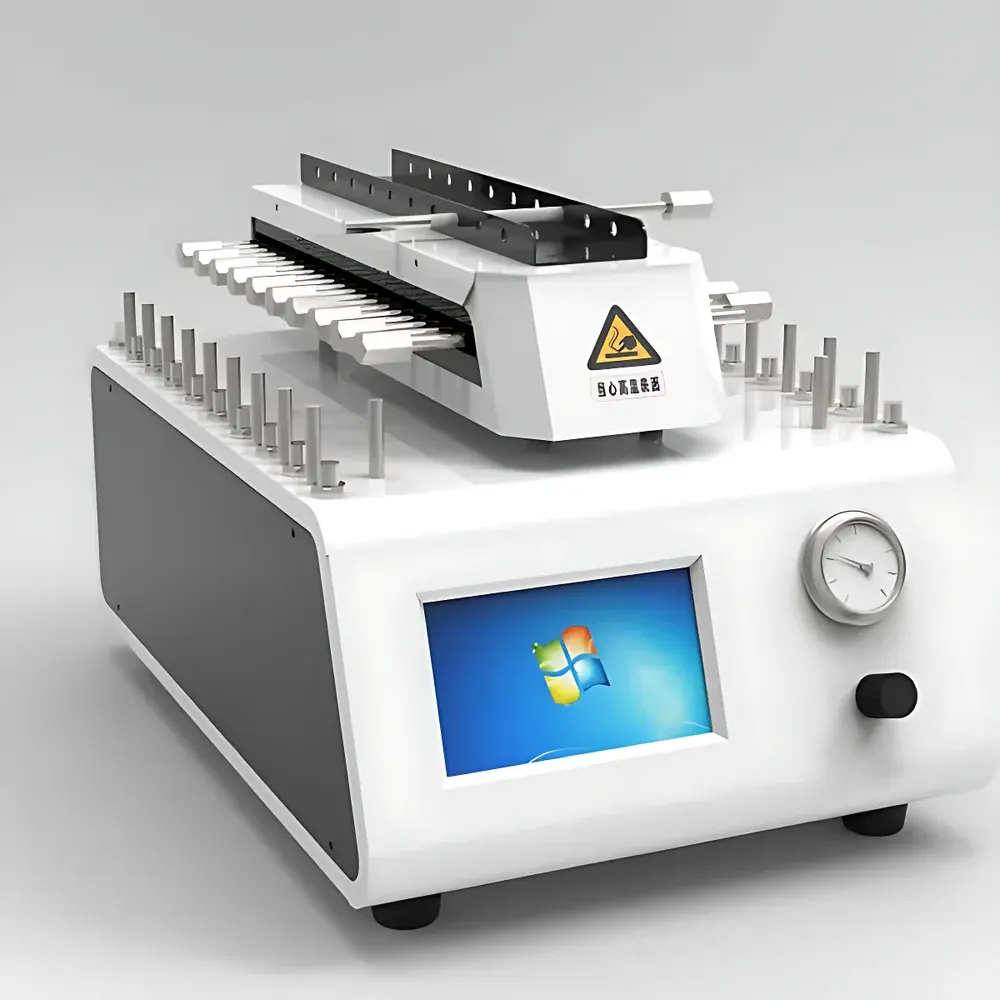
LH-20A Intelligent Adsorption Tube Aging Instrument (Dual 10-Position)
| Brand | Shandong Luchuang |
|---|---|
| Origin | Shandong, China |
| Manufacturer Type | Direct Manufacturer |
| Region Classification | Domestic (China) |
| Model | LH-20A |
| Temperature Control Range | Ambient to 450 °C |
| Gas Flow Rate | 0–3000 mL/min |
| Tube Capacity | 20 tubes (dual 10-position) |
| Temperature Accuracy | ±1 °C |
| Timer Range | 1 min to 999 h 59 min |
| Power Consumption | <300 VA |
| Tube Dimensions | 88.9 mm × 6.35 mm (3.5″ × 1/4″) |
| Dimensions (H×W×D) | 230 × 270 × 395 mm |
| Net Weight | 6.5 kg |
| Operating Environment | 220 VAC ±10%, 50 Hz |
Overview
The LH-20A Intelligent Adsorption Tube Aging Instrument is a precision-engineered thermal conditioning system designed for the automated regeneration and preconditioning of sorbent-packed sampling tubes used in thermal desorption–gas chromatography (TD–GC) workflows. It operates on the principle of controlled thermal purging: inert carrier gas flows through individual adsorption tubes while they are heated to specified temperatures—typically between ambient and 450 °C—to remove residual moisture, volatile contaminants, and legacy analytes that may compromise analytical reproducibility. Unlike conventional ovens or manual aging setups, the LH-20A integrates dual independent heating zones, enabling simultaneous yet thermally isolated aging of two groups of up to 10 tubes each (20 total), with real-time temperature and flow monitoring. Its architecture supports method-driven trace analysis in environmental air monitoring, occupational hygiene, indoor air quality (IAQ), and regulatory compliance testing where ISO 16000-6, EPA TO-17, and ASTM D6196 specify rigorous tube preconditioning protocols.
Key Features
- Dual-zone independent temperature control: Two 10-position heating blocks operate at user-defined setpoints (ambient to 450 °C) with ±1 °C accuracy—eliminating cross-zone thermal interference and enabling parallel aging of heterogeneous tube batches.
- Integrated mass-flow regulated carrier gas delivery: Built-in digital flow control (0–3000 mL/min per zone) ensures consistent purge velocity across all tubes, critical for uniform desorption efficiency and method transferability.
- 5-inch high-resolution color touchscreen interface: Provides intuitive navigation, real-time parameter visualization (temperature, flow, elapsed time), and programmable multi-step aging sequences—including ramp-hold-cool profiles.
- Automated gas sequencing logic: Carrier gas automatically initiates at program start and terminates upon completion—reducing operator intervention and minimizing risk of accidental over-purging or gas waste.
- Compact benchtop footprint (230 × 270 × 395 mm) with robust aluminum-alloy housing: Engineered for stability under continuous operation and compatibility with fume hoods or dedicated GC lab workspaces.
- Compliance-ready timer resolution: Programmable duration from 1 minute to 999 hours 59 minutes supports extended aging protocols required for high-capacity carbon-based sorbents (e.g., Tenax TA, Carbopack B/C).
Sample Compatibility & Compliance
The LH-20A accommodates standard 3.5-inch × 1/4-inch OD stainless steel or glass adsorption tubes—compatible with widely adopted formats per EPA Method TO-17 and ISO 16000-6. Each heating block accepts tubes with internal diameters ranging from 4 to 6 mm, ensuring secure thermal contact without mechanical stress. The instrument’s temperature uniformity (<±2 °C across zone) and flow repeatability (<±2% FS) meet essential performance criteria for GLP-compliant laboratories. While not certified to IEC 61000 or UL standards out-of-box, its electrical design (220 VAC, 50 Hz, <300 VA) conforms to general-purpose lab equipment safety expectations in CE-marked environments when installed per local electrical codes. Documentation includes full operating instructions, calibration guidelines, and maintenance logs aligned with ISO/IEC 17025 traceability requirements.
Software & Data Management
The LH-20A operates via embedded firmware with no external PC dependency. All aging methods—including temperature ramps, dwell times, flow setpoints, and end-condition triggers—are stored locally in non-volatile memory (up to 50 user-defined protocols). The touchscreen interface logs timestamped run records (start time, final temperature, total duration, zone status) viewable on-device for immediate QA review. Though it lacks native network connectivity or FDA 21 CFR Part 11-compliant electronic signatures, raw run metadata can be manually exported via USB flash drive (optional accessory) for integration into laboratory information management systems (LIMS) or audit-ready documentation packages. For regulated environments, users may implement procedural controls—such as dual-operator verification and printed logbook archiving—to satisfy GxP data integrity expectations.
Applications
- Preconditioning of sorbent tubes prior to active or passive air sampling in EPA-compliant environmental monitoring programs.
- Regeneration of reused tubes in high-throughput industrial hygiene labs performing OSHA or NIOSH method analyses.
- Method development and validation studies requiring precise thermal history control for sorbent stability assessment.
- Quality assurance of commercial tube lots—verifying absence of background VOCs or breakthrough artifacts before deployment.
- Supporting accredited testing per ISO 16000-6 (indoor air), ISO 16017-1 (workplace air), and ASTM D6196 (volatile organic compound sampling).
FAQ
What tube formats are supported?
Standard 3.5-inch × 1/4-inch OD metal or glass tubes with internal diameters of 4–6 mm. Custom adapters are not included but may be fabricated per lab specifications.
Can both zones run at different temperatures simultaneously?
Yes—each 10-position heating zone is fully independent, allowing differential setpoints (e.g., 280 °C for Tenax TA and 320 °C for Carbopack C in the same run).
Is calibration traceable to national standards?
The unit ships with a factory calibration certificate referencing NIST-traceable RTD sensors. Users should perform periodic verification using calibrated reference thermometers per ISO/IEC 17025 Section 6.5.
Does the instrument support purge-and-trap integration?
No—it is dedicated solely to offline tube aging. Integration with thermal desorbers (e.g., Markes UNITY, Gerstel TDS) requires separate carrier gas line routing and timing coordination.
What maintenance is required?
Quarterly inspection of heating element contacts, annual verification of flow sensor linearity, and routine cleaning of tube ports with lint-free swabs and isopropanol—per manufacturer-recommended intervals.




