
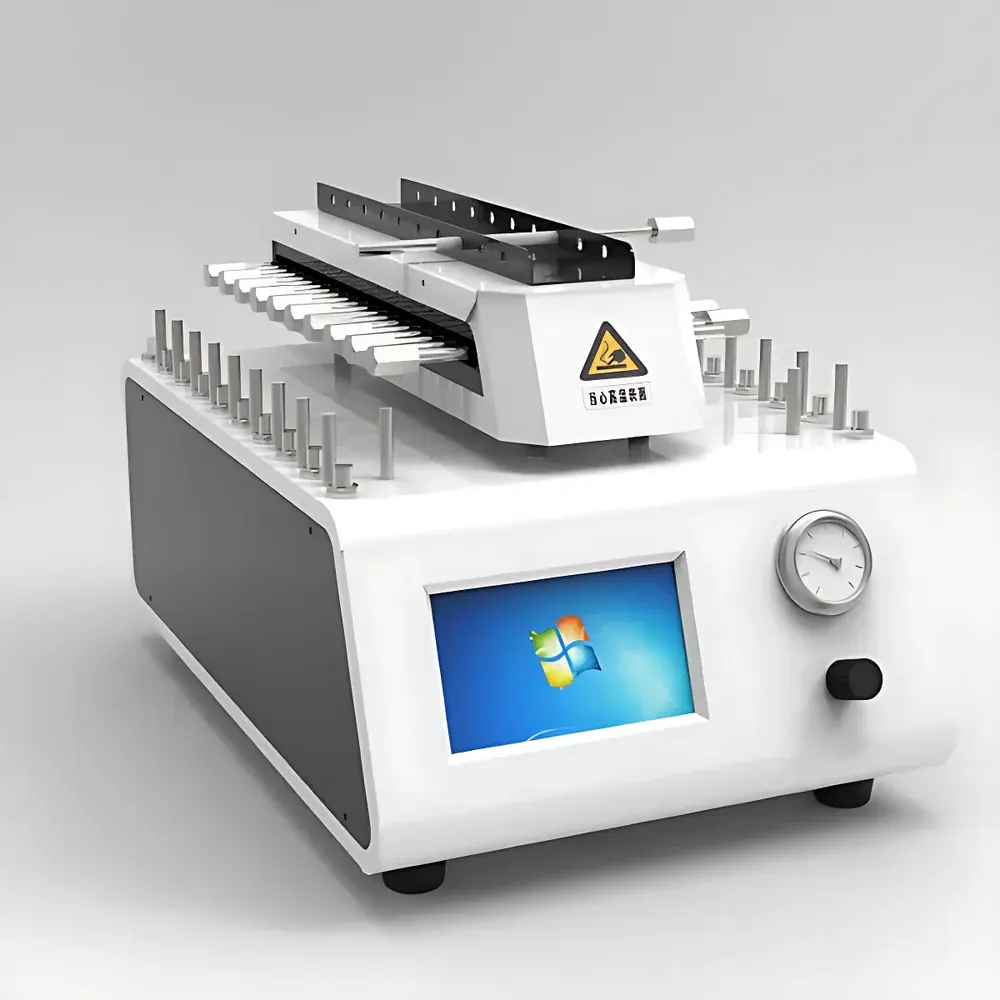
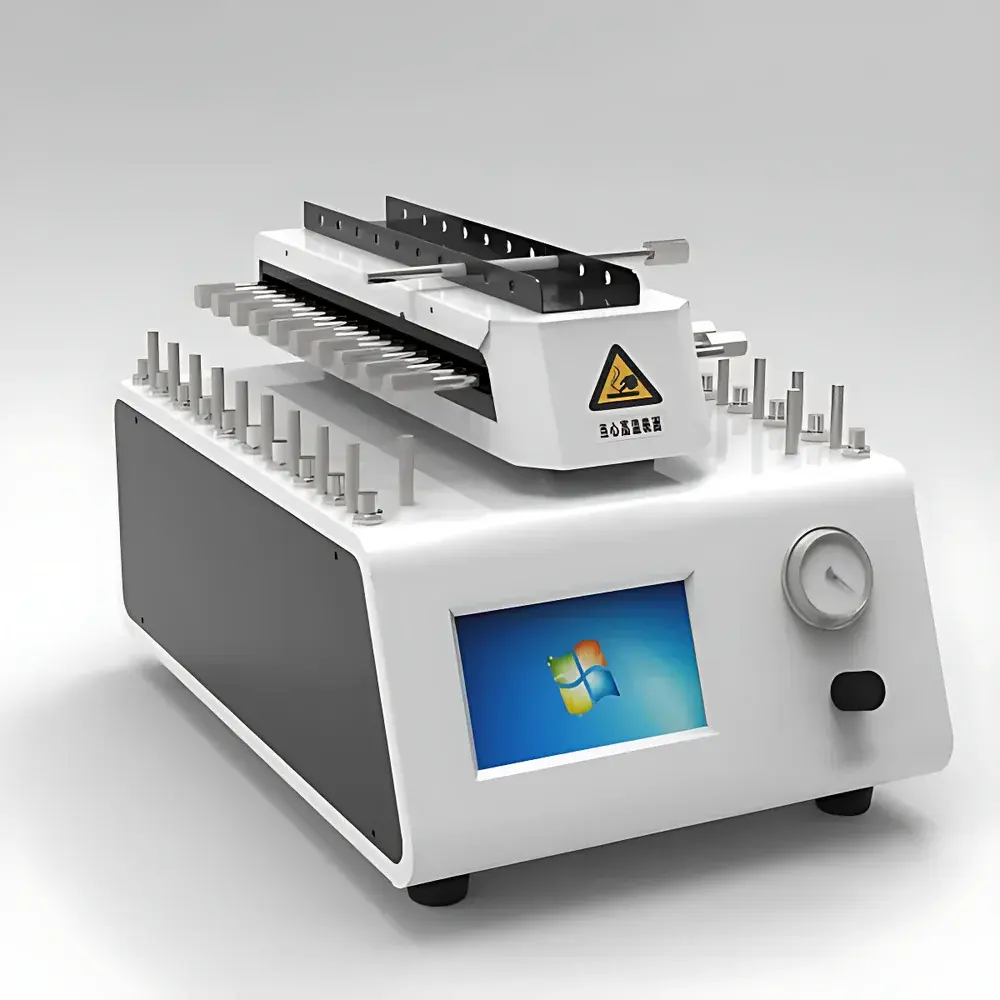
LH-20A Smart Adsorption Tube Aging Instrument
| Brand | Shandong Luchuang |
|---|---|
| Origin | Shandong, China |
| Manufacturer Type | Direct Manufacturer |
| Product Category | Domestic |
| Model | LH-20A Smart Adsorption Tube Aging Instrument |
| Price Range | USD 630–1,120 (est.) |
| Temperature Control Range | Ambient to 450 °C |
| Temperature Accuracy | ±1 °C |
| Flow Rate Adjustment Range | 0–3000 mL/min |
| Number of Tubes per Batch | 20 (dual 10-position configuration) |
| Tube Dimensions | 88.9 mm × 6.35 mm (3.5″ × 1/4″) |
| Dimensions (H×W×D) | 230 mm × 270 mm × 395 mm |
| Net Weight | 6.5 kg |
| Power Consumption | <300 VA |
| Timer Range | 1 min to 999 h 59 min |
| Operating Environment | 220 VAC ±10%, 50 Hz ±0.5 Hz |
| Carrier Gas Pressure Limit | ≤0.4 MPa |
| Ambient Temp | +5 °C to +35 °C |
| Relative Humidity | ≤85% RH |
Overview
The LH-20A Smart Adsorption Tube Aging Instrument is a dedicated thermal conditioning system engineered for the rigorous preparation of sorbent-packed sampling tubes prior to use in thermal desorption–gas chromatography (TD–GC) workflows. Unlike generic ovens or manual heating setups, this instrument implements precise, programmable thermal aging under controlled inert gas flow—essential for removing residual volatiles, moisture, and contaminants from adsorbent beds (e.g., Tenax TA, Carbopack B/C, graphitized carbon blacks). Its dual-zone architecture enables independent temperature and flow control across two groups of ten tubes each, ensuring batch uniformity and trace-level cleanliness required for compliance with EPA Method TO-17, ISO 16017-1, and ASTM D6196. The system operates on the principle of dynamic thermal desorption: heated carrier gas sweeps through conditioned tubes at defined flow rates and dwell times, carrying away volatile impurities while preserving sorbent integrity.
Key Features
- Dual 10-position tube rack with fully independent thermal and flow control per group—enabling parallel aging of heterogeneous tube types or staggered protocols.
- Integrated 5-inch color touchscreen interface with intuitive navigation, real-time parameter monitoring, and password-protected method storage (up to 20 user-defined protocols).
- Precision temperature regulation from ambient to 450 °C with ±1 °C accuracy over full range; PID-controlled heating elements ensure minimal overshoot and thermal stability ≤±0.5 °C over 60 min.
- Wide-range mass flow control (0–3000 mL/min) with built-in digital flow meters calibrated for nitrogen, helium, and air—supporting both low-flow conditioning (e.g., 10–50 mL/min for fragile polymers) and high-purge applications (e.g., 2000 mL/min for activated carbon).
- Automated sequence execution: carrier gas initiation, ramp-hold-cool cycles, and end-of-program shut-off—all synchronized without external timers or manual intervention.
- Compact benchtop footprint (230 × 270 × 395 mm) with reinforced stainless-steel housing and insulated chamber walls—designed for continuous operation in QC laboratories with limited space and strict safety requirements.
Sample Compatibility & Compliance
The LH-20A accommodates standard 3.5″ × 1/4″ OD stainless steel or glass adsorption tubes, including those packed with single- or multi-bed sorbents (e.g., Tenax GR/Carbopack C/Carboxen 1000 combinations). It supports aging protocols aligned with regulatory frameworks governing ambient air, indoor air, and workplace monitoring—specifically EPA TO-17 Appendix A (pre-conditioning), ISO 16017-1 Annex B (cleaning procedure), and EN 16755 (sampling tube validation). All thermal and flow parameters are logged with timestamp and operator ID (when enabled), supporting GLP-compliant recordkeeping. While not FDA 21 CFR Part 11 certified out-of-the-box, audit trails and method locking features provide foundational traceability for GxP-aligned environments undergoing internal validation.
Software & Data Management
The instrument embeds firmware-based method management—no PC dependency required for routine operation. Each stored protocol includes up to three temperature ramps, dwell times, flow setpoints, and cooldown profiles. All runtime data (actual temperature, measured flow, elapsed time) is displayed in real time and retained in non-volatile memory for the last 100 runs. Optional USB export (via FAT32-formatted drive) generates CSV files compatible with LIMS integration or statistical process control (SPC) analysis. Firmware updates are delivered via downloadable .bin files—validated checksums ensure integrity during installation.
Applications
- Pre-aging of new sorbent tubes to eliminate background VOCs prior to calibration standard loading.
- Regeneration of used tubes after high-concentration sample exposure—restoring breakthrough capacity and minimizing carryover.
- Method development for novel sorbent materials requiring custom thermal soak profiles (e.g., metal–organic frameworks or polymer-coated substrates).
- Quality assurance in accredited environmental labs performing ISO/IEC 17025 audits—documented tube conditioning is a mandatory element of TD–GC uncertainty budgets.
- Research-scale evaluation of sorbent thermal stability under accelerated aging conditions (e.g., 300 °C for 24 h).
FAQ
Can the LH-20A age tubes containing thermally labile sorbents such as polyacrylate or porous polymer resins?
Yes—the instrument’s fine-resolution flow control (down to 1 mL/min increments) and sub-1 °C temperature stability allow gentle conditioning protocols (e.g., 120 °C @ 20 mL/min for 4 h) suitable for heat-sensitive media.
Is external gas regulation required?
No—the unit integrates pressure-regulated mass flow controllers; only a clean, dry, oil-free carrier gas source at ≤0.4 MPa inlet pressure is needed.
Does it support remote monitoring or network connectivity?
Not natively; however, the USB data export capability enables periodic synchronization with centralized lab data systems via scheduled scripts or manual transfer.
What maintenance is required for long-term reliability?
Annual verification of temperature sensor calibration using NIST-traceable reference thermocouples and visual inspection of tube ports for residue buildup are recommended. No consumables beyond standard carrier gas filters are required.
How is method reproducibility validated?
Each run logs actual vs. setpoint values for temperature and flow; deviation thresholds (e.g., >±2 °C or >±5% flow error) can be reviewed post-run to assess thermal chamber performance consistency across batches.




