
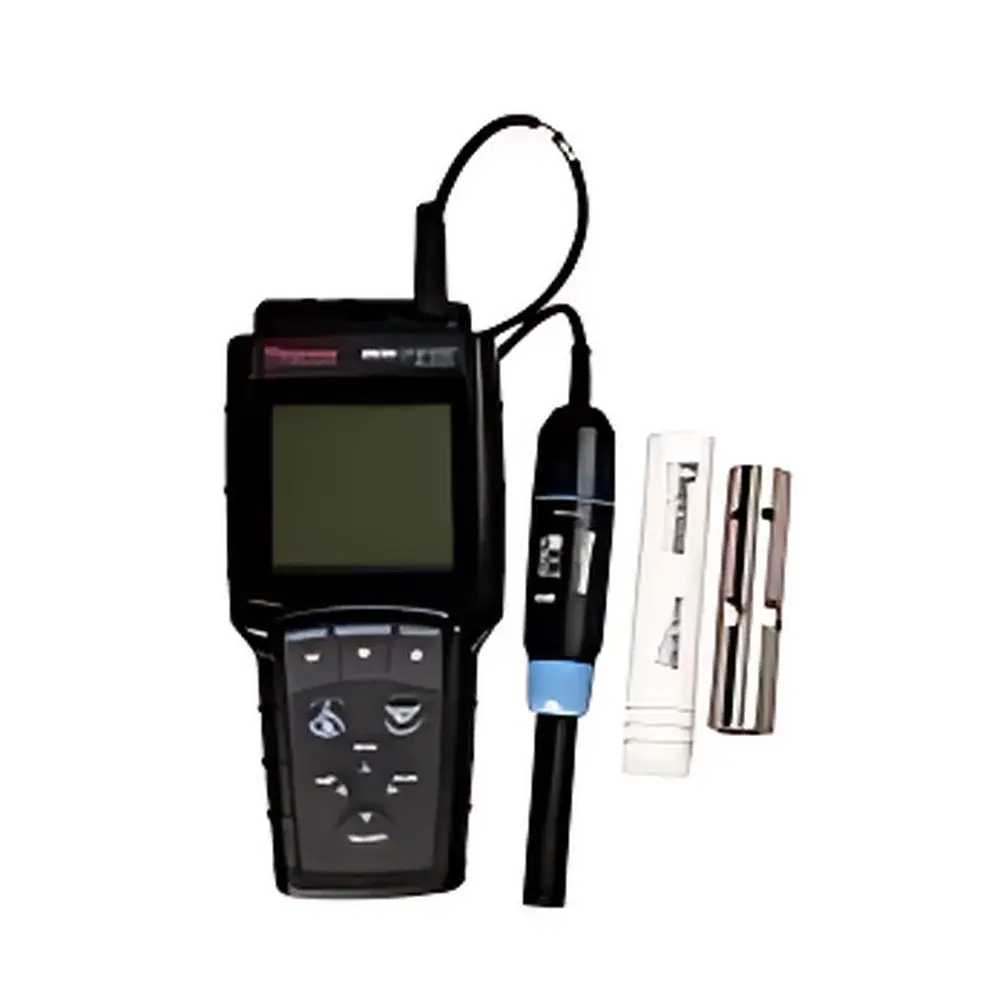
Thermo Fisher Scientific Orion Star A Portable pH/Dissolved Oxygen Meter 420D-01A
| Brand | Thermo Fisher Scientific |
|---|---|
| Origin | USA |
| Model | 420D-01A |
| Instrument Type | Portable |
| Measurement Principle | Fluorescence-based (RDO) and Polarographic DO |
| pH Range | −2.000–20.000 |
| pH Resolution | 0.001 |
| pH Accuracy | ±0.001 |
| pH Calibration Points | Up to 5 |
| mV Range | ±2000.0 mV |
| mV Resolution | 0.1 mV |
| DO Concentration (RDO) | 0–50 mg/L |
| DO Accuracy (RDO) | ±0.1 mg/L (0–8 mg/L), ±0.2 mg/L (8–20 mg/L), ±10% of reading (20–50 mg/L) |
| DO Saturation | 0–500% |
| Saturation Accuracy | ±2% |
| Temperature Range | −5 to 105 °C |
| Temp Resolution | 0.1 °C |
| Temp Accuracy | ±0.1 °C |
| Data Storage | 5000 GLP-compliant entries |
| Protection Rating | IP67 (portable unit) |
| Interface | USB, RS232 |
| Power | 4×AA batteries or AC adapter |
Overview
The Thermo Fisher Scientific Orion Star A Portable pH/Dissolved Oxygen Meter 420D-01A is a dual-channel, field-deployable analytical instrument engineered for high-reliability water quality assessment in environmental monitoring, wastewater treatment, aquaculture, and regulatory compliance applications. It integrates two independent electrochemical measurement systems—pH/mV and dissolved oxygen (DO)—within a single ruggedized, handheld platform. The instrument supports both polarographic (Clark-type) and luminescent-based (RDO) dissolved oxygen sensing technologies, with factory-default configuration optimized for the fluorescence-quenching principle: excitation of a ruthenium-based luminophore immobilized on the sensor tip, followed by phase-shift analysis of emitted light decay kinetics to determine oxygen partial pressure. This method eliminates oxygen consumption during measurement, provides rapid response (<30 s T90), and is insensitive to flow rate, hydrogen sulfide, or heavy metal interference—critical advantages over traditional amperometric probes in complex natural waters. The pH channel employs high-impedance potentiometric detection via BNC-compatible electrodes, supporting NIST-, USA-, and DIN-traceable buffer recognition and multi-point slope/offset calibration. Designed for operational continuity across diverse ambient conditions, the 420D-01A operates from −10 to 50 °C and maintains metrological integrity under immersion (IP67-rated housing).
Key Features
- Simultaneous dual-parameter display: Real-time side-by-side readouts of pH (or mV/RmV) and DO concentration (mg/L) or saturation (%), with integrated temperature compensation.
- AUTO-READ™ intelligent stabilization algorithm automatically locks readings upon signal convergence, indicated by dynamic stability icons—reducing operator dependency and minimizing transcription errors.
- Multi-language interface (English, Chinese, Spanish, French, German, Portuguese) configurable via system settings for global field teams and multilingual laboratory environments.
- Advanced calibration management: Edit individual pH calibration points post-calibration to refine slope and offset without full recalibration; automatic recognition of buffer standards (pH 4.01, 7.00, 10.01) per IUPAC and ASTM D1293 protocols.
- RDO probe auto-detection: Seamless switching between polarographic and fluorescence-based DO sensors via 9-pin mini-DIN interface; no manual mode selection required.
- Robust data governance: Stores up to 5000 timestamped, user-ID-tagged, sample-ID-annotated measurements with full GLP audit trail—including electrode ID, calibration history, atmospheric pressure, salinity correction factor, and operator signature fields.
- Flexible power architecture: Operates continuously for >200 hours on four AA alkaline batteries or via universal 100–240 V AC adapter; battery level indicator and low-power warning prevent unexpected shutdowns during extended surveys.
Sample Compatibility & Compliance
The 420D-01A is validated for use with freshwater, seawater (up to 45 ppt salinity), wastewater effluents, groundwater, and surface runoff samples. Its RDO probe (087010MD) features a stainless-steel sinking sleeve and protective calibration cap suitable for turbid or particulate-laden matrices. Atmospheric pressure compensation (450.0–850.0 mmHg) ensures accurate DO reporting at altitudes ranging from sea level to 3000 m. The instrument complies with key regulatory frameworks: data storage meets GLP requirements per 21 CFR Part 11 (with optional password-protected user roles and electronic signature capability); pH accuracy aligns with ISO 10523 and ASTM D1293; DO measurement methodology conforms to ASTM D888 (Standard Test Methods for Dissolved Oxygen in Water) for fluorescence-based determination. All supplied buffers and standards are certified traceable to NIST SRMs.
Software & Data Management
Data export and firmware updates are performed via USB or RS232 connection using Thermo Fisher’s proprietary Orion™ Com software (Windows-compatible). The software enables batch download of GLP-compliant datasets, customizable report generation (PDF/CSV), graphical trend analysis (pH vs. DO vs. time), and calibration certificate printing. Audit logs record all configuration changes, calibration events, and data deletions—including timestamps, user IDs, and originating device serial numbers—to support FDA, EPA, or ISO 17025 laboratory accreditation audits. Firmware updates preserve existing calibration coefficients and user-defined parameters, ensuring continuity across instrument lifecycle maintenance.
Applications
- Regulatory field monitoring: EPA Method 360.1 (DO), 365.1 (pH), and WQPC compliance sampling in rivers, lakes, estuaries, and coastal zones.
- Wastewater treatment plant (WWTP) process control: Aeration basin optimization, nitrification/denitrification profiling, and effluent discharge verification.
- Aquaculture and marine biology: Real-time DO stress threshold tracking in hatcheries, coral reef surveys, and hypoxia event response.
- Drinking water distribution system integrity assessment: Detection of stagnation-induced pH drift and localized DO depletion in dead-end mains.
- Educational and research deployments: Undergraduate environmental science labs, graduate thesis fieldwork, and long-term ecological research (LTER) network stations.
FAQ
Does the 420D-01A require annual recalibration to maintain traceability?
No—calibration frequency is application-dependent and governed by internal QA procedures or regulatory mandates (e.g., EPA requires daily calibration checks for field DO measurements). The instrument retains calibration coefficients until manually reset or overwritten.
Can the RDO probe be used in high-sulfide environments such as anaerobic digesters?
Yes. Unlike polarographic sensors, the fluorescence-based RDO probe is chemically inert to H₂S, Cl₂, SO₂, and heavy metals, making it suitable for biogas scrubber effluents and sediment porewater profiling.
Is the included ROSS™ pH electrode compatible with high-ionic-strength seawater?
Yes—the 8107UWMMD triple-junction electrode features a flowing liquid junction and KCl gel electrolyte, minimizing junction clogging and liquid junction potential drift in salinities up to 45 ppt.
How is atmospheric pressure measured for DO compensation?
The instrument includes a built-in barometric sensor; users may also enter manual pressure values derived from local weather services or calibrated barometers.
Does the USB interface support direct connection to modern laptops without legacy serial ports?
Yes—USB communication uses standard CDC ACM class drivers compatible with Windows 10/11, macOS 12+, and Linux kernel ≥5.4; no additional hardware adapters are required.







