
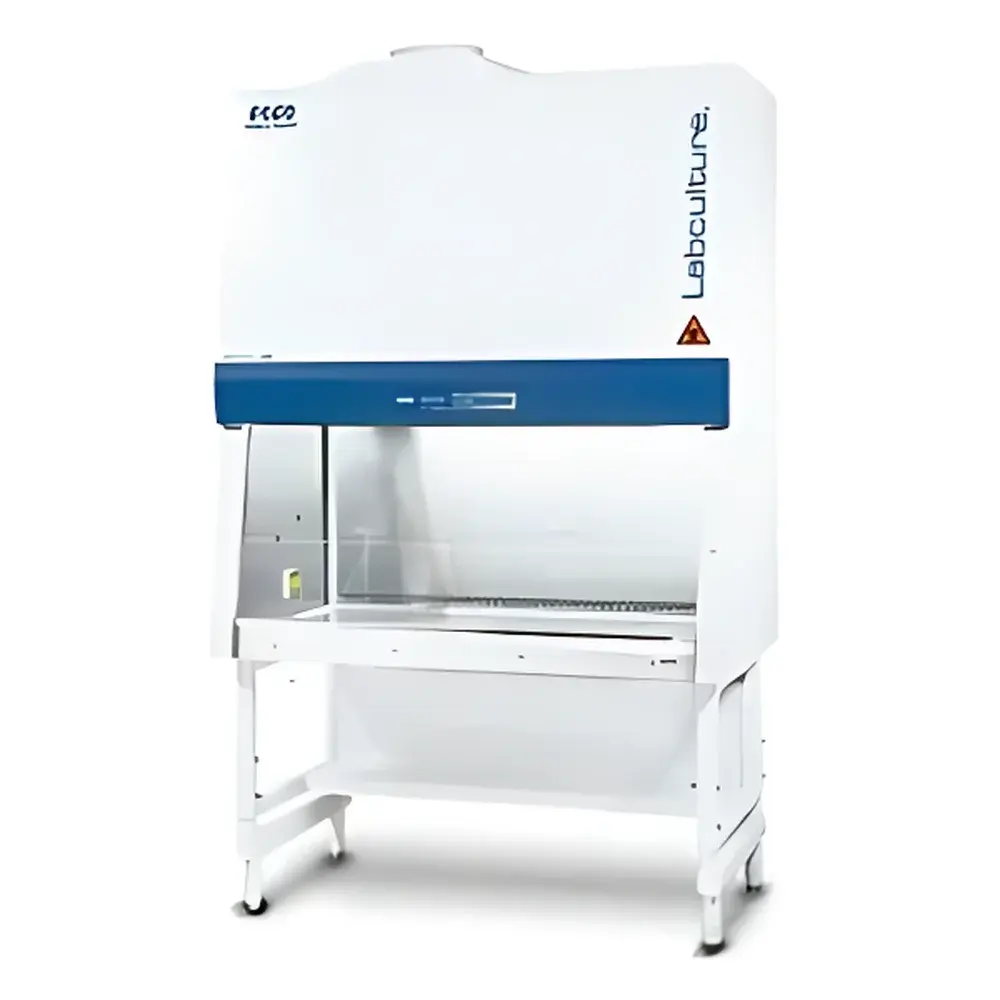
Esco Labculture® LB2-B Class II Type B2 Biosafety Cabinet
| Brand | Esco |
|---|---|
| Origin | Singapore |
| Cabinet Type | Class II, Type B2 (Total Exhaust) |
| Certification | NSF/ANSI 49, YY0569 |
| Filter Efficiency | ≥99.999% for particles ≥0.1 µm (ULPA) |
| Inflow Velocity | 0.53 m/s (105 fpm) |
| Downflow Velocity | 0.31 m/s (60 fpm) |
| Power Supply | 220 VAC, 50 Hz |
| Construction | Seamless stainless steel work chamber |
| Motor | Brushless DC motor |
| Control System | Esco Sentinel Gold microprocessor-based interface |
| Compliance | Meets IEST-RP-CC001.3 for ULPA filter performance |
| Airflow Configuration | Unidirectional downflow + total external exhaust |
Overview
The Esco Labculture® LB2-B is a certified Class II, Type B2 biosafety cabinet engineered for applications requiring absolute containment of both biological aerosols and hazardous chemical vapors. Unlike Type A2 cabinets—which recirculate a portion of filtered air into the work area—the LB2-B operates as a total-exhaust system: 100% of the intake air is drawn through the front grille, passes across the work surface, and is then fully expelled via dedicated ductwork to an external exhaust system. This configuration eliminates any risk of chemical vapor re-entrainment, making the LB2-B suitable for procedures involving volatile toxic compounds (e.g., ethidium bromide, formaldehyde, chloroform), radioactive isotopes, or high-risk pathogens under BSL-2+ or ABSL-2+ containment protocols. Its aerodynamic design maintains stable inward inflow and uniform vertical downflow—both validated per NSF/ANSI 49 and YY0569—to ensure simultaneous protection of personnel, product, and environment. The cabinet’s structural integrity derives from a one-piece, seamless 304 stainless steel work chamber with no seams, welds, or fasteners in the airflow path, minimizing microbial harborage and enabling rapid decontamination.
Key Features
- NSF/ANSI 49 and YY0569 certified for Class II, Type B2 performance—validated for personnel, product, and environmental protection.
- ULPA filtration system (≥99.999% efficiency at 0.1–0.3 µm per IEST-RP-CC001.3) on both supply and exhaust air streams.
- Brushless DC motor driving the dual-blower system—delivering consistent airflow stability, extended service life, and reduced energy consumption versus AC induction motors.
- Sentinel Gold microprocessor control panel with full-color LCD display: real-time monitoring of inflow/downflow velocities, filter loading status, UV lamp operation, alarm history, and system diagnostics.
- Ergonomic design elements: 15° sloped front window for operator comfort; ADA-compliant angled control pad; frameless tempered glass sash for unobstructed access and simplified cleaning.
- Enhanced side-wall baffle geometry and optimized plenum distribution improve particle capture efficiency and reduce turbulence near the work surface.
- ISOCIDE™ antimicrobial coating applied to all painted surfaces inhibits bacterial colonization on non-stainless components.
- High-positioned rear grille prevents obstruction from equipment placement while maintaining laminar downflow integrity.
- RS-232 serial port enables integration with laboratory building management systems (BMS) or centralized safety monitoring platforms.
Sample Compatibility & Compliance
The LB2-B accommodates a wide range of manipulations including cell culture, molecular cloning, PCR setup, mycological work, and handling of low-to-moderate toxicity chemical agents. It supports compatibility with standard lab equipment such as centrifuges, pipette aids, and microscopes (via optional factory-installed observation ports). All models comply with international biosafety infrastructure requirements: airflow patterns are validated under static and dynamic load conditions per NSF/ANSI 49 Annex D; electrical safety conforms to IEC 61010-1; and mechanical construction adheres to ISO 14644-1 Class 5 (ISO Class 5) cleanroom-grade particulate control. For regulated environments—including GLP, GMP, and FDA 21 CFR Part 11 workflows—the Sentinel Gold system logs timestamped operational events with audit-trail capability when paired with compliant data acquisition software.
Software & Data Management
The Sentinel Gold interface provides embedded firmware with configurable alarm thresholds (e.g., inflow velocity deviation >±10%, filter pressure drop >250 Pa), visual and audible alerts, and password-protected parameter adjustment. Event logs store up to 10,000 entries—including date/time stamps, user ID (if enabled), alarm type, and resolution status—with export via RS-232 to CSV-compatible databases. Optional Esco Connect software (Windows-based) enables remote monitoring of multiple cabinets across a facility, trend analysis of airflow decay over time, predictive maintenance scheduling based on cumulative runtime, and automated report generation for internal QA audits or regulatory submissions.
Applications
The LB2-B is routinely deployed in academic research laboratories conducting recombinant DNA work with chemical co-reagents; pharmaceutical QC labs performing sterility testing of cytotoxic drug formulations; clinical microbiology units processing specimens suspected of tuberculosis or other airborne-transmitted pathogens; and biotech manufacturing suites where open-vessel operations require simultaneous biological and chemical containment. Its total-exhaust architecture also supports EPA Method 1600-series analyses, NIOSH-certified hazardous material handling, and USP sterile compounding when integrated with appropriate HVAC and exhaust stack specifications.
FAQ
What distinguishes a Type B2 cabinet from a Type A2?
A Type B2 cabinet provides 100% exhausted airflow with zero recirculation, whereas a Type A2 recirculates ~70% of filtered air back into the work area. This makes Type B2 mandatory for volatile chemicals that cannot be captured by carbon or HEPA/ULPA filters.
Is ducting required for installation?
Yes. The LB2-B must be connected to a dedicated, balanced external exhaust system with constant static pressure compensation. Flexible ducting is not permitted; rigid galvanized steel or stainless steel ductwork is required per NSF/ANSI 49 Section 7.3.2.
Can the cabinet operate without external exhaust during power failure?
No. Loss of exhaust fan power results in immediate inflow velocity collapse and automatic shutdown of UV and lighting circuits to prevent unsafe operation.
How often should ULPA filters be replaced?
Under typical use (8 hrs/day, moderate particulate load), supply and exhaust ULPA filters last 5–7 years. Replacement intervals must be verified via in-situ filter integrity testing (e.g., DOP/PAO scanning) per ISO 14644-3.
Does the LB2-B support decontamination with vaporized hydrogen peroxide (VHP)?
Yes—its seamless chamber, gasketed sash, and corrosion-resistant materials are compatible with validated VHP cycles. Formal validation per ISO 14644-7 is recommended prior to routine implementation.
Related Products




