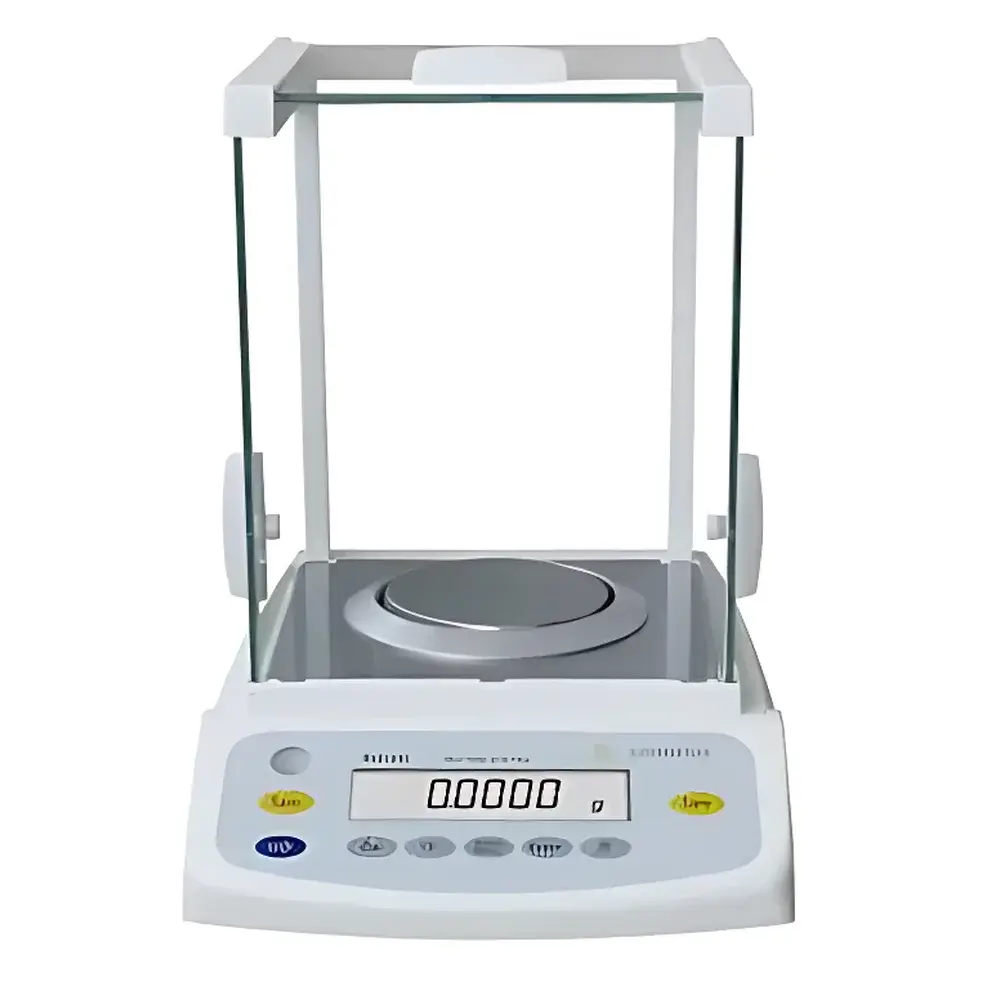
Sartorius BSA Series Analytical Balances
| Brand | Sartorius |
|---|---|
| Origin | Germany |
| Type | Analytical Balance |
| Models | BSA224S, BSA124S-CW, BSA223S |
| Capacity | 120–6200 g |
| Readability | 0.1 mg to 100 mg |
| Repeatability | ≤ ±0.1 mg (for 0.1 mg models) |
| Linearity | ≤ ±0.2 mg (for 0.1 mg models) |
| Pan Size | 90 mm to 180 × 180 mm |
| Internal Calibration | Motor-driven, built-in砝码 (CW models) |
| Interface | RS232 |
| Environmental Compensation | Dynamic temperature & drift compensation |
| Processor | 40 MHz microcontroller |
| Sensor | Dual-lever electromagnetic force restoration |
| Draft Shield | Five-sided antistatic glass |
| Leveling | Front-mounted bubble level |
| Protection | Overload, auto-diagnostic, quad-stage vibration damping |
Overview
The Sartorius BSA Series Analytical Balances are precision laboratory instruments engineered for high-reproducibility mass measurement in regulated and research-intensive environments. Based on electromagnetic force compensation (EMFC) technology, each BSA balance employs a super-stable dual-lever sensor architecture that delivers true analytical-grade performance across its full range of readability—from 0.1 mg (0.0001 g) for micro-analytical applications to 100 mg (0.1 g) for coarse industrial weighing. Manufactured in Germany and compliant with ISO/IEC 17025 traceability requirements, the BSA platform integrates real-time environmental compensation algorithms—including dynamic temperature drift correction and adaptive vibration filtering—to maintain metrological integrity under non-ideal lab conditions (e.g., air currents, thermal gradients, or floor-borne vibrations). Unlike generic entry-level balances, the BSA series is purpose-built for GLP/GMP-aligned workflows where data integrity, audit readiness, and long-term stability are non-negotiable.
Key Features
- Electromagnetic Force Compensation (EMFC) Sensor: High-stability dual-lever transducer ensures linearity ≤ ±0.2 mg and repeatability ≤ ±0.1 mg (for 0.1 mg models), meeting ASTM E898 and USP <41> accuracy criteria.
- Motorized Internal Calibration (CW Models): Fully automated, one-touch calibration using factory-certified internal weights—eliminates manual handling errors and supports ISO 9001 and FDA 21 CFR Part 11 compliance when paired with audit-trail-capable software.
- Dynamic Environmental Compensation: Real-time thermal drift modeling and 4-stage mechanical damping system mitigate effects of ambient temperature fluctuations and low-frequency vibrations (e.g., HVAC systems or foot traffic).
- High-Contrast Backlit Display: 15 mm character height, wide viewing angle LCD with intuitive English-language prompts and context-sensitive icons—optimized for prolonged use in multi-shift laboratory operations.
- Front-Mounted Level Indicator: Integrated bubble level positioned adjacent to the display enables rapid, tool-free verification of horizontal alignment—critical for minimizing gravitational error per OIML R76 recommendations.
- Robust Connectivity & Data Integrity: Standard RS232 interface supports direct connection to label printers (e.g., YDP03-0CE), LIMS, or electronic lab notebooks (ELN); configurable print formats include date/time stamps, operator ID, and calibration status.
Sample Compatibility & Compliance
The BSA Series accommodates diverse sample types—from volatile solvents and hygroscopic powders to irregularly shaped solids—via optional accessories including draft shields with electrostatic-dissipative glass, anti-static weighing pans, and universal sample holders. All models comply with international regulatory frameworks governing analytical instrumentation: ISO 9001:2015 (quality management), ISO/IEC 17025:2017 (testing and calibration laboratories), and OIML R76-1 (non-automatic weighing instruments). CW variants support full traceability documentation required for GLP audits and FDA inspections, including printable calibration certificates with uncertainty budgets, adjustment logs, and user-defined metadata fields (e.g., batch ID, sample code). The built-in diagnostic suite performs self-tests at startup and during idle periods, flagging sensor drift, mechanical binding, or environmental instability before measurement begins.
Software & Data Management
While the BSA operates as a standalone instrument, its RS232 output enables seamless integration into validated digital workflows. When connected to Sartorius LabX™ (optional), users gain full 21 CFR Part 11 compliance—including electronic signatures, role-based access control, and immutable audit trails for all weighing events, calibrations, and configuration changes. For basic documentation needs, the YDP03-0CE printer generates tamper-evident reports containing net/gross/tare values, statistical summaries (n, mean, SD), and GLP headers. All internal memory stores up to 999 weighing records with timestamps, even during power interruption—ensuring continuity in time-critical assays such as dissolution testing or gravimetric standard preparation.
Applications
- Pharmaceutical QC: Quantitative assay of active pharmaceutical ingredients (APIs), excipient blending verification, and uniformity-of-weight testing per USP <905>.
- Academic Research: Precise reagent dispensing for synthetic chemistry, stoichiometric calculations in catalysis studies, and sample preparation for ICP-MS or HPLC analysis.
- Materials Science: Density determination via buoyancy method (built-in density application), powder flow characterization, and catalyst loading consistency checks.
- Food & Beverage: Moisture content analysis (with moisture analyzer integration), nutritional labeling compliance (FDA 21 CFR 101.9), and ingredient proportioning in R&D kitchens.
- Environmental Labs: Filter weighing for particulate matter (PM2.5/PM10) analysis per EPA Method 201A, and gravimetric recovery of extracted contaminants.
FAQ
What does “CW” signify in model numbers like BSA124S-CW?
The “CW” suffix indicates integrated motorized internal calibration—eliminating the need for external weights and enabling fully automated, operator-independent recalibration.
Is the BSA Series compatible with FDA 21 CFR Part 11 requirements?
Yes—when used with LabX software and appropriate user access controls, the BSA-CW models provide full electronic signature capability, audit trail generation, and data immutability as mandated by Part 11.
How does the four-stage vibration damping system improve measurement reliability?
It isolates the sensor from sub-Hz mechanical disturbances (e.g., building resonance or nearby centrifuges), reducing settling time and preventing false stabilization readings common in conventional single-stage designs.
Can the BSA perform density measurements directly?
Yes—the built-in density application supports solid and liquid density calculation using Archimedes’ principle, requiring only user input of immersion fluid density and temperature.
What is the warranty coverage for BSA balances purchased through authorized Sartorius distributors?
All BSA instruments carry a standard 3-year limited warranty covering parts and labor, extendable to 5 years with Sartorius ServicePlus contract registration.