
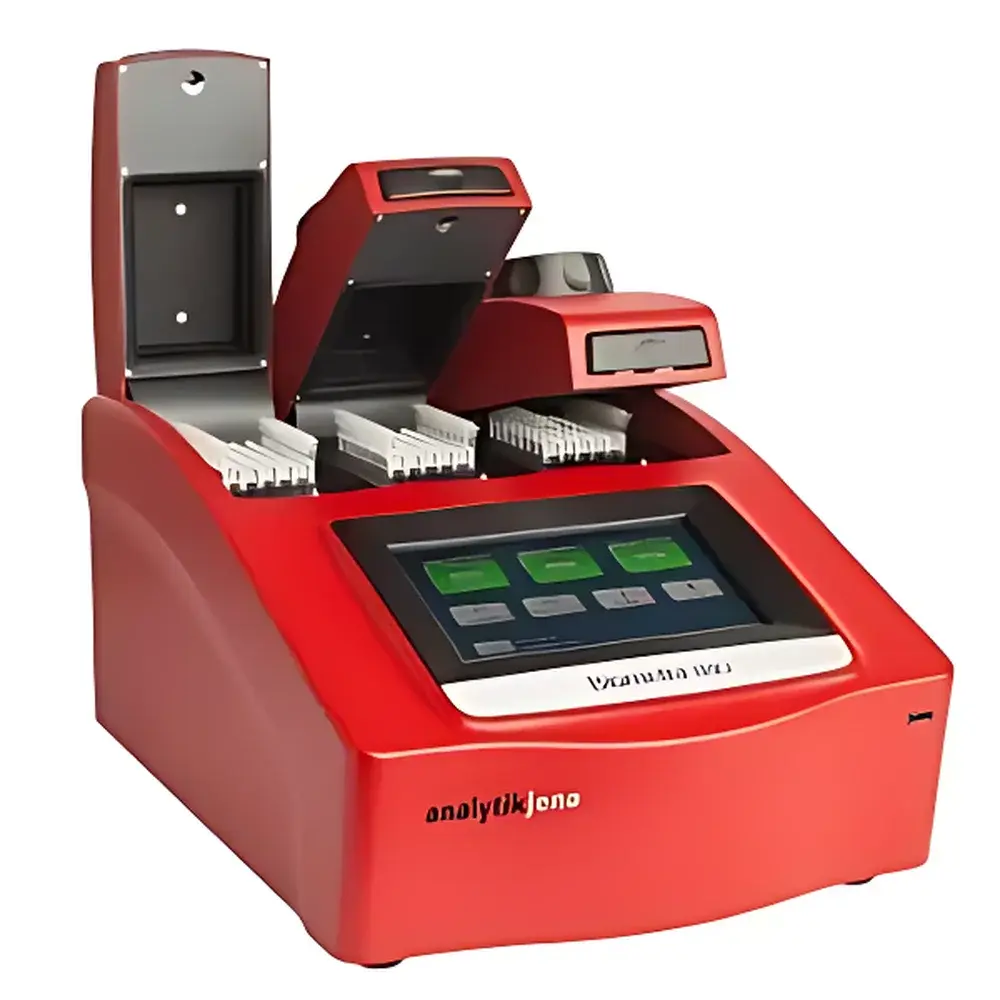
Analytik Jena TRIO Triple-Block PCR Thermocycler
| Brand | Analytik Jena |
|---|---|
| Origin | Shanghai, China |
| Manufacturer Type | Authorized Distributor |
| Instrument Type | Standard PCR Thermocycler |
| Model | TRIO |
| Sample Capacity | 3 × 48-well blocks (144 total wells) |
| Heating Rate | 5 °C/s |
| Temperature Accuracy | < ±0.1 °C |
| Block Uniformity | < ±0.2 °C across wells |
| Display | 7-inch full-color capacitive touchscreen |
| Design | Bottom-intake / rear-exhaust airflow |
| Tube Compatibility | Standard 0.2 mL tubes and 8-tube strips |
| Compliance | Designed to support GLP/GMP workflows with audit-ready operation logs |
Overview
The Analytik Jena TRIO Triple-Block PCR Thermocycler is an engineered solution for laboratories requiring parallel amplification capacity without compromising thermal precision or operational integrity. Based on Peltier-driven solid-state thermoregulation and calibrated block architecture, the TRIO implements three independent 48-well aluminum heating blocks—each thermally isolated and individually addressable—enabling simultaneous execution of distinct thermal cycling protocols. This architecture eliminates cross-program interference while maintaining uniform thermal response across all 144 reaction positions. The instrument operates within a standard laboratory environment (15–30 °C ambient, ≤80% non-condensing humidity) and conforms to IEC 61010-1 safety standards for laboratory equipment. Its core design philosophy centers on reproducibility: every thermal ramp, hold, and transition is governed by closed-loop feedback control using high-stability NTC sensors embedded directly beneath each block surface.
Key Features
- Triple independent 48-well blocks—each programmable with unique ramp rates, hold durations, and cycle counts—supporting true multiplexed experimental workflows.
- Thermal accuracy of < ±0.1 °C at target setpoints (verified at 60 °C and 95 °C per ISO/IEC 17025 traceable calibration procedures) ensures fidelity in primer annealing and extension kinetics.
- Block uniformity of < ±0.2 °C across all 48 positions per block minimizes inter-sample Cq variation in quantitative applications.
- 7-inch capacitive touchscreen interface with multi-language support (English, German, French, Spanish, Chinese) and intuitive icon-based navigation reduces operator training time and input error risk.
- Acoustically optimized enclosure and vibration-damped block mounting achieve sound pressure levels <38 dB(A) during full-cycle operation—critical for open-lab environments and shared core facilities.
- Asymmetric airflow path (bottom intake, rear exhaust) enables side-to-side placement within standard 60 cm benchtop cabinets without thermal buildup or adjacent instrument interference.
Sample Compatibility & Compliance
The TRIO accepts universally standardized consumables: 0.2 mL thin-wall PCR tubes and 8-tube strips conforming to ANSI/SBS dimensional specifications. No proprietary consumables are required. Each block accommodates standard skirted or semi-skirted formats without adapter plates. From a regulatory standpoint, the system supports documentation practices aligned with FDA 21 CFR Part 11 when paired with optional PC-based software (e.g., Biometra TRIO Control Suite v3.x), enabling electronic signatures, user access tiers, and immutable audit trails for temperature log export. While not certified as GMP manufacturing equipment, its thermal validation protocol (IQ/OQ/PQ templates available upon request) meets common requirements for method transfer in QC labs operating under ISO 13485 or CLIA frameworks.
Software & Data Management
Instrument control and data logging are managed via the Biometra TRIO Control Suite—a Windows-compatible application supporting local storage, USB export (CSV, PDF), and networked deployment in domain-authenticated lab networks. All thermal profiles, run metadata (user ID, timestamp, block assignment), and real-time temperature curves are timestamped and stored with SHA-256 hash integrity verification. Exported datasets include raw sensor readings sampled at 100 ms intervals, enabling post-run deviation analysis. Software updates are delivered through signed firmware packages verified against Analytik Jena’s public key infrastructure, ensuring supply-chain authenticity.
Applications
The TRIO serves diverse use cases including routine genotyping, cDNA synthesis, colony PCR screening, and pre-sequencing library amplification. Its triple-block capability is especially valuable in clinical research settings where concurrent processing of control + patient + no-template samples is required per assay batch. In teaching labs, independent block programming allows instructors to demonstrate gradient optimization (e.g., annealing temperature sweeps) alongside fixed-profile controls in a single instrument footprint. The system is routinely deployed in food safety testing (ISO 22118), environmental DNA monitoring (EPA Method 1615), and veterinary diagnostics where throughput and thermal consistency directly impact limit-of-detection thresholds.
FAQ
Can the three blocks run different programs simultaneously?
Yes—each block has fully independent thermal control logic and can execute unique protocols with distinct ramp rates, hold temperatures, and cycle counts.
Is calibration traceable to national standards?
Yes—factory calibration uses NIST-traceable dry-block calibrators; users may perform periodic verification using external reference probes compliant with ASTM E2877-22.
Does the TRIO support gradient PCR?
No—gradient functionality is not implemented; however, users may simulate gradient conditions by assigning different setpoints to each block.
What maintenance is required?
Annual verification of thermal performance is recommended; no consumable parts (e.g., bulbs or lasers) require replacement—the Peltier modules are rated for >500,000 cycles.
Is remote monitoring supported?
Yes—via optional Ethernet interface and SNMP-enabled status polling; real-time block status and error codes can be integrated into centralized lab infrastructure management systems.



