
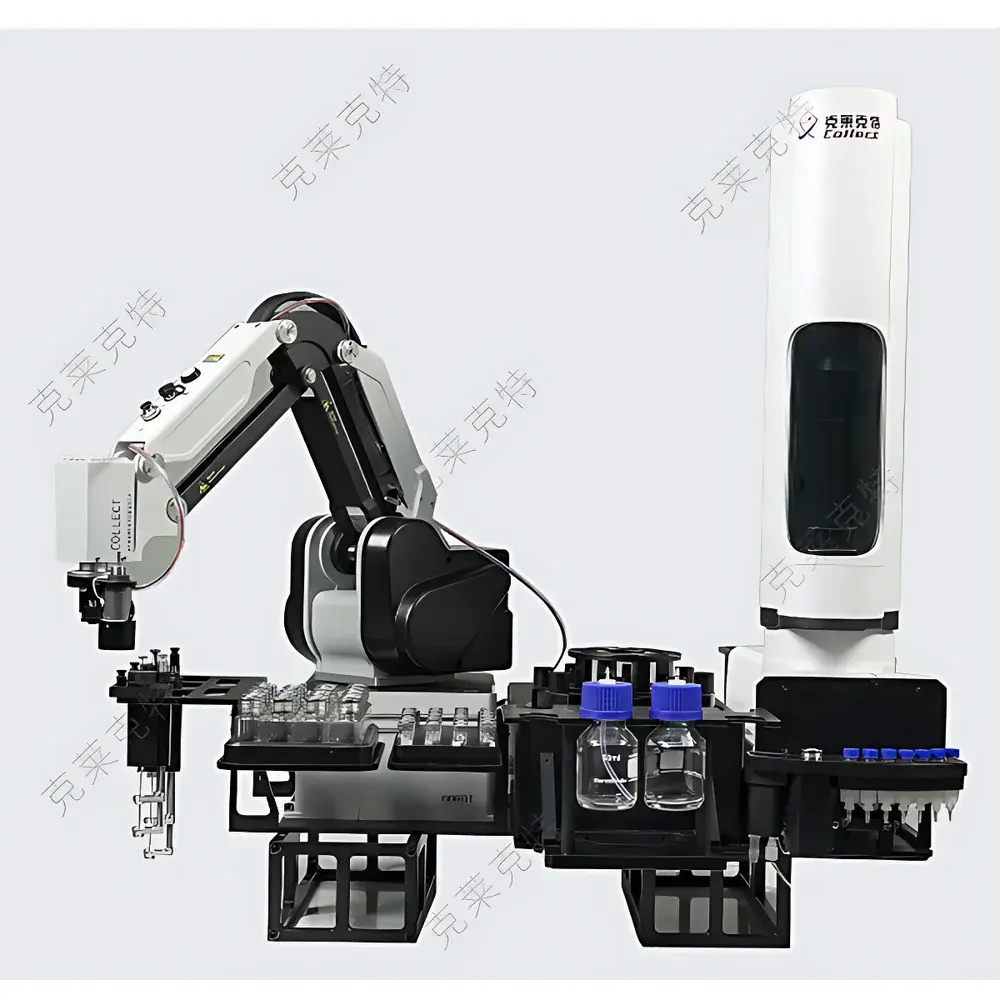
Clarete Auto Chloropropanol Ester Derivatization & Sample Preparation Platform
| Brand | Clarete |
|---|---|
| Origin | Henan, China |
| Manufacturer Type | Manufacturer |
| Origin Category | Domestic |
| Model | Preparatory Platform |
| Instrument Type | GC Autosampler |
| Max Sample Capacity | 8 samples per run |
| Minimum Injection Volume | 0.1 µL |
| Positioning Accuracy | <0.1 mm |
| Motion Mechanism | Robotic Arm |
| Needle Wash Cycles | Unlimited |
| Replicate Injections per Sequence | 1–99 times |
Overview
The Clarete Auto Chloropropanol Ester Derivatization & Sample Preparation Platform is a fully integrated, modular robotic sample handling system engineered for high-throughput, reproducible preparation of chloropropanol esters (e.g., 3-MCPD and 2-MCPD esters) prior to gas chromatographic analysis. It implements a multi-step, programmable workflow—including liquid dispensing, derivatization reagent addition, heating-assisted saponification or transesterification, vortex mixing, SPME fiber exposure, headspace sampling, and precise GC injection—within a single instrument footprint. Designed in accordance with ISO 18363-1:2019 and AOAC Official Method 2017.01 requirements for chloropropanol ester quantification in edible oils and lipid matrices, the platform minimizes manual intervention while ensuring trace-level accuracy, inter-batch consistency, and full auditability of all critical process parameters.
Key Features
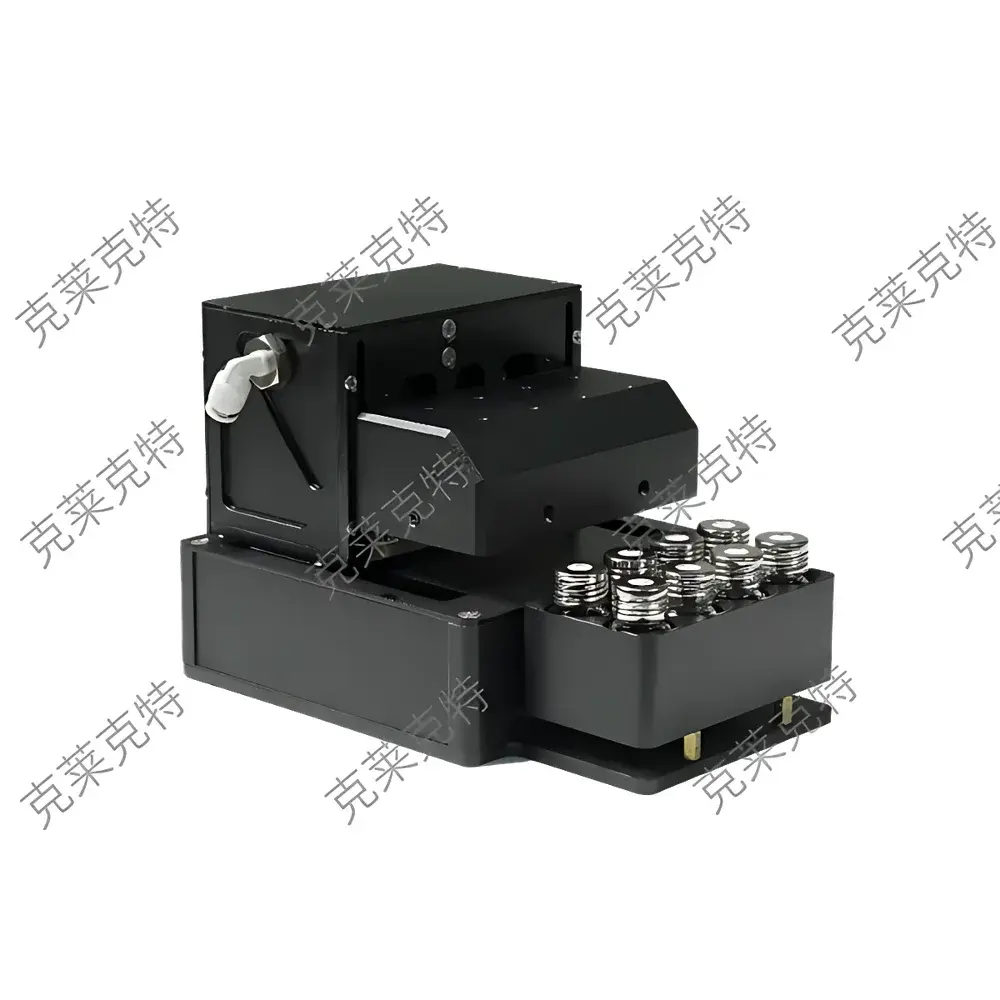
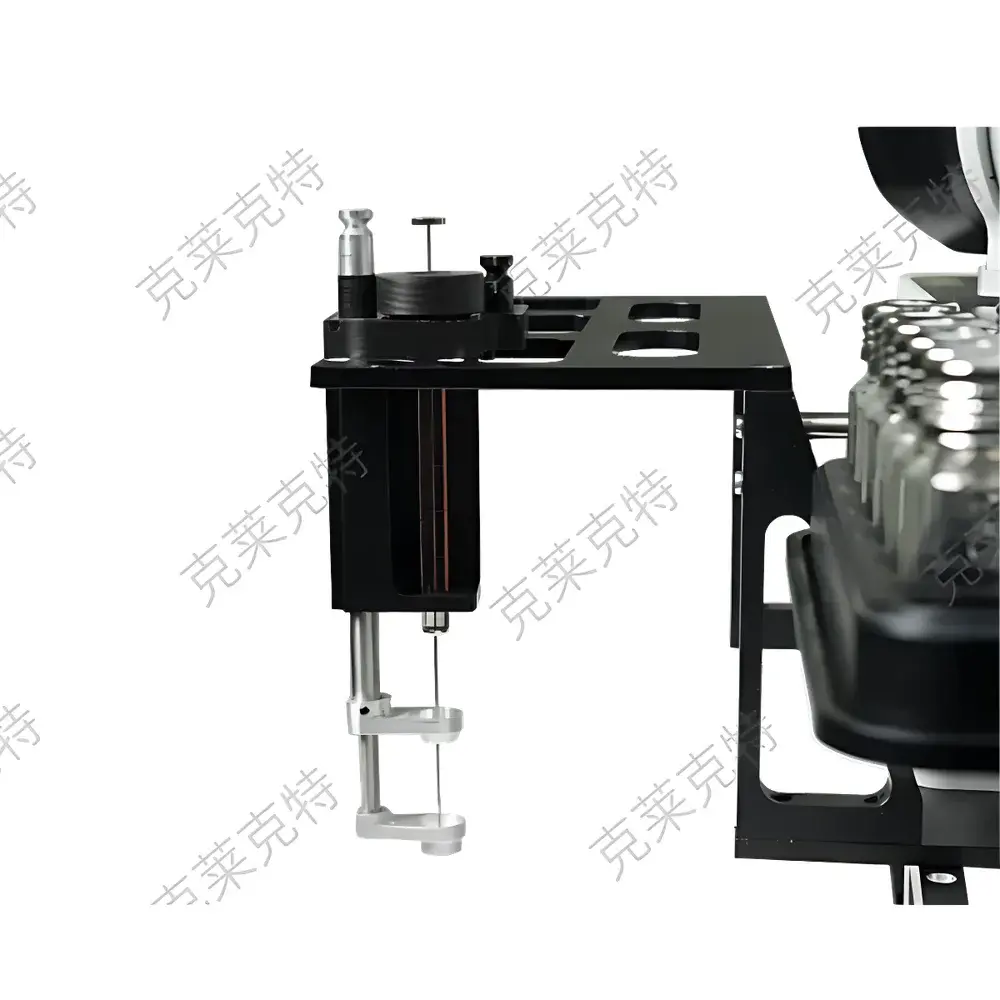
- Modular architecture supporting four functional tool modules: Liquid Handling (with three interchangeable syringe configurations: C1 for 1–100 µL, C2 for 250–1000 µL, C3 for 2.5–10 mL), Headspace Sampling (1/2.5/5 mL needles, 40–150 °C needle temperature control, inert gas purge), SPME Automation (fiber holder compatibility for 10/20 mL vials, on-board thermal desorption and derivatization support), and Dilution/Reagent Addition (up to 10 solvent channels, volumetric accuracy ±0.5% at ≥100 µL)
- Robotic arm with optical encoder feedback loop ensures positional repeatability <0.1 mm and motion stability across extended unattended operation (24/7 capability)
- Integrated thermal management: dual-zone temperature control — an 8-position heated/cooled sample block (0–260 °C, ±0.3 °C stability) and an independent 8-position vortex-heating module (30–80 °C, 500–3000 rpm, timer up to 9999 min)
- Intuitive 10.1″ capacitive touchscreen HMI with step-by-step guided workflows, real-time status visualization, and contextual help overlays
- Open communication protocol (RS-485, Ethernet TCP/IP, Modbus RTU) enables seamless integration into LIMS, ELN, or custom SCADA systems; supports ASTM E1384-compliant data exchange
- Expandable bus interface for future attachment of auxiliary modules (e.g., solid-phase extraction cartridges, centrifuge adapters, or barcode readers)
Sample Compatibility & Compliance
The platform accommodates standard GC-compatible vial formats: 2 mL crimp-top, 10 mL screw-cap, and 20 mL wide-mouth vials. All fluidic pathways contacting derivatization reagents (e.g., sodium methoxide, BF₃-methanol) are chemically resistant (PTFE, PEEK, fused silica). The system meets GLP documentation requirements through built-in electronic logbook recording of operator ID, method version, timestamps, environmental conditions (ambient temp/humidity), and all executed actions. Full compliance with FDA 21 CFR Part 11 is enabled via optional digital signature module and audit trail configuration. Validation packages include IQ/OQ documentation templates aligned with ISO/IEC 17025 and USP Analytical Instrument Qualification guidelines.
Software & Data Management
Clarete PrepControl™ v3.2 software provides unified control of all hardware modules via a role-based access interface. Each method file stores complete parameter sets—including syringe calibration coefficients, thermal ramp profiles, vortex acceleration curves, and SPME equilibration durations—with version-controlled revision history. Raw execution logs are exported in CSV and XML formats compliant with ASTM E2500-17. Data integrity safeguards include automatic checksum verification of method uploads, write-protected archive mode for completed batches, and configurable retention policies (minimum 10 years). Optional cloud sync enables remote monitoring and centralized fleet management across multiple laboratory sites.
Applications
- Quantitative determination of 3-MCPD and 2-MCPD fatty acid esters in refined vegetable oils, margarines, infant formula, and processed foods per EU Regulation (EU) No 2018/290 and Chinese GB 5009.191-2023
- Automated derivatization workflows for glycidyl esters (GEs) using acid-catalyzed cleavage followed by phenylboronic acid derivatization
- High-precision dilution series generation for calibration curve construction in multi-analyte GC-MS methods
- Unattended headspace-GC analysis of volatile chloropropanols post-acid hydrolysis
- SPME-GC coupling for screening of residual chloropropanols in packaging materials and food contact surfaces
- Method development support for AOAC SMPR 2022.001-compliant validation studies (accuracy, precision, LOD/LOQ, matrix effect assessment)
FAQ
Does the platform support method validation according to ISO/IEC 17025?
Yes — the system includes traceable calibration certificates for all motor encoders, temperature sensors, and syringe actuators, along with automated performance verification reports.
Can I integrate this platform with my existing Agilent or Thermo GC system?
Absolutely — native drivers for Agilent OpenLab CDS, Thermo Chromeleon, and Shimadzu GCsolution are available; custom API integration is supported via documented RESTful endpoints.
Is the SPME module compatible with commercial fiber coatings (e.g., PDMS/DVB, CAR/PDMS)?
Yes — the fiber holder accepts standard 1 cm or 2 cm SPME fibers from Supelco, Restek, and Sigma-Aldrich without adapter modification.
What maintenance intervals are recommended for long-term reliability?
Daily needle wash verification, monthly syringe seal inspection, and annual encoder recalibration — all tracked automatically in the maintenance scheduler.
How is data integrity ensured during power interruption or unexpected shutdown?
All active method steps are checkpointed every 2 seconds; recovery resumes from the last validated state without sample loss or parameter corruption.




