
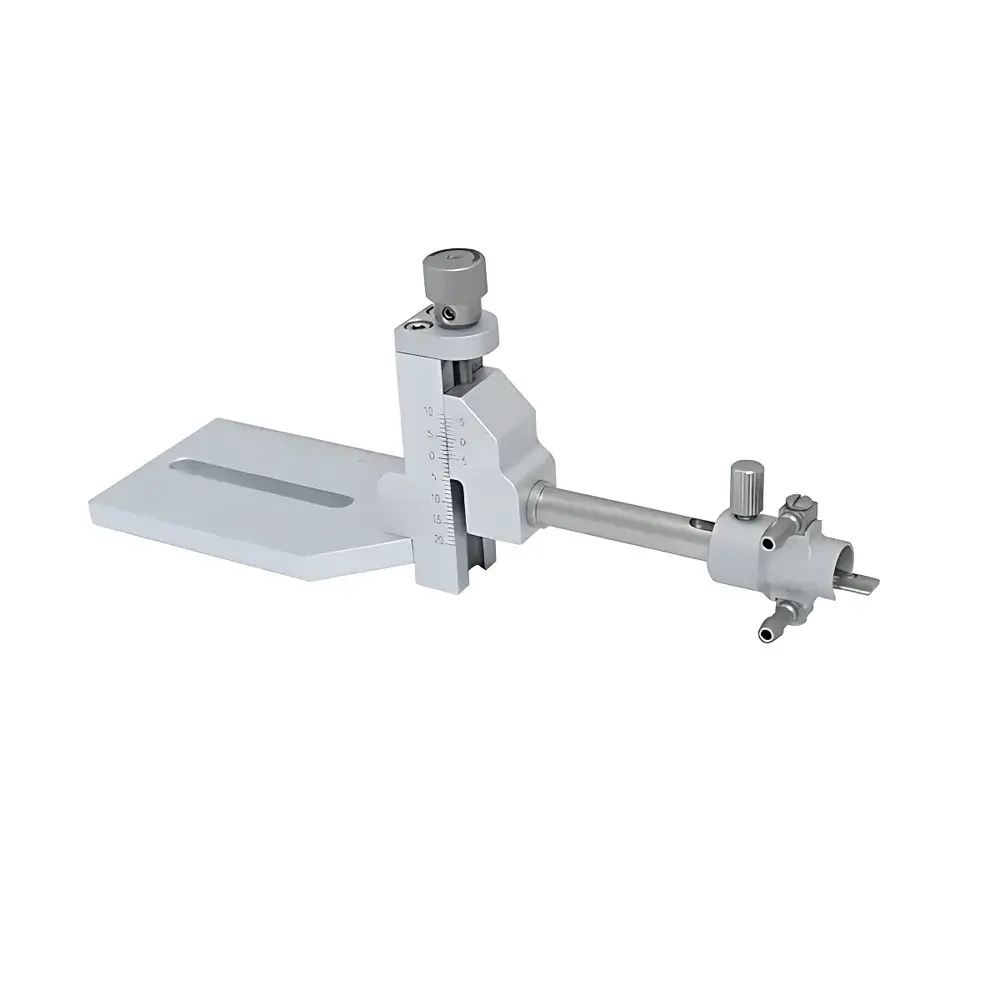
RWD 68077 Mouse Anesthesia Adapter
| Brand | RWD |
|---|---|
| Origin | Shenzhen, China |
| Manufacturer Type | OEM Manufacturer |
| Region of Origin | Domestic (China) |
| Model | 68077 |
| Pricing | Upon Request |
Overview
The RWD 68077 Mouse Anesthesia Adapter is an engineered accessory designed for precise, reproducible, and ethically compliant inhalational anesthesia delivery in murine research models. It operates on the principle of controlled head immobilization combined with optimized gas flow dynamics to ensure consistent anesthetic agent concentration at the airway interface. The device integrates seamlessly with standard small-animal anesthesia systems—particularly those utilizing isoflurane or sevoflurane vaporizers—and supports both induction and maintenance phases under regulated flow rates (typically 0.5–2 L/min). Its mechanical design prioritizes physiological stability: minimizing head movement reduces stress-induced catecholamine release, thereby improving experimental consistency in neuroscience, pharmacokinetic, and longitudinal imaging studies.
Key Features
- Anatomically contoured anesthesia mask with adjustable nasal seal geometry to accommodate strain- and age-dependent variations in murine craniofacial morphology (e.g., C57BL/6, BALB/c, CD-1, and nude mice aged 6–12 weeks).
- Integrated incisor bar mechanism with dual-point lateral stabilization, enabling secure yet non-traumatic fixation of the maxillary incisors without mandibular compression or occlusion interference.
- Dedicated exhalation port fitted with a standardized 1/4″ NPT or ISO 5356-1 compatible connector for direct coupling to active scavenging systems—ensuring compliance with OSHA PEL (Permissible Exposure Limits) and NIOSH REL (Recommended Exposure Limits) for halogenated anesthetics.
- Vertical height adjustment via precision-machined M4 threaded rod and locking nut assembly, allowing ±12 mm fine-tuning relative to stereotaxic frames or imaging stages (e.g., MRI, PET, or optical coherence tomography platforms).
- Modular mounting interface compatible with standard 10 mm pitch dovetail rails and universal clamping brackets used in commercial stereotaxic instruments (e.g., David Kopf, Stoelting, and Leica systems).
Sample Compatibility & Compliance
The adapter is validated for use with adult and adolescent mice (body weight range: 18–35 g). It does not support neonatal or juvenile subjects (<14 days old) due to anatomical scaling constraints. All polymer components—including the mask body, incisor bar housing, and sealing gasket—are fabricated from medical-grade, autoclavable polyetherimide (PEI) and silicone elastomer (Shore A 50), certified per ISO 10993-5 (cytotoxicity) and USP Class VI. The device aligns with AAALAC International accreditation requirements for anesthesia equipment validation and supports institutional adherence to NIH Guide for the Care and Use of Laboratory Animals (8th Edition) Section IV.C.3 on inhalant anesthetic delivery safety.
Software & Data Management
As a hardware-only mechanical adapter, the RWD 68077 does not incorporate embedded electronics, firmware, or proprietary software. However, it is fully interoperable with third-party anesthesia monitoring platforms (e.g., Kent Scientific’s LabScribe, Nonin’s Avant Guardian, or ADInstruments’ LabChart) when paired with compatible gas analyzers (e.g., Datex-Ohmeda S/5 or Capnomac Ultima) and physiological data acquisition modules. Audit trails for usage, maintenance, and calibration are maintained manually per GLP-compliant laboratory SOPs; no electronic record generation or FDA 21 CFR Part 11 functionality is provided or required.
Applications
- Functional neuroimaging under stable anesthesia: Enables high-resolution fMRI and intrinsic signal optical imaging by eliminating motion artifacts during prolonged acquisition windows (>30 min).
- Stereotaxic surgical procedures: Facilitates accurate electrode, cannula, or viral vector placement by maintaining fixed head orientation relative to bregma-lambda coordinates.
- Longitudinal electrophysiology: Supports chronic recording paradigms where repeated anesthesia sessions demand consistent positioning across days or weeks.
- Toxicology and PK/PD studies: Ensures uniform anesthetic depth across cohorts, reducing inter-subject variability in cardiovascular and respiratory endpoints.
- Preclinical echocardiography and Doppler ultrasound: Stabilizes thoracic position while permitting unobstructed acoustic coupling through the ventral thorax.
FAQ
Is the RWD 68077 compatible with rats or larger rodents?
No—this adapter is specifically dimensioned for mice. Rat adaptation requires distinct incisor spacing, mask volume, and airflow resistance profiles; RWD offers separate rat-specific models (e.g., 68078).
Can the exhalation port connect directly to a wall suction system?
No—it requires connection to an active scavenging unit with negative pressure regulation (typically −20 to −60 mm H₂O) and charcoal or soda lime canister filtration to meet ANSI Z79.11 and local environmental health standards.
What sterilization methods are validated for this device?
Autoclaving at 121°C, 15 psi for 20 minutes is validated for all components. Ethylene oxide (EtO) and gamma irradiation are not recommended due to potential degradation of silicone seals and PEI structural integrity.
Does RWD provide calibration documentation or traceable metrology reports?
Not applicable—the device contains no sensors, transducers, or measurable output parameters requiring calibration. Mechanical dimensional verification reports are available upon request for QA/QC audits.
How often should the silicone mask seal be replaced?
Under routine use (≤5 procedures/week), replacement is recommended every 6 months or after visible signs of compression set, cracking, or loss of elasticity occur.




