
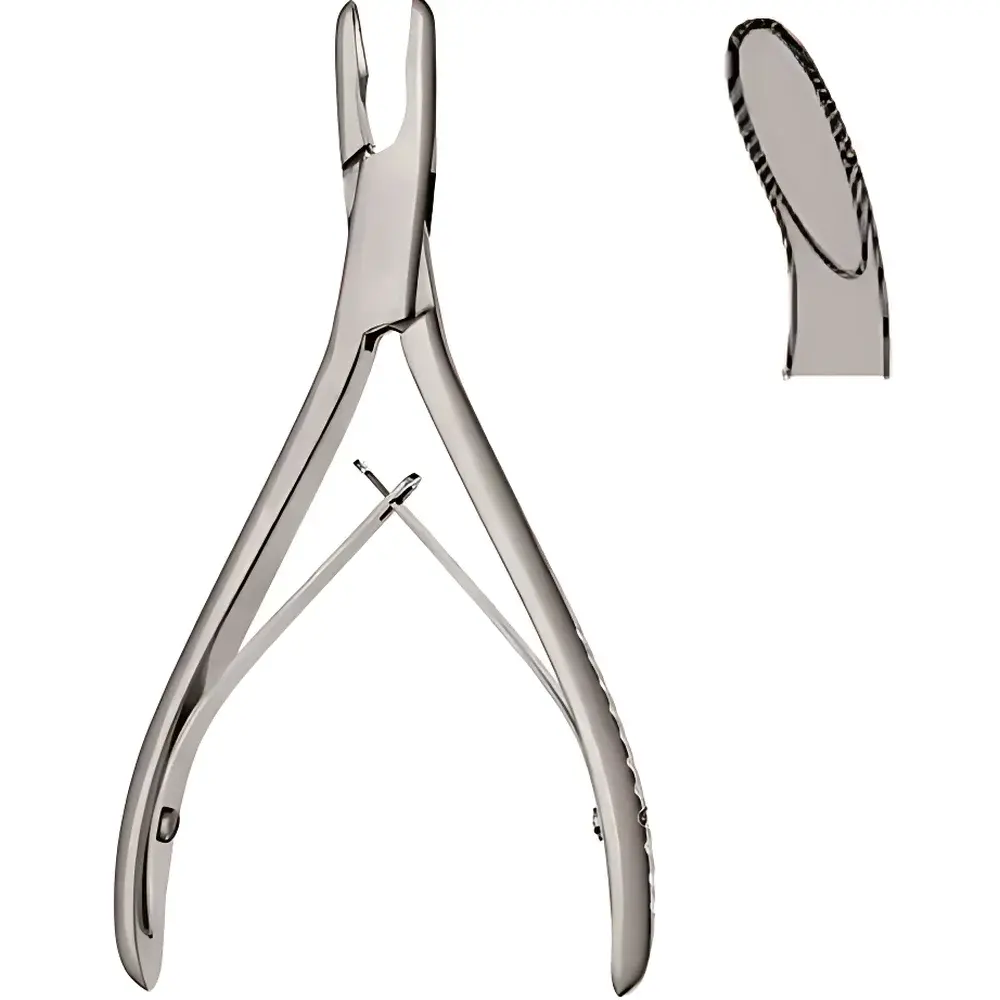
LUER Single-Joint Bone Rongeur – Curved, Small Jaw (3 mm), 15 cm
| Brand | RWD |
|---|---|
| Origin | Shenzhen, China |
| Manufacturer Type | Original Equipment Manufacturer (OEM) |
| Country of Origin | China |
| Model | S21001-15 |
| Price | USD 80 (FOB Shenzhen) |
Overview
The LUER Single-Joint Bone Rongeur – Curved, Small Jaw (3 mm), 15 cm (Model S21001-15) is a precision surgical instrument engineered for controlled bone and calcified tissue removal in preclinical research and neurosurgical applications. Designed with a single-joint articulation mechanism and a permanently aligned curved tip, this rongeur enables high-accuracy access to confined anatomical spaces—particularly during craniotomy, spinal laminectomy, or skull base dissection in rodent and small mammal models. Its 3 mm jaw width provides optimal balance between tissue selectivity and mechanical advantage, minimizing unintended trauma to adjacent dura mater, neural structures, or vascular elements. The instrument operates on the principle of lever-mediated compression force transmission, where manual grip pressure is amplified at the jaw interface to achieve clean, reproducible bone cuts without slippage or crushing.
Key Features
- Single-joint pivot design ensures consistent jaw alignment across repeated use—eliminating cumulative misalignment common in multi-hinge rongeurs.
- Curved profile (15°–20° arc radius) optimized for subtemporal, intracranial, and posterior fossa access in murine and rat neurosurgery.
- Hardened stainless steel construction (AISI 420 or equivalent) with Rockwell hardness ≥52 HRC for long-term edge retention and resistance to autoclave-induced stress corrosion.
- Ergonomic, knurled handle with 15 cm overall length—designed to fit standard human hand anthropometry while maintaining fine motor control under microscope-assisted procedures.
- Non-reflective satin finish reduces intraoperative glare under surgical lighting and stereomicroscope illumination.
- Compatible with standard LUER-lock sterilization trays and ultrasonic cleaning protocols per ISO 15883-1.
Sample Compatibility & Compliance
This rongeur is validated for use with fresh-frozen, formalin-fixed, and decalcified osseous specimens from Sprague-Dawley rats, C57BL/6 mice, and New Zealand White rabbits. It meets dimensional tolerances specified in ISO 7740-1:2019 (Surgical Instruments — Rongeurs — Part 1: Requirements and Test Methods). The device carries CE marking under Regulation (EU) 2017/745 (MDR) as a Class I non-sterile, reusable surgical instrument. While not intended for human clinical use, its manufacturing process adheres to ISO 13485:2016 quality management system requirements. Sterilization validation includes 100 cycles of saturated steam at 134 °C for 5 minutes (EN 285), with post-cycle functionality verified per ASTM F1875-22 (Standard Practice for Testing Reusable Surgical Instruments After Sterilization).
Software & Data Management
As a manually operated mechanical instrument, the S21001-15 requires no embedded electronics, firmware, or software integration. However, it is fully compatible with digital surgical workflow documentation systems: instrument usage logs can be recorded in electronic lab notebooks (ELNs) such as LabArchives or Benchling; sterilization cycle data may be imported from autoclave loggers (e.g., Tuttnauer T-Log) via CSV export; and procedural metadata—including instrument ID, lot number, and maintenance history—can be linked to animal study records in compliance with NIH OLAW and AAALAC International reporting standards. No FDA 21 CFR Part 11 compliance is applicable, as the device contains no electronic data capture or storage capability.
Applications
- Craniotomy window preparation in mouse cortical electrophysiology studies (e.g., chronic implantation of silicon probes or optrodes).
- Laminectomy for spinal cord injury modeling in rat thoracic vertebrae (T9–T11).
- Skull base fenestration in zebrafish or chick embryo cranial surgery protocols.
- Removal of calvarial bone fragments following controlled cortical impact (CCI) injury models.
- Preparation of ex vivo bone explants for biomechanical testing or histomorphometric analysis.
- Training tool in veterinary surgical curricula for developing tactile feedback and depth perception in osteotome manipulation.
FAQ
Is this instrument certified for human clinical use?
No. The S21001-15 is manufactured and labeled exclusively for laboratory research and preclinical veterinary applications. It is not approved by the FDA, MHRA, or NMPA for human surgical use.
What is the recommended sterilization method?
Autoclaving at 134 °C for 5 minutes (pre-vacuum cycle) is validated. Ethylene oxide (EtO) and hydrogen peroxide plasma sterilization are acceptable alternatives when steam exposure must be avoided.
Can the jaws be resharpened after extended use?
Yes—by qualified biomedical instrument technicians using diamond-lapped jigs calibrated to maintain the original 3 mm aperture and 12° internal bevel angle. Resharpening must be followed by functional testing per ISO 7740-1 Annex B.
Does RWD provide traceable calibration or maintenance documentation?
Each unit ships with a Certificate of Conformance (CoC) including material lot traceability, dimensional inspection report, and sterilization compatibility statement. Maintenance logs are user-maintained per institutional biosafety protocols.




